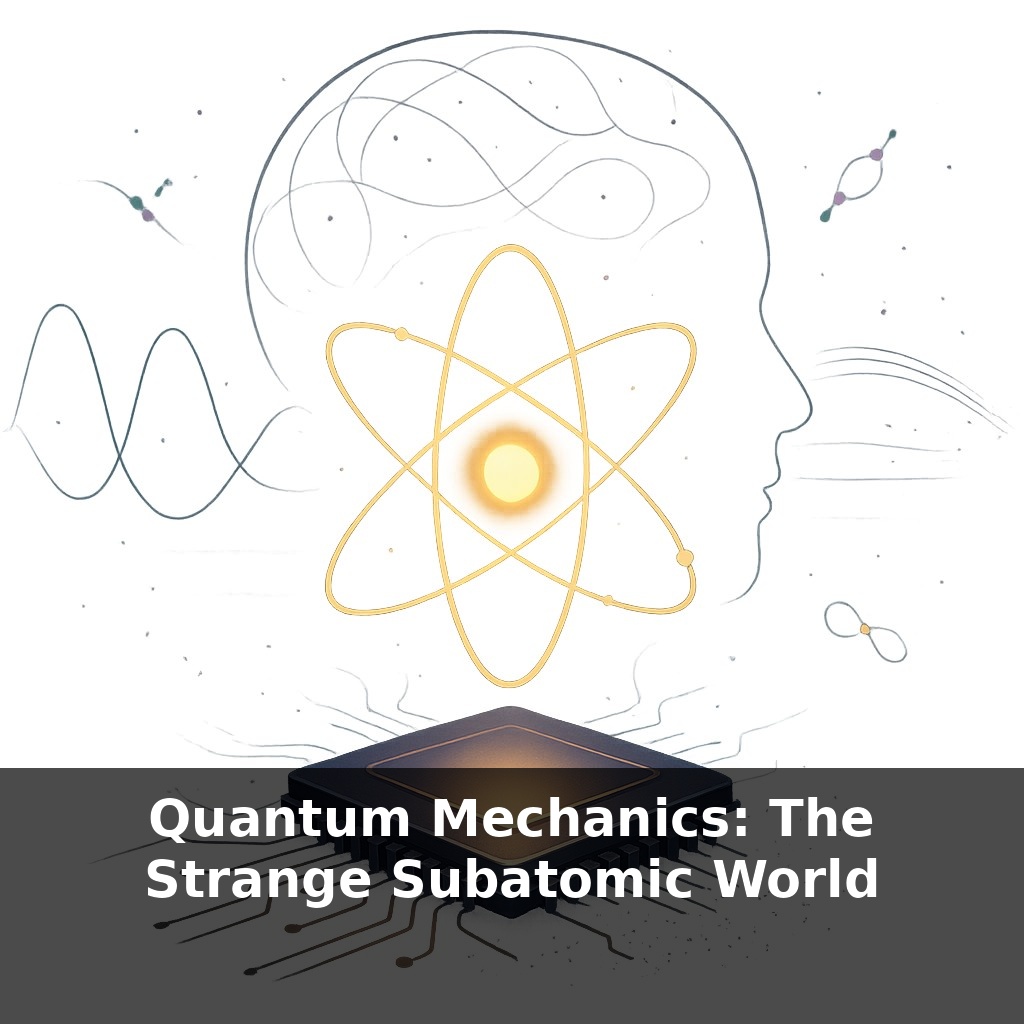
Light bulbs, GPS, and your phone’s chip all work because, deep down, reality refuses to act “normally.” At the tiniest scales, particles can be in several places at once and influence each other across huge distances—yet those bizarre rules are our most accurate laws of nature.
At the turn of the 20th century, careful measurements started to misbehave. Heated metal glowed with the wrong colors, atoms emitted light in strangely precise shades, and electrons in circuits refused to follow the smooth curves engineers expected. The old playbook of physics wasn’t just slightly off; in some cases, it gave nonsense. To fix it, scientists didn’t tweak a few equations—they had to admit that, at small scales, nature “clicks” in steps instead of sliding continuously. Max Planck captured this with a new constant, h, a tiny number that quietly governs how energy, matter, and even information come in packets. Decades later, this radical shift didn’t stay in blackboards and notebooks. It became the hidden engine of lasers in barcode scanners, the chips timing your music stream, and the MRI machines peering inside your body.
Instead of a smooth backdrop, the subatomic world looks more like a crowded city grid at night: certain “streets” light up, others stay dark, and only specific routes are allowed. That strict pattern gives rise to stable atoms, sharp spectral lines used in forensic labs, and the precise colors in LED screens. The same framework lets us design semiconductor junctions so delicately that whole processors hinge on electrons preferring one path over another. Even biological processes, like photosynthesis, quietly exploit these rules to shuttle energy with remarkable efficiency.
Niels Bohr once warned, “Those who are not shocked when they first come across quantum theory cannot possibly have understood it.” The shocks didn’t stop with odd atomic spectra—they deepened as physicists probed how *information* itself behaves at tiny scales.
One of the strangest discoveries is that quantum objects don’t just have uncertain properties; they can genuinely *lack* definite properties until they interact. An electron passing through a carefully prepared device will produce an interference pattern consistent with having gone through multiple paths at once. Block off one path or “check” which route it took, and the pattern vanishes. The rules aren’t “the particle knows but we don’t”; the rules say there simply *isn’t* a single, settled story between start and finish.
Superposition scales up dramatically in quantum computers. Instead of flipping ordinary bits from 0 to 1, engineers at places like Google and IBM coax tiny circuits into well-controlled quantum states where many possibilities coexist and interfere. Carefully timed microwave pulses and Josephson junctions in superconducting loops let them choreograph these states so that wrong answers cancel and desired ones are amplified. The promise is not “faster calculators” in general, but machines that can, for specific problems like factoring large numbers or simulating new materials, explore an immense landscape of options in fewer steps than any classical device can manage.
Entanglement pushes weirdness further. When two particles are prepared in a special joint state, measurements on one are correlated with measurements on the other in ways no ordinary shared “hidden instructions” can explain. Experiments over mountain ranges, across fiber networks, and via satellites like China’s Micius have closed loopholes that might let classical explanations sneak back in. The upshot: quantum theory really does describe a world where separated systems form a single, inseparable whole—yet still stubbornly refuse to transmit usable signals faster than light.
This delicate machinery isn’t just for lab puzzles. Quantum tunneling lets protons in stellar cores fuse at temperatures that would otherwise be far too low, sustaining the Sun’s output. In your devices, carefully engineered barriers allow electrons to “leak” in controlled ways, enabling flash memory operations and ultrastable frequency standards.
And hovering over all of this is the uncertainty principle: not a confession of experimental clumsiness, but a precise limit baked into reality about how sharply certain pairs of quantities can be pinned down.
Doctors already lean on quantum effects without naming them. MRI scanners rely on atomic nuclei acting like tiny bar magnets; when they relax after a radio‑frequency pulse, the faint signals they emit are processed into detailed images of soft tissue, catching tumors early. In cardiology, quantum‑grade precision in timekeeping lets GPS synchronize signals so accurately that subtle timing shifts can reveal how blood flows in the heart during movement.
Weather satellites benefit too. Ultra‑stable clocks based on carefully controlled transitions in atoms help align data from multiple instruments, sharpening forecasts for hurricanes and atmospheric rivers. Even the “grid” itself is guarded by quantum tricks: devices that exploit delicate interference patterns track minuscule changes in voltage and current, spotting faults in power lines before they cascade into blackouts.
Superposition is like a chef preparing several spice blends at once in tiny separate bowls, then combining just the right mixture at the last moment to create a sauce with exactly the flavor they want.
Hospitals, power grids, and stock markets may all quietly depend on quantum tech, much like cities rely on buried water pipes they never see. Quantum simulators could let chemists “test‑drive” greener fertilizers or safer batteries before mixing real chemicals. Navigation might follow Earth’s tiny gravitational ripples instead of GPS. As industries adopt these tools, laws, ethics, and education will have to evolve so more people can question, guide, and repair this invisible machinery.
We’re still early in learning how far these rules can be bent without breaking. Quantum sensors may map buried archaeology, probe brains without surgery, or guide airplanes when GPS fails. Your challenge this week: whenever a gadget feels “instant” or “too precise,” pause and ask which unseen quantum constraints quietly set its limits.