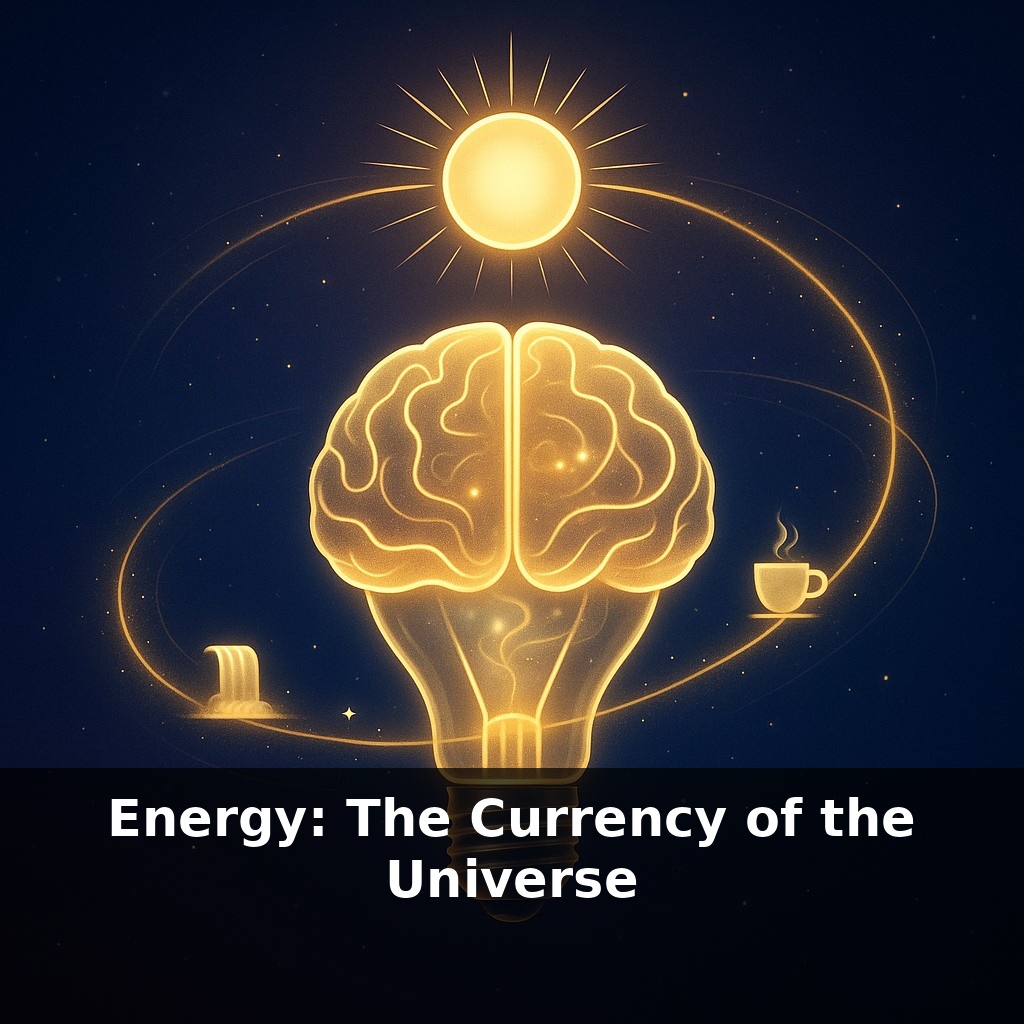
Right now, as you listen, your brain is burning about as much power as a very dim light bulb—yet it’s orchestrating your entire world. A star’s furnace, a waterfall, your morning coffee: all driven by the same hidden currency. So what, exactly, is this universal fuel?
Every second, the Sun pours more energy onto Earth than all of humanity uses in a year—yet we still argue about “energy shortages.” The puzzle isn’t that there isn’t enough energy; it’s that useful energy is hard to capture, store, and direct.
Your phone battery, a thunderstorm, a hydroelectric dam, and the molecules in your lunch are all parts of the same story: flows and transformations of energy through different “routes” nature allows. Sometimes these routes are smooth and efficient, like water gliding through a well‑designed canal. Other times they’re leaky and wasteful, spilling into random jostling of atoms we feel as heat.
We’ve become a technological species largely by learning which routes to exploit: burning chemical fuels, taming falling water, tapping nuclear bonds, and, increasingly, harnessing sunlight with growing precision.
In physics, energy isn’t a substance you can bottle; it’s a number that stays stubbornly consistent whenever anything happens. Strike a match, charge a battery, fire a rocket—the bookkeeping always balances. What changes is *how* that energy is arranged and how available it is to do something specific. A cup of hot coffee and a rock at room temperature can contain similar total energy, yet only one can warm your hands. The story gets richer when we track *where* energy flows: through power grids, food chains, engines, and even through the tiny voltage differences that keep your heart beating.
Energy looks abstract in textbooks, but physics treats it with ruthless precision. To say a system “has” a certain amount of energy means something very specific: if you know its energy and the rules it obeys, you can predict what it can and cannot do. That’s why conservation of energy is more than a slogan; it’s one of the sharpest filters we have for sorting possible futures from impossible ones.
Start with motion. A speeding car carries kinetic energy; slam the brakes and that energy doesn’t disappear, it shows up mostly as heat in the brake pads and tires. Climb a hill, and the car–Earth system now stores gravitational potential energy; roll back down, and it’s traded back into motion. On top of that, the fuel still in the tank holds chemical energy that could, in principle, move the car further—until it’s exhausted and the only changes left are in the surrounding air and road temperature.
Now zoom way out. Humanity’s ~604 exajoules per year is drawn from different “reservoirs”: sunlight, fossil fuels, nuclear reactions, Earth’s interior, moving air and water. Each reservoir has a characteristic *quality* of energy, not just a quantity. A hot object in a cold room can drive an efficient heat engine; the same object in a nearly equally hot room can’t do much. The total energy might be similar, but its *arrangement*—how concentrated, how uneven—is what makes work possible.
That’s where real-world numbers matter. The Sun bathes Earth in ~1.74×10^17 watts, but the fraction we intercept with solar panels depends on geography, weather, and technology. Modern photovoltaics, wind turbines, and hydro plants all wrestle with the same question: given a certain incoming flow, how much can we steer into electricity instead of random heating? Hydro turbines can redirect up to ~90% of falling water’s mechanical energy into electrical form; lithium-ion batteries can return ~90–95% of what you feed them. Internal combustion engines, by contrast, typically deliver under 40% of fuel energy to the wheels.
The twist is that even “losses” are not really lost; they’re just degraded into forms—like slightly warmer air—that are hard to corral back into anything organized. The art of energy engineering is to postpone that degradation for as long, and through as many useful stages, as possible.
Stand in a kitchen for a minute and you can *hear* energy changing form: water starting to boil, a fridge compressor kicking on, a toaster coil glowing. Each appliance is a tiny laboratory for the rules we’ve been talking about. Turn off the stove: the coil cools, but not because its energy vanishes. It seeps into the air, the pan, the rising steam—spreading out, getting harder to reclaim.
Consider your own body. The food energy you eat doesn’t “become” movement in one step. It’s stored in chemical bonds, parceled into ATP molecules, then spent in muscle fibers where microscopic “motors” pull on protein filaments. Only part becomes motion; much becomes heat that keeps you at roughly 37°C. In endurance sports, managing that heat loss is as crucial as fueling.
On planetary scales, storm systems are another great example. Sunlight absorbed unevenly by land and sea sets air masses in motion, building vast rotating structures like hurricanes. Their winds, rain, and lightning are intricate, temporary ways that the atmosphere shuffles energy around before it ultimately diffuses.
Every future technology you’ve heard hyped—fusion drives, planet‑scale AI, fully circular industries—quietly lives or dies on energy bookkeeping. Design a habitat on Mars, and the hardest question isn’t air or food, it’s how to power air‑making and food‑growing nonstop. Cities face a similar puzzle: how to choreograph millions of tiny, daily energy decisions so the grid behaves more like a well‑tuned orchestra than a series of last‑minute drum solos.
Your challenge this week: for one day, treat yourself as a “walking power plant.” Whenever you do something that clearly *changes* the world around you—cooking, commuting, charging a device—pause for five seconds and ask: “Where did the energy for this just come from, and where is it going next?” Don’t write anything down; just build the reflex. By the end of the day, notice which activities you can now “see” as energy exchanges that were invisible to you before.
Energy, then, is less a thing and more a strict “before and after” rule the universe refuses to break. Every storm, server farm, and heartbeat is a negotiation within that rule. As we design smarter grids, longer‑lived batteries, and cleaner reactors, we’re really learning to choreograph change itself—trading brute force for finesse in how we spend our cosmic budget.
Before next week, ask yourself: 1) “Looking at my days like an energy budget, which 2–3 ‘energy leaks’ (doom-scrolling, saying yes when I mean no, late-night email, etc.) are costing me the most, and what’s one concrete boundary I’m willing to experiment with for just the next 3 days?” 2) “If I treated my peak-energy hours as sacred currency, what specific task, relationship, or project would I ‘spend’ that energy on tomorrow—and when, exactly, will I protect that time?” 3) “What’s one thing that reliably recharges me (a 10‑minute walk outside, deep breathing between meetings, a no-phone lunch), and where will I plug that exact practice into my schedule in the next 24 hours?”