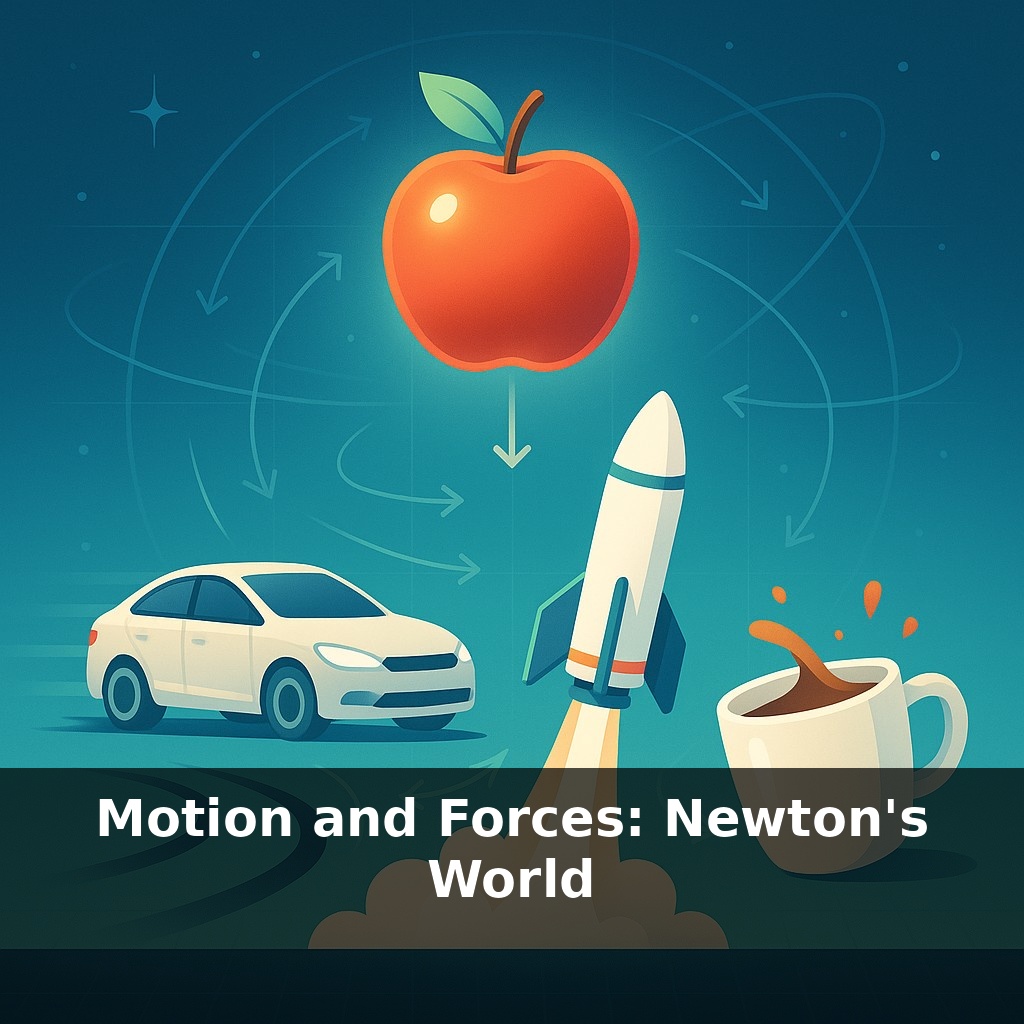
An apple falls, a rocket launches, a car slams its brakes—and the same three short rules quietly script every move. In this episode, we’ll step inside Newton’s world of motion, where a simple idea about forces explains both your coffee spill and a mission to Mars.
Your coffee doesn’t slosh in the same way on a train, in an elevator, and on a plane hitting turbulence—and Newton’s ideas quietly decide the difference. Now that we’ve met the rules, we’ll follow them into real-world habitats: from highways and high-rises to launchpads and low‑Earth orbit. Why does a skyscraper sway without snapping? How does a seatbelt “know” when to lock? And how do engineers choreograph a spacecraft so precisely that Voyager 1 can thread a needle of gravity and leave the Solar System? Along the way, we’ll see how tiny misjudgments in force can topple bridges, waste fuel, or make landings impossible—and how getting the numbers right lets SpaceX drop a 20‑story booster onto a moving drone ship with room to spare.
Stand on a bus as it pulls away from a stop and your body “votes” to stay put while the floor slides under you; lean in on a bike turn and you’re unconsciously negotiating with the same rules that guided Voyager 1. In daily life we don’t write equations, we improvise them: a builder choosing where to place support beams, a surgeon judging the right pressure with a tool, a game designer tuning how a character jumps. Newton’s world isn’t just about motion; it’s about predicting consequences whenever a push, pull, or twist might turn stability into surprise.
Step out onto a rainy sidewalk and you’re suddenly doing applied physics. Each footstep has to push the ground just hard enough, in just the right direction, to keep you upright on a surface that’s trying to slide you sideways. Sneaker designers obsess over this: tread patterns and rubber compounds are tuned so the frictional force can “grab” the pavement without gluing you in place. Too little grip, you skid; too much, and your joints, not your shoes, absorb the twist.
That same quiet negotiation with the ground scales up to cars. When engineers quote “0–100 km/h in 3.0 s,” they’re not just bragging about engines; they’re balancing tire forces, road texture, and air drag. The engine can only turn fuel into forward push as fast as the tires can transmit that push without spinning out. On a wet highway, the limiting factor isn’t horsepower, it’s how much sideways and forward force the rubber–road contact can sustain before the car starts to drift. Electronic stability systems continuously sense tiny yaw and slip, then nudge individual brakes to keep the total force vector pointed where the steering wheel says “go.”
Look upward and the same bookkeeping of pushes and pulls shapes bridges and walkways. When pedestrians cross a flexible footbridge, each step adds a small sideways force. If the timing of those steps lines up with the bridge’s natural sway, the oscillations can grow—exactly what happened to London’s Millennium Bridge on its opening day. Engineers later tamed it by adding dampers: devices that soak up motion by turning organized sway into harmless heat, the structural equivalent of a good shock absorber.
Even inside your body, forces are budgeted with care. Orthopedic implants, like artificial hips, are modeled so that every stride routes stress through bone and metal in safe proportions; get that distribution wrong and microscopic cracks can slowly accumulate with each step. Sports scientists, likewise, instrument runners’ shoes and floors with force plates to see how impact spreads through ankles, knees, and spine, then tweak technique or cushioning so power goes into motion rather than injury.
Your challenge this week: pick one place you move through daily—a staircase, a bus route, a favorite running path. At three different times, pause and ask: “Where are the biggest forces here, and what’s being done to control or redirect them?” Then test a tiny change: hold the handrail on the stairs, stand facing backward on the bus during braking, or adjust your stride on a slope. Notice how even subtle tweaks in where and how forces act can make the same environment feel either effortless or precarious.
In the kitchen, Newton quietly decides whether dinner ends up on the floor. Stir a thick soup slowly and the spoon resists; yank it fast and broth leaps from the pot. The same law that lets engineers aim Voyager 1 means a sudden acceleration gives the liquid no “warning,” so it surges outward and up. Bakers rely on this too: slam a loaf pan down and trapped gas pockets feel a sharp jolt, rising and bursting to even out the crumb. Weather forecasters lean on similar reasoning. When a cold front barrels into warm air, there’s an abrupt change in how fast huge masses of air are pushed around; clouds billow where those accelerations are strongest, and storms form if rising air can’t spread its “traffic” smoothly. Emergency-room doctors see the cost when forces change too violently: a helmet that lengthens a crash by just a few extra milliseconds spreads the same momentum change over a gentler acceleration, often marking the line between a concussion and a normal ride home.
As vehicles learn to drive themselves and delivery drones crowd the air, software will need a kind of “force literacy”: constantly inferring invisible pushes from noisy sensor data, then reacting in milliseconds. Hospitals already hint at this future—robotic surgical arms thread tools through arteries while algorithms predict tiny shifts from a patient’s breathing. Even city planners are joining in, simulating how crowds surge at festivals so exits, barriers, and schedules can adapt in real time.
Each step you take is a tiny deal you strike with the universe: “I’ll push here, you’ll move me there.” Newton’s world isn’t a chapter in a textbook; it’s the ongoing negotiation behind every tossed set of keys, every elevator ride, every drone delivery arc across the sky. The more you notice those hidden bargains, the more transparent everyday motion becomes.
Before next week, ask yourself: “Where in my daily life—on my bike, in the car, or even just pushing a door—do I clearly see Newton’s first law in action, and what exactly is changing (or not changing) about the motion in that moment?” Then ask: “The next time I throw or catch something (a ball, my keys, a grocery item), how can I deliberately notice the balance of forces, acceleration, and mass, and predict what will happen before it moves?” Finally, wonder: “If I had to explain Newton’s three laws using only examples from my own routine today—like braking at a stoplight, sliding a mug on a table, or jumping off a chair—how would I tell that story so it actually makes intuitive sense to me?”