Right now, in a lab deep underground, particles are smashing together at speeds just shy of light—yet almost everything they reveal was predicted decades ago. In this episode, you’ll learn how a tiny set of building blocks can script nearly all of visible reality.
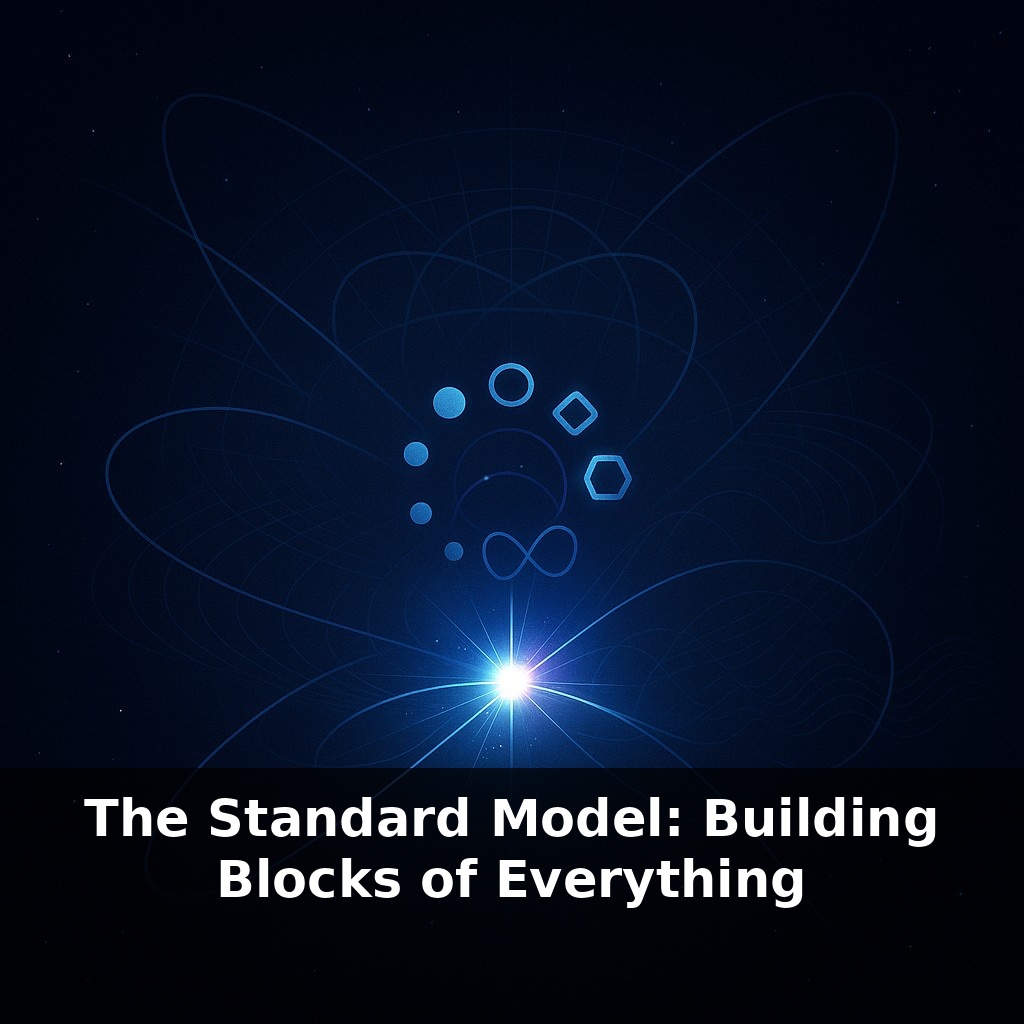
An electron in your fingertip obeys the same equations as one in a star 100,000 light‑years away—and the Standard Model has predicted its behavior to something like 1 part in a trillion. That level of accuracy isn’t an accident; it’s the result of a framework tuned and tested over more than 50 years, from early accelerator experiments in the 1960s to the 13‑trillion‑electron‑volt collisions at CERN’s Large Hadron Collider today. In this episode, you’ll see how this framework is organized: 6 types of quarks, 6 types of leptons, 4 force carriers, and the Higgs boson, all interacting through 3 distinct forces. You’ll also see where that success hits a wall: why this picture cannot explain dark matter, why neutrinos don’t quite fit, and why gravity still stubbornly sits outside the story.
To see how powerful this framework really is, focus on its track record with numbers. In 2012, the Higgs particle showed up almost exactly where earlier calculations said it should, within a few GeV of 125. Today, the magnetic moment of the electron has been checked to about 12 decimal places, and theory and experiment still match. At CERN, roughly 40 million proton–proton collisions happen every second; almost all outcomes fit the existing equations. Yet about 95% of the universe’s energy content lies in forms the framework cannot describe. Our task is to map both its precision and its blind spots.
Start with how the pieces are organized. The framework groups everything by two ideas: what a particle is allowed to do, and how strongly it is allowed to do it.
First, the “matter” sector is arranged in three repeating sets, called generations. Within each set, particles share the same charges but differ in mass. The lightest generation is the one that builds ordinary atoms; the heavier two decay quickly. For example, the top quark—the heaviest known fundamental particle—has a mass around 173,000 MeV/c², nearly as heavy as a gold atom compressed into a point. Yet it lives for only about 5×10⁻²⁵ seconds before decaying. This layered structure is something the framework accepts but does not explain: why exactly three copies, and why these particular masses?
Next, the interaction rules. They are encoded in a compact mathematical object called a Lagrangian. Written out, it fits on a poster, but every term in it has been tested in collisions at facilities from Fermilab to CERN. Each term says, effectively, “this particle may turn into that one with this strength.” The strengths are set by a handful of numbers called coupling constants. The electromagnetic coupling, often written α, is about 1/137 at low energies; the strong coupling is of order 1 at the scale of everyday protons but shrinks below 0.1 at the highest collider energies. This energy‑dependence—especially for the strong interaction—is not guessed; it is measured and then derived from the equations.
The binding inside a proton is a good place to see this in action. Add up the masses of its three valence quarks and you get only about 9 MeV/c². The proton’s mass is about 938 MeV/c², so more than 99% comes from interaction energy: gluons and virtual quark–antiquark pairs constantly flashing in and out of existence. High‑precision lattice simulations of this churning, done on supercomputers using billions of CPU‑hours, now reproduce the proton’s mass within a few percent.
One carefully tuned ingredient in the equations, called the Higgs field vacuum value, is about 246 GeV. Tiny changes here would dramatically alter which particles can exist and how atoms behave. This “fine‑tuning” is one of the big hints that a deeper layer of structure may still be missing.
At room temperature, roughly 10²³ particles in a small glass of water are quietly following the same rules used to design the Large Hadron Collider’s 27‑kilometer ring. To see how this plays out, zoom in on a single hydrogen atom in that water. Its electron can only occupy specific energy levels; jump it with a photon of exactly 10.2 eV, and it will hop from the ground state to the first excited state. In labs, those energy gaps are measured to better than 1 part in 10¹⁴ and match calculations that rely on quantum fields and couplings, not classical orbits.
Here’s a lab‑scale example with numbers: in a PET scanner, a typical medical dose leads to around 10⁷ positron annihilations per second inside the body. Each annihilation produces two 511 keV photons flying in opposite directions. Detectors record those photons at precise angles, reconstructing where they came from. The timing, angles, and energies all rely on quantum predictions first worked out for particle beams and then adapted to clinical devices.
Billions of collisions at CERN already test these ideas, but next‑gen machines aim far beyond. A 100 km Future Circular Collider could reach 100 TeV, probing Higgs interactions to the 0.1% level and revealing subtle cracks in current equations. Space missions like Euclid and the Roman Telescope will chart billions of galaxies, cross‑checking collider results with cosmic data to see whether today’s framework truly survives at the largest scales.
Your challenge this week: when you read any tech or medical headline that sounds “revolutionary,” take 10 seconds to ask: “Which tiny piece of physics is being pushed to its limit here?” Then try to identify whether it’s about precision timing, extreme fields, or ultra‑small structures. That habit will quietly train you to see how pushing the Standard Model at the edges is already shaping tomorrow’s tools.
In the next decade, surveys of 10¹⁰–10¹¹ galaxies and colliders delivering over 3,000 fb⁻¹ of data will either tighten today’s equations or expose tiny mismatches, even at the 0.01% level. Your task is to treat each such “anomaly” you hear about as a test: ask what measurement changed, by how much, and over how many independent experiments.
Before next week, ask yourself: 1) When I think about quarks, leptons, and force-carrying particles, which one actually sticks in my mind, and how could I explain that specific particle (say, the photon or Higgs boson) in one or two sentences to a curious friend? 2) The podcast described forces as particles being “exchanged” — where in my everyday life (like magnets on the fridge, phone batteries, or light bulbs) can I pause and consciously connect what I’m seeing to the electromagnetic or weak force from the Standard Model? 3) If the Standard Model is incomplete (it doesn’t fully explain gravity or dark matter), which “mystery” mentioned in the episode fascinates me most, and what’s one concrete thing I can look up or watch today to go a step deeper into that specific puzzle?