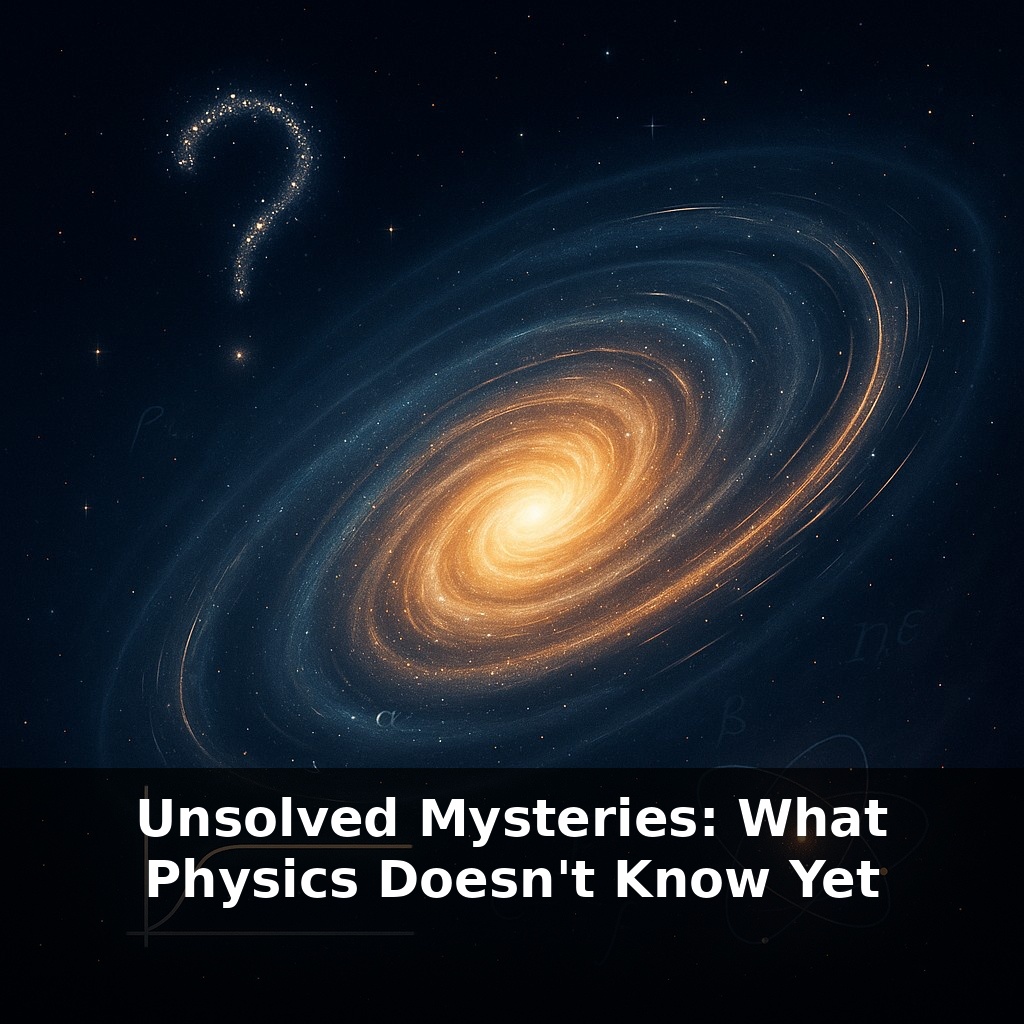
Most of the matter in the universe is invisible—and we only know it’s there because galaxies spin “wrong.” Stars at the edge whirl just as fast as ones near the center, defying our best equations. In this episode, we’ll stroll right up to the edge of what physics can explain.
If our current physics were a recipe, it would be the kind that reliably bakes cakes and launches rockets—but keeps getting the total ingredient list wrong. We can predict how particles collide inside the Large Hadron Collider, yet we misjudge the universe’s contents so badly that most of its matter and energy are filed under “unknown.” Dark matter is one part of that mystery. An even stranger piece is dark energy, a smooth, persistent “something” that makes the expansion of the universe speed up instead of slow down. Meanwhile, gravity itself refuses to fit neatly into quantum rules that work beautifully for the other forces. In this episode, we’ll follow these cracks in our understanding—not to fix them, but to see how far they run, and why solving them might demand new ideas as radical as relativity once was.
So where do these gaps in understanding actually show up when physicists do real work? One place is in precision measurements that stubbornly disagree with theory by tiny, nagging amounts—like a kitchen scale that’s always off by a gram no matter how often you reset it. Another is in cosmic surveys that map how galaxies cluster across billions of light-years and find subtle patterns that today’s best simulations strain to match. Even particle colliders, designed to smash known physics to pieces, mostly confirm our equations while leaving small tensions that refuse to go away. Each of these “almost fits” hints that something important is missing.
Physicists attack these gaps from three very different directions: the sky, the lab, and pure math.
From the sky, more and more evidence piles up that something beyond ordinary atoms is out there. Rotation data are only the first clue. When telescopes map how background light is bent on its way to us, the patterns reveal huge, invisible clumps shaping the paths of photons. Collisions between galaxy clusters show normal matter getting slowed down while the bulk of the mass sails through almost unaffected. Completely different techniques converge on the same conclusion: most of the mass doesn’t shine, and barely interacts.
On Earth, detectors sit deep underground, underwater, or under Antarctic ice, trying to catch rare events. Tanks of ultra-pure xenon wait for a single unexpected flash. Cryogenic crystals listen for tiny vibrations. So far: nothing conclusive. But “nothing” is still data. Each year of silence chops away at once-promising ideas—certain masses, certain interaction strengths—like a careful surgeon removing options while leaving the patient (the overall dark-matter picture) alive.
Meanwhile, colliders such as the LHC look for new particles that might explain both cosmology and particle puzzles in one stroke. Extra dimensions, new symmetries, hidden sectors: they’re not just flights of fancy. They’re attempts to resolve several tensions at once—why the Higgs mass is what it is, why the known forces have the strengths they do, and how they might merge at extreme energies.
The unification problem is trickier. Quantum field theory works astonishingly well for three forces, but fails for gravity at very short distances. Mathematically, infinities refuse to cancel. Approaches like string theory and loop quantum gravity are bold guesses about spacetime at its most granular. Each predicts subtle signatures—tiny deviations in early-universe signals, or microscopic black-hole behavior—that current instruments can’t yet test cleanly.
This is the awkward stage where theory is ahead of data. Many proposals can’t all be right; most are probably wrong. Yet without them, we wouldn’t know what kinds of evidence to seek, or which new instruments to build. The frontier is less a tidy boundary and more a moving fog bank, thinning in some places as new results roll in, thickening in others when old certainties dissolve.
In medicine, doctors rarely jump straight to a grand new theory of disease; they watch vital signs, order scans, and compare symptoms to countless case histories. Physics at the edge works similarly. Astronomers “triage” odd signals by checking them against known instrument glitches, then against catalogs of simulated universes. Only the stubborn leftovers earn serious attention. Lab teams do something akin to clinical trials: they run one detector “regimen,” see no effect, then switch materials, temperatures, and analysis methods, pruning away entire families of particle models.
On the theory side, proposals live or die like experimental drug candidates. A neat idea must survive multiple “phases”: can it reproduce known particle data? Does it respect existing symmetries? Can it be tuned without becoming absurdly contrived? Very few make it to the stage where billion-dollar machines are justified to test them. Your mental image of “breakthrough” should be less lone genius, more coordinated research hospital, where many small, negative results gradually steer everyone toward a diagnosis that finally fits.
If we do crack these riddles, the payoff may be less like inventing a single gadget and more like discovering electricity: messy, gradual, but transformative. New particles or space‑time structures could seed materials with odd stability, sensors that “feel” imperceptible fields, or timing systems that make GPS look clumsy. Even if answers stay elusive, the tools we forge to chase them—smarter algorithms, cleaner imaging, quieter detectors—tend to escape the lab and quietly upgrade everyday life.
We’re still missing most of the “ingredients list” for reality, but the search itself keeps sharpening our tools. Ultra‑quiet sensors end up monitoring bridges and hearts; data methods built for particle hunts sift climate records and traffic flows. Your challenge this week: whenever you use GPS or MRI, pause and ask which future mystery those tools might secretly be training us to solve.