About half of what you charge might be pure guesswork—and your customers decide the “right” price in seconds. A freelancer quotes a website build. A SaaS founder pitches a demo. A consultant scoping a project. Same hours, wildly different prices. Why do some numbers feel instantly fair?
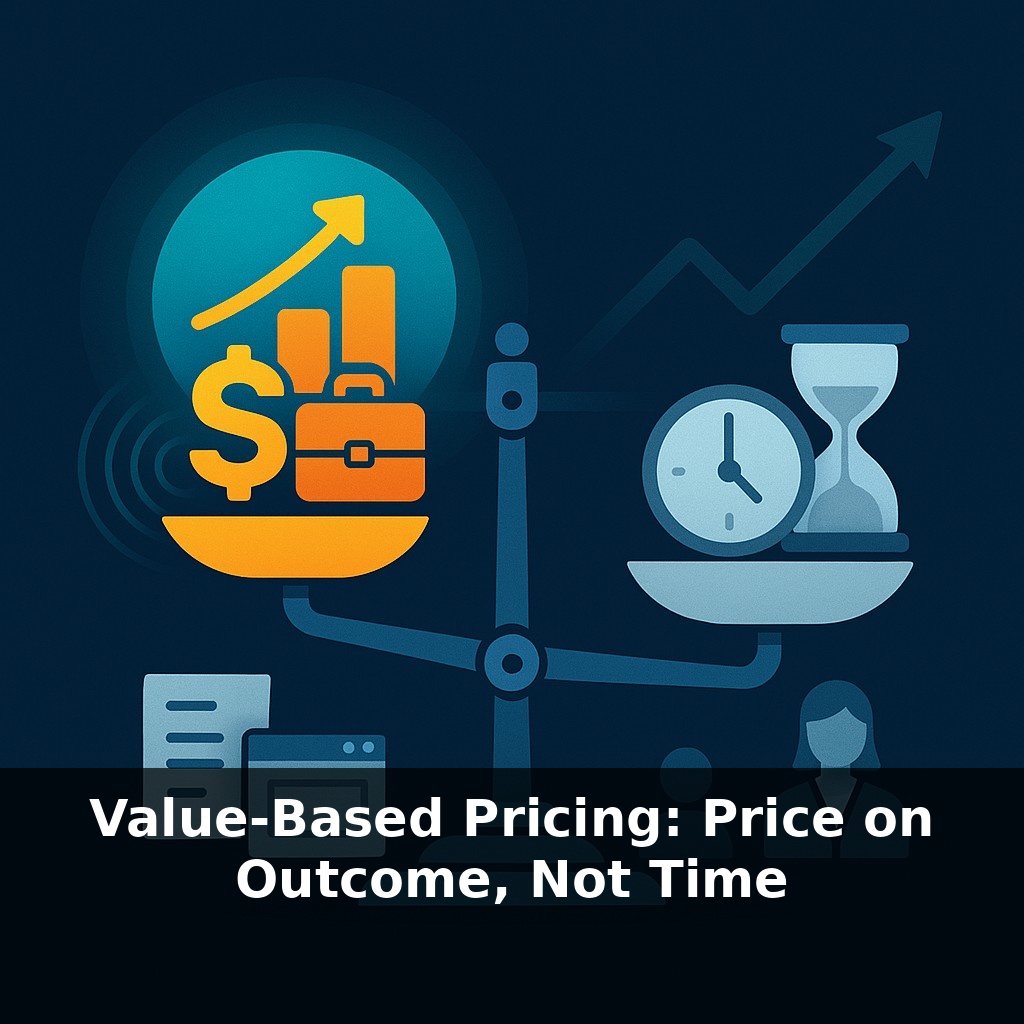
A client doesn’t care that your proposal took three hours to write—they care whether it adds $300,000 to their bottom line or saves them three months of chaos. That gap between your effort and their outcome is where most pricing power gets lost. If you peg your price to time, you’re effectively saying your work is interchangeable with anyone who logs the same hours. But when you anchor your price to a concrete result—more revenue, fewer errors, faster cycle times—you shift the conversation from “How much do you cost?” to “How big is this win?” The data backs this up: companies that master value-based pricing routinely keep a bigger share of the value they create, without changing their product at all. In this episode, we’ll dig into how to uncover that value, quantify it credibly, and translate it into prices that feel fair—and higher—on purpose.
Now we’re going to zoom in on a practical shift: moving your price tag from “input” to “impact.” Instead of asking, “How long will this take me?” you start asking, “Where, exactly, does this change the customer’s world?” That means looking beyond money. Maybe you reduce risk, unlock speed, remove political friction, or protect someone’s reputation. Different buyers value those outcomes very differently. A founder racing to hit a funding milestone cares about days; a compliance officer cares about avoiding headlines. Your job is to map those hidden priorities before you ever write a number.
“On average, companies keep just 20–25% of the economic value they create.” That means for every $1,000 of impact you generate, you’re often walking away with $200 and leaving $800 on the table—for the simple reason that your price is anchored to your effort, not to what changed for the buyer.
So how do you close that gap without feeling like you’re “pushing it” or bluffing? You get specific about *who* you’re helping and *what* is at stake for *them*.
Start with one segment, not everyone. The sales leader at a fast-growing SaaS has different stakes than the owner of a local agency, even if they buy the same type of service. Ask: “Who gets the biggest win when this works?” That’s your lead segment. Within that group, separate “must-have” buyers (pain is acute, timing is urgent) from “nice-to-have” buyers (interest is real, stakes are lower). Value-based pricing only works if you aim it where value actually concentrates.
Next, zoom in on the moment your work “shows up” in their world. Not your deliverable—their before-and-after. Did their close rate move? Did their support tickets drop? Did onboarding time shrink? Did their team stop fighting about something that stalled decisions? Concrete outcome metrics like this become the scaffolding for your price.
Now link your work to that shift with a clear, believable line. You don’t need perfect data; you need a reasonable story you can defend. “Your win rate went from 20% to 26% after we rolled out the new onboarding. You told me each 1% is worth about $150k annually. That’s roughly $900k in incremental pipeline quality. Let’s talk about a price that reflects a slice of that.”
Notice the structure: their numbers, their language, your synthesis.
As you do this, your pricing model itself can change. Instead of a big flat fee, you might use: - A base + performance kicker (e.g., lower fixed fee, bonus tied to hitting specific KPIs) - Tiered packages aligned to sophistication (starter, pro, enterprise) that map to bigger, sharper outcomes - Usage or volume bands that track the intensity of value (seats, API calls, processed transactions)
Value-based pricing isn’t “charge the most you can say with a straight face.” It’s a disciplined way of asking: “Where is the value *concentrated*—and how can we share it in a way that feels obvious once we say it out loud?”
A copywriter who charges $500 for a sales page might feel “expensive” next to a $150 freelancer—until you trace the downstream effect. One lands a page that bumps conversions by 0.8% for a store doing $2M a year in sales. That’s $16,000 in extra revenue, every year, from a single project. Suddenly, $500 looks less like a fee and more like a tiny equity stake in a much bigger upside.
Concrete examples help sharpen this. A recruitment agency could move from flat placement fees to a lower upfront plus a bonus if the hire stays past 12 months. A data consultancy can peg part of its price to cost savings verified three months after implementation. A productized service might offer three tiers based on how aggressively the client wants to pursue a specific KPI: “stabilize,” “improve,” or “dominate.”
Done well, clients start asking for the higher-priced option—not because it’s premium, but because the path from spend to gain feels visible, testable, and shared.
Over the next decade, value-based pricing will quietly turn into value-based *systems*. As AI and sensors track everything from crop yield per acre to student progress per lesson, price will follow those live signals like a weather vane follows the wind. You’ll see contracts that “breathe” with performance: when outcomes improve, invoices rise; when they stall, prices soften. The real moat won’t be having the lowest rate, but owning the clearest, most trusted way to prove you actually moved the needle.
Treat this as an ongoing experiment: keep testing offers where clients “win first, pay more later.” Track where risks feel lopsided, where proof is thin, and where clients light up because the deal mirrors how they already think about success. Over time, your price becomes less like a sticker on a box and more like a living scorecard both sides helped design.
Before next week, ask yourself: “If I could only be paid for one concrete outcome I create for clients (e.g., 10% revenue lift, 30% fewer support tickets, 2x faster onboarding), what would that be—and how would I measure it?” Then ask: “Looking at my last 3–5 projects, what results did clients actually care about most, and how would my pricing have changed if I’d priced those outcomes instead of hours?” Finally, ask: “Which current or past client would be safest to approach and say, ‘If I could help you achieve [specific outcome] in the next 90 days, what would that be worth to you?’—and when will I have that exact conversation this week?”