Schrödinger's Cat: Life, Death, and Quantum Superposition
📝 Transcript
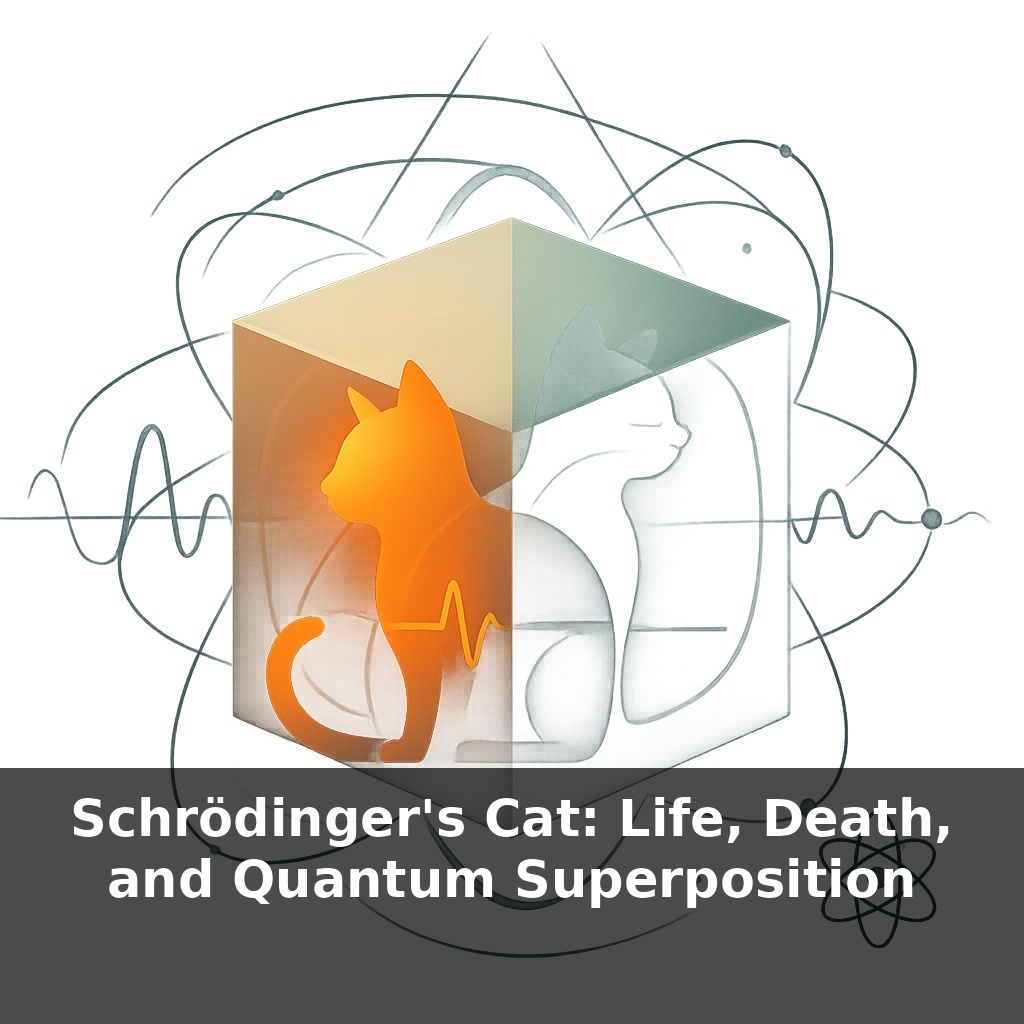
A cat is sealed in a box—and physics calmly insists it is both alive and dead at the same time. No trick, no metaphor. As you listen, stay with that tension: one animal, two mutually exclusive fates, and a theory that says reality itself waits for a decision.
Schrödinger didn’t propose his cat because he liked tormenting imaginary animals; he was attacking what he saw as an absurd implication of then-standard quantum thinking. If tiny particles could exist in blended possibilities, why didn’t that weirdness infect everyday objects—tables, teacups, and yes, cats? His sealed box was a protest: a way of saying, “Follow your rules to the end, and you get nonsense.” Nearly a century later, experiments have complicated the verdict. Physicists now assemble fragile “cat states” in labs, coaxing electric currents, light fields, or vibrating chips into delicately balanced both‑and conditions. These aren’t cartoons of cats, but carefully engineered systems where the same uneasy question lurks: at what point does a definite world emerge from quantum ambiguity, and is that boundary real or just a practical convenience?
To see why Schrödinger’s setup still matters, we have to leave the sealed box and walk into real labs. Physicists aren’t debating cats; they’re wiring quantum rules into devices. Superconducting “cat qubits” at Yale, for instance, use microwave fields in tiny cavities to store information in delicately opposed states, stretching coherence far beyond earlier designs. Elsewhere, massive molecules are sent through interferometers, and their wavelike behavior survives longer than common sense suggests. Each success nudges the puzzle into hardware: if we can engineer such states, can we also engineer when, how, or even whether they “collapse”?
Open the lid on the thought experiment and you find three separate mysteries hiding inside: how the math works, what counts as a “measurement,” and whether there’s just one outcome or many.
Mathematically, the cat’s fate is tied to a quantum trigger—say, a decaying atom—by entanglement. Once linked, neither can be described independently. You don’t have “an atom plus a cat”; you have a single joint state that encodes both stories at once: decay/poison released/dead, or no decay/poison sealed/alive. Modern labs routinely build such joint states with photons and superconducting circuits, then tease apart the correlations. Change one, and the statistics of the other follow in lockstep, even across distance. Schrödinger’s cartoon simply glues this to something macroscopic and emotional.
That raises the next issue: what exactly breaks the spell? One camp says there is a real, physical “collapse.” Models like GRW (Ghirardi–Rimini–Weber) and Penrose’s gravity‑related ideas propose that large, spread‑out states spontaneously snap to a single outcome, with a rate that grows with mass or complexity. These theories predict tiny deviations from standard quantum behavior, so teams push ever‑bigger objects into delicate superpositions, hoping to catch collapse in the act.
Another view, decoherence, keeps the quantum rules but notes that no system is perfectly isolated. The cat, the box, stray photons, vibrating atoms in the walls—all become entangled. From the outside, interference between “alive” and “dead” branches vanishes almost instantly, leaving a mixture that behaves classically. On this story, there’s no sharp line, just a rapid loss of access to quantum phases as systems grow and interact.
Then comes the most radical response: maybe nothing truly collapses. In Everett’s many‑worlds interpretation, the joint state simply evolves, and “measurement” is you becoming part of the entangled story. In some branches, you find a living cat; in others, a dead one. The theory’s equations stay untouched; what changes is our picture of reality—no single outcome, but a branching tapestry of them.
Your challenge this week: whenever you face a key decision, pause and explicitly list the main “branches” of your next hour—distinct actions with distinct consequences. Don’t pick yet. Instead, ask: what information would make one branch clearly better? Spend five minutes trying to obtain that missing piece—an email, a quick calculation, a short conversation. Only then choose. By Friday, look back and ask: in which situations did delaying “collapse” while you gathered information materially change the outcome compared with how you usually decide?
In practice, “alive‑and‑dead” style physics shows up in places that don’t look anything like a cat in a box. In chemistry, for example, certain reactions proceed only because intermediate molecules occupy delicately balanced alternatives that steer which products you get; tweak temperature or light and you subtly bias which outcome becomes real in your test tube. In quantum technologies, engineers deliberately nurture similar balances. The 2022 Yale devices, for instance, don’t just store a 0 or 1, but use structured microwave fields so errors tend to nudge both “sides” in ways that can be detected and corrected, extending useful lifetimes beyond typical transmons. Even proposed quantum networks rely on linking remote nodes through such fragile joint states, then carefully “reading” only parts of them to teleport information. It’s less a single cat and more an intricate sports playbook: many possible routes drawn on the whiteboard, with clever timing dictating which pattern the team actually runs.
If we can scale and stabilize these fragile states, technology starts to look less like today’s binary circuitry and more like a reconfigurable city grid, where paths redirect on demand. Medicine could exploit quantum‑enhanced imaging to spot tumors far earlier. Finance and logistics might run simulations that sample whole landscapes of risk at once. Even law and ethics may adapt, once it’s routine for experiments to probe whether “events” have well‑defined histories at all scales.
So Schrödinger’s cat isn’t just a puzzle about boxes; it’s a rehearsal for how we handle uncertainty everywhere else. As labs push superpositions into bigger systems—chips, mirrors, maybe tiny robots—we’re forced to ask whether “facts” are more like software updates than fixed bricks in a wall, arriving only when interactions demand a stable version of events.
Try this experiment: Pick a simple future event—like whether you'll get a reply to an email by tonight—and treat it as your “quantum cat” in a superposition of “yes” and “no” until the outcome is known. Before checking, write two short, concrete plans: one assuming the email *is* answered, one assuming it *isn’t* (what you’ll do, how you’ll respond, what it means for you). Now delay “opening the box” for a few hours—notice how your mind keeps trying to collapse the scenario into one outcome, and how holding both possibilities changes your anxiety, planning, or optimism. Finally, when you do check, compare how prepared and emotionally steady you feel versus how you’d normally react when you rush to find out immediately.
From this course
Quantum Wonders
6 episodesUnlock all episodes
Full access to 6 episodes and everything on OwlUp.
Subscribe — $1.99/monthLess than a coffee ☕ · Cancel anytime