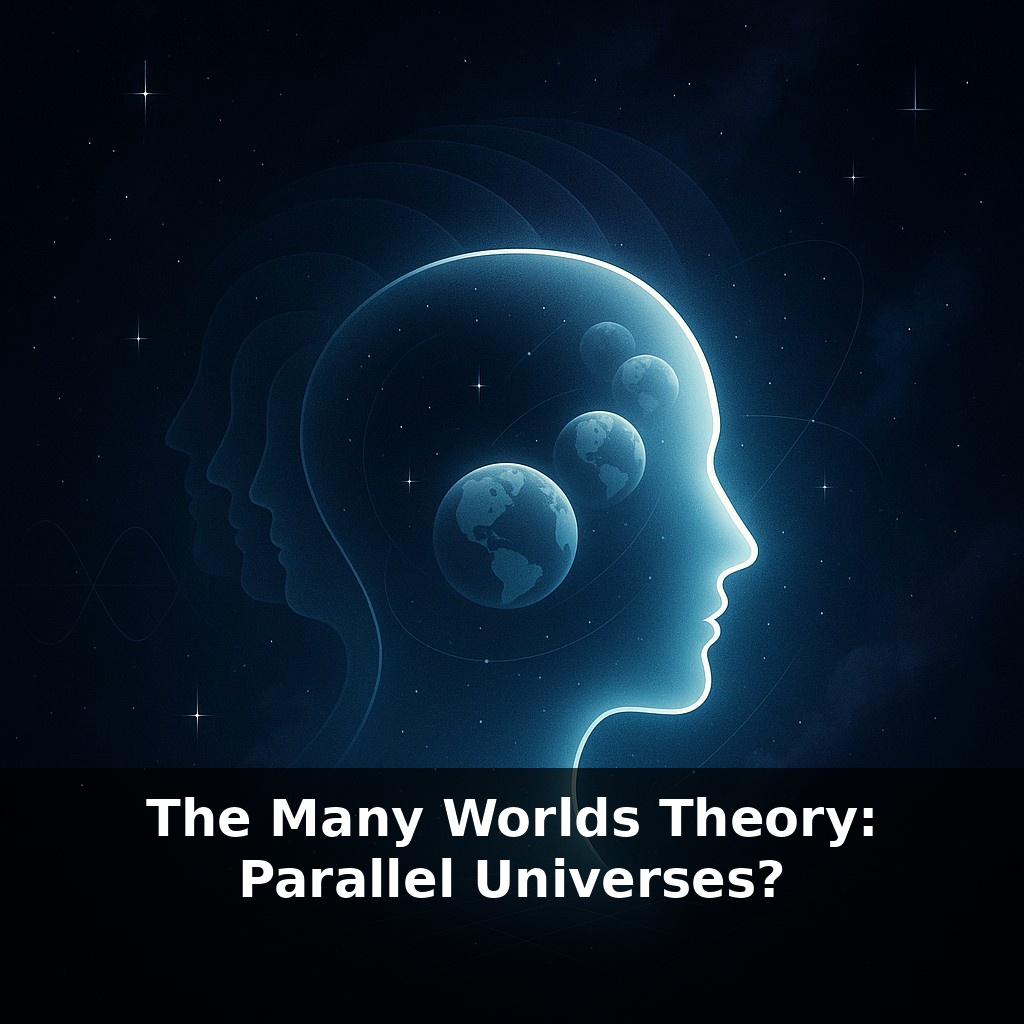
A decision you don’t remember making might already have split the universe. Right now, in some branch of reality, you turned this podcast off. In another, you never found it. Today we step into the idea that every quantum “maybe” becomes a real, but unreachable, world.
In this episode, we push past the sci‑fi vibe and treat the many‑worlds idea as a serious scientific proposal. Here’s the strange part: on paper, it doesn’t add any new equations at all. It keeps the same neat, deterministic rulebook that governs a single electron and insists we apply it to everything—cats, brains, entire galaxies—without ever adding a special “measurement” rule.
That move has consequences. It means the universe must be described by one gigantic wave-pattern that includes you listening right now, plus countless other versions that will never meet you. No extra magic collapse, just relentless math.
Yet this minimalist math leads to a maximal reality: countless parallel outcomes, all baked into one structure. So why did this view stay fringe for decades—and why are more physicists starting to take it seriously?
To see why people argue about this, zoom in on an ordinary “measurement.” In the lab, that might be a photon hitting a detector. In daily life, it could be you checking whether a job offer email has arrived. Standard quantum mechanics says the system sits in a blur of possibilities until you look, then somehow snaps to a single result. Everett’s move was to say: stop snapping. Just let the same smooth equation run right through the detector, the lab, and your nervous system. Now the puzzle shifts: not “how does collapse occur?” but “why do you, subjectively, feel only one outcome?”
Here’s where Everett’s proposal gets both precise and slippery. He doesn’t add new math; he adds a new *reading* of the math. The core claim is: take the same linear evolution that works for electrons and apply it to absolutely everything, including measuring devices, air molecules, and your brain activity when you register a result.
In that story, what we call “outcomes” are really stable patterns in the universal wave-function. You, seeing result A, are one such pattern; another you, seeing result B, is another. The key technical ingredient that makes those patterns behave like separate realities is **decoherence**.
Decoherence is what happens when a quantum system gets entangled with countless degrees of freedom in its environment—photons, vibrations, thermal noise—so thoroughly that different possible results no longer interfere. Mathematically, the off‑diagonal terms in the system’s density matrix, which encode quantum interference between alternatives, get suppressed to effectively zero extremely fast. For macroscopic setups, that suppression can happen in less than a trillionth of a second.
Crucially, decoherence doesn’t pick a single outcome. It just makes the alternatives dynamically independent: no interference, no recombining, no observable cross‑talk. In the MWI view, that’s all you need for “worlds” to behave separately. Each decohered branch contains records, memories, and physical traces consistent with one result, and observers inside it will reconstruct a history in which that result was “the one that happened.”
This perspective turns familiar lab gear into branching engines. A Geiger counter deciding whether it clicks, a CCD sensor registering a photon, your visual cortex resolving a pixel on a screen—all are just physical processes where quantum superpositions get routed into macroscopically distinct, decohered histories.
It also reframes quantum randomness. Instead of a single universe picking one option with some probability, you get a structured spread of outcomes, weighted by the squared amplitudes of each branch. Those weights still match the Born rule, so every test of quantum statistics so far fits, but now they describe how much of the total wave-function’s structure is devoted to each kind of history, not how “likely” one universe is to realize it.
In practice, you can see the many‑worlds mindset lurking behind cutting‑edge technology. Quantum computers, for example, are engineered to keep delicate superpositions alive just long enough for interference patterns to amplify some computational paths and suppress others. Whether or not you buy the “parallel outcomes” story, the hardware—like Google’s 53‑qubit Sycamore chip—forces us to think in terms of vast landscapes of possibilities evolving together, then being sampled by a readout.
A single photon experiment offers a more down‑to‑earth case. Fire one photon at a beam splitter, send each output arm to a different detector, and let decoherence with the electronics lock in distinct records. On the textbook view, one detector wins. On the Everettian view, the full description includes consistent traces at both, with each lab notebook telling a self‑contained story.
One way to picture this is like a software project using branching in version control: all branches are real codebases, but a developer working in one branch doesn’t directly see the edits in another.
If every outcome persists somewhere, ethics and risk start to look different. Do we still fear failure, knowing some counterpart succeeds? Or do stakes feel *higher*, because every roll of the dice populates more futures with our choices? In designing quantum tech, MWI can act like an architectural sketch, nudging engineers to treat “all allowed processes” as resources. Your challenge this week: when you face a choice, pause and ask, “Which future *storylines* am I creating with this move?”
So where does this leave you? MWI says our universe might be less a lone highway and more a sprawling transit hub, with countless tracks quietly diverging beyond view. That picture can nudge science, too: it motivates experiments pushing superposition to heavier objects, and sharper tests of decoherence, searching for any hint that the branching story ever fails.
To go deeper, here are 3 next steps: (1) Watch Sean Carroll’s free “Quantum Mechanics and the Many-Worlds Interpretation” lecture on YouTube and pause every 10 minutes to sketch the branching-worlds diagrams he shows, so you can literally see how wavefunction branching is supposed to work. (2) Read Chapter 2 (“The Splitting Worlds”) of David Deutsch’s *The Fabric of Reality* and, as you go, keep your browser open to WolframAlpha to plug in the simple quantum examples he discusses (like interference patterns) to see the actual numbers behind the claims. (3) Open the “Quantum Game with Photons 2” (a free browser game) and play through the levels on beam splitters and interference; treat it like a lab where you test whether the podcast’s claim—that all outcomes “exist” in parallel—matches what happens when you change the experimental setup.