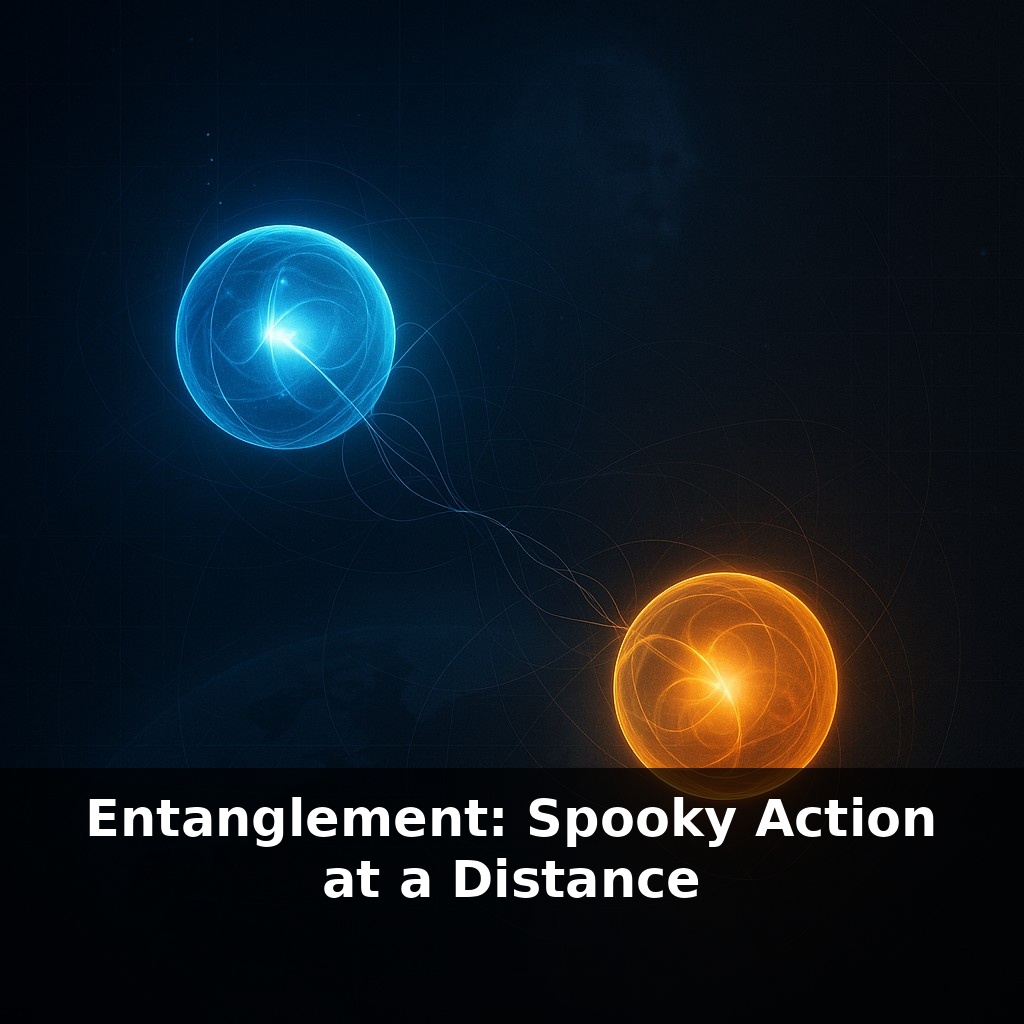
Einstein once called it “spooky action at a distance”—then experiments proved the spookiness was real. Now, picture two tiny particles, on opposite sides of the planet, behaving like a single object. No signal. No messenger. Just instant, perfect coordination.
Entanglement isn’t just a philosophical headache for physicists—it’s quietly becoming a new kind of technology. Engineers now treat these fragile quantum links the way civil planners treat bridges: as infrastructure you can build entire systems on. Those eerie correlations are being woven into quantum networks, experimental “quantum internets,” and computers where 50+ qubits cooperate as a single, exquisitely sensitive device. The striking part is how seriously the field takes this. Governments fund satellite missions to beam entangled photons between continents. Hardware teams battle stray heat and vibration the way race-car teams fight drag, shaving away noise to keep those correlations alive just a little longer. Step by step, what began as a challenge to Einstein is turning into a toolkit for secure communication, new sensors, and machines that compute in ways we’re only starting to map.
To see where this is heading, follow the experiments. In 2017, a Chinese satellite flung pairs of linked photons to stations over 1,200 km apart and still saw the telltale correlations. In 2015, a Dutch team separated labs by over a kilometer and closed major loopholes that skeptics had pointed to for decades. These aren’t isolated stunts; they’re more like early test tracks for a coming “quantum infrastructure.” Today’s prototypes hint at global-scale systems where fragile quantum links are generated, routed, checked, and repaired, much like packets in a data center—only far more delicate.
Start with the weirdest part: when physicists test entanglement, they don’t just see “strong correlation”—they see patterns that are mathematically impossible for any system obeying local, classical rules. That’s what Bell inequalities capture: a hard numerical line between “the universe is secretly classical under the hood” and “nope, reality itself is more quantum than that.” Modern experiments blow past that line by tens of standard deviations. It’s not a close call.
Those results force an uncomfortable choice. Either influences aren’t strictly local in the way Einstein hoped, or measurement outcomes aren’t fixed in advance. Many interpretations bite different bullets—some give up locality, some give up the idea that outcomes are pre-written, some even tinker with what we mean by “reality” between measurements. What they can’t do is sneak in a normal, signal-carrying mechanism that would let us actually send a message faster than light. The statistics won’t allow it: each side just sees random outcomes until they’re compared with slow, classical communication.
This “non-signaling but non-classical” middle ground is exactly what today’s quantum engineers exploit. Entanglement now shows up on blueprints: in quantum repeaters that will one day stitch together long-distance networks; in device-independent cryptography, where Bell violations certify security even if you don’t fully trust your hardware; in quantum error-correcting codes that spread information across many qubits so that no small subset reveals the whole. Google’s GHZ states, for instance, are like locking a 50-piece vault so that every piece must cooperate to open it.
Protocols such as entanglement swapping push things further. You can start with two independent entangled pairs, never let the end particles meet, and still end up with a fresh entangled pair between distant nodes. That’s the backbone of proposed quantum repeaters and, eventually, continent-scale networks. The dancers never rehearse together, yet a clever middle step leaves them moving in sync.
Your challenge this week: whenever you see a news story about quantum tech—computers, communication, sensing—ask one specific question: “Where does entanglement enter the story, and how is it verified?” Then, dig until you either find a mention of Bell tests, entanglement witnesses, or multi-qubit correlations—or notice their absence. By the end of the week, you’ll start to distinguish marketing buzz from real use of one of nature’s strangest, hardest-won resources: correlations that no classical script can explain.
Think of entanglement as a kind of “design material” that engineers can shape into very different tools. In quantum key distribution, labs in Vienna and Beijing already use it to check if a communication line has been disturbed: if an eavesdropper pokes the system, the delicate correlations warp in ways you can spot statistically. In metrology, teams use entangled atoms to build clocks that tick more uniformly than any classical ensemble, squeezing down timing noise beyond standard quantum limits. And in many-body physics, researchers create intricate webs of entangled ions or superconducting circuits to emulate exotic phases of matter that don’t exist in nature, then tune and probe them like synthetic crystals. Even black hole physics now borrows entanglement as a bookkeeping tool: theorists track how it’s distributed across “toy universes” to test ideas about information escaping from evaporating holes. In all these cases, the same raw resource is bent into wildly different shapes.
Entanglement’s strangest legacy may be how it reshapes *questions*, not just devices. As labs learn to weave ever-larger webs of correlations, they’re probing whether space, time, and even “cause and effect” might be emergent—like patterns in a vast game rather than fixed background rules. In materials science, tuning entanglement could let us “sketch” properties first, then grow matter to match, the way software updates once transformed how we use the same old hardware.
As labs scale up these fragile connections, they’re also treating them like a wind tunnel for reality: a controlled space to stress-test ideas about space, time, and causality. We’re not just asking “What can this build?” but “What breaks first when we push the rules?” The answers may redraw the boundary between what’s merely hard and what physics forbids.
To go deeper, here are 3 next steps:
1. Watch entanglement in action by running IBM’s free Quantum Composer (quantum-computing.ibm.com) and load the sample circuit that creates a Bell pair—play with measuring just one qubit first, then both, to see how the probabilities change. 2. Grab Adam Becker’s book *What Is Real?* or David Kaiser’s *How the Hippies Saved Physics* and read the chapters on Bell’s theorem and the early “spooky action” experiments, then pause to compare their historical stories with the episode’s explanation of nonlocal correlations. 3. Open the Quantum Country “Quantum Computing for the Very Curious” essay (quantum.country) and complete the section on qubits and entanglement, actually answering the built-in review questions so the math behind “spooky action” starts to feel intuitive instead of mystical.