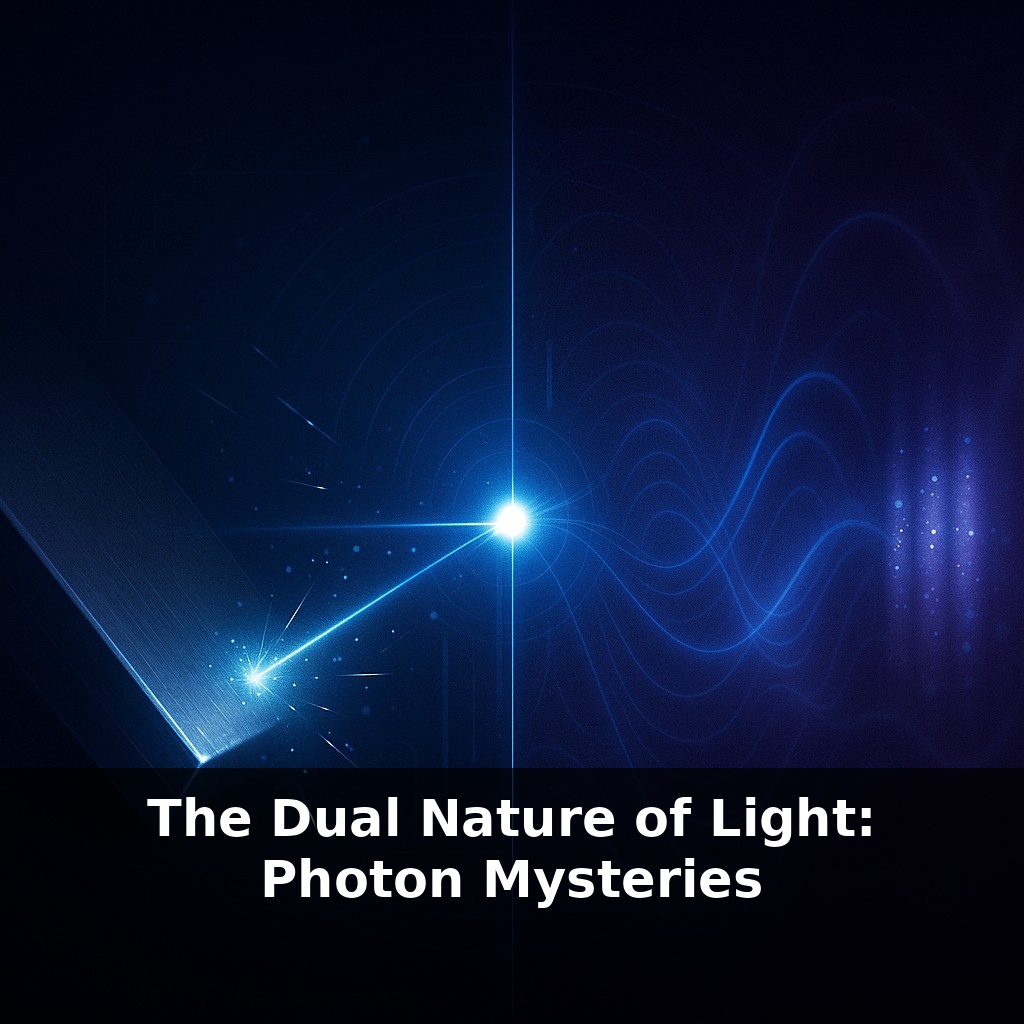
Light can hit a metal plate and knock out electrons instantly—yet the same light, sent one photon at a time, slowly paints a ghostly interference pattern on a screen. In this episode, we’ll follow a single photon and ask: what *is* this thing that behaves as both hit and haze?
“Light has no home in our everyday categories,” physicist Steven Weinberg once noted, “so it forces us to rebuild the categories.” In this episode, we’ll push beyond the textbook slogan that light is “both a wave and a particle” and ask a sharper question: what rules does light actually obey?
To do that, we’ll lean on quantum electrodynamics, the theory that treats light as quantized excitations of the electromagnetic field. This sounds abstract, but its fingerprints are all over modern life: every laser pointer, fiber-optic cable, and quantum-encrypted message depends on those rules.
We’ll see how a photon “decides” where to land when many paths are available, why its energy is locked to frequency, and how spin quietly shapes what polarized sunglasses block. Step by step, we’ll trade familiar labels for a more precise, if stranger, picture of what light really is.
To get a feel for how strange light really is, shift the focus from *what* it is to *how* it interacts. QED doesn’t just describe lone photons; it precisely predicts how they’re emitted, absorbed, and scattered—down to tiny corrections that match experiments to more than ten decimal places. That uncanny accuracy is why we trust it to design GPS satellites, MRI machines, and semiconductor lasers. Yet the same equations that guide engineers also license deeply non-classical feats like quantum teleportation and ultra-secure quantum key distribution riding on single photons in today’s fiber networks.
Start with something that sounds wrong: a single photon can go through *both* slits and *only one* slit, depending on what you ask it. The tension isn’t in the photon; it’s in the question.
QED’s answer is to stop thinking about little pellets flying along neat tracks and instead assign each possible path a *complex probability amplitude*. Where classical physics adds ordinary probabilities, QED adds these amplitudes—quantities with both size and “angle”—and only at the very end converts them into actual probabilities. When paths are indistinguishable, their amplitudes add and can cancel or reinforce, giving interference. When you make paths distinguishable—say by placing a detector at a slit—you’ve changed the question, and with it, the allowed additions. No mystery “choice,” just different bookkeeping rules.
This is where complementarity lives. You never see “half a track and half an interference pattern.” The experimental setup defines which aspects of the underlying quantum object you can reveal at once. In one configuration, detection events line up like classical impacts. In another, their statistics record delicate phase relationships you never witness directly, only infer from the build-up.
The “dual nature” also shows up beyond simple paths. In high-energy experiments, photons routinely turn into matter–antimatter pairs—an electron and a positron—when they pass near a nucleus. Crank the energy higher and the same field that mediates radio waves suddenly writes new particles into existence. Flip the story and accelerating charges radiate photons, a process so well understood that modern synchrotrons sculpt beams of X‑rays precise enough to resolve individual atoms in a protein.
Technologists lean into this strangeness. Superconducting qubits in microwave cavities trade single photons like players passing a ball in a tightly choreographed drill, letting engineers shuttle quantum information around a chip without ever “seeing” the carriers directly. Integrated photonics now routes and interferes individual light quanta on etched waveguides, much as early electronics routed electrons on copper traces, but obeying interference rules instead of simple currents.
Your challenge this week: treat every beam of light you encounter—headlights, fiber‑optic links, barcode scanners—as a testbed. For each one, ask: where, in this device, would interference between *indistinguishable* paths matter, and where would making paths distinguishable kill it? Try to identify a concrete mechanism—lens, detector, mirror—that tips the balance. By the end of the week, aim to find *one* everyday gadget whose operation clearly depends on keeping some photon paths indistinguishable.
When engineers build an interferometer for gravitational‑wave observatories, they’re effectively constructing a kind of optical racetrack. Laser light is split, sent down arms kilometers long, bounced off mirrors, and recombined so that only *tiny* differences in path length show up as changing brightness at the detector. The device is tuned so that ripples in spacetime, not local vibrations or temperature drifts, dominate the signal. In labs, similar “light racetracks” are shrunk onto photonic chips where etched waveguides steer single photons around tight bends and through beam splitters you’d need a microscope to see. There, carefully arranged phase shifts turn fragile interference effects into logic operations for quantum circuits. Think of light like a distributed software system: each mirror, fiber segment, or splitter is a module that transforms an incoming “message” according to strict rules, and the emergent behavior—whether we call it particle‑like or wave‑like—depends on how all those modules are wired together.
Mastering this split personality of light is like getting root access to reality’s network stack: it lets us program how information moves at the most fundamental level. Future chips may route streams of single photons the way today’s routers juggle data packets, but with security and timing guarantees no classical signal can match. As we learn to sculpt light’s quantum states on demand, “turning on a light” could one day mean spinning up sensors, computers, and communication channels in one seamless optical fabric.
Light’s strangeness is less a bug than a design manual we’re still learning to read. Tweak timing, geometry, or detection and the same field becomes microscope, router, or qubit highway. As labs tame ever fainter signals, expect “lighting up” a system to mean configuring flows of quantum information as easily as apps reshuffle data today.
Start with this tiny habit: When you flip a light switch at home, pause for two seconds and quietly say to yourself, “Wave or particle?” as you look at the light. Then imagine just one photon racing from the bulb to your eye, choosing a path only when you “look,” like they described with the double-slit experiment. If you’re near a screen, glance at a pixel and picture its light behaving like a spread-out wave until it hits your retina. This takes only a moment, but it keeps the weird dual nature of light alive in your everyday life.