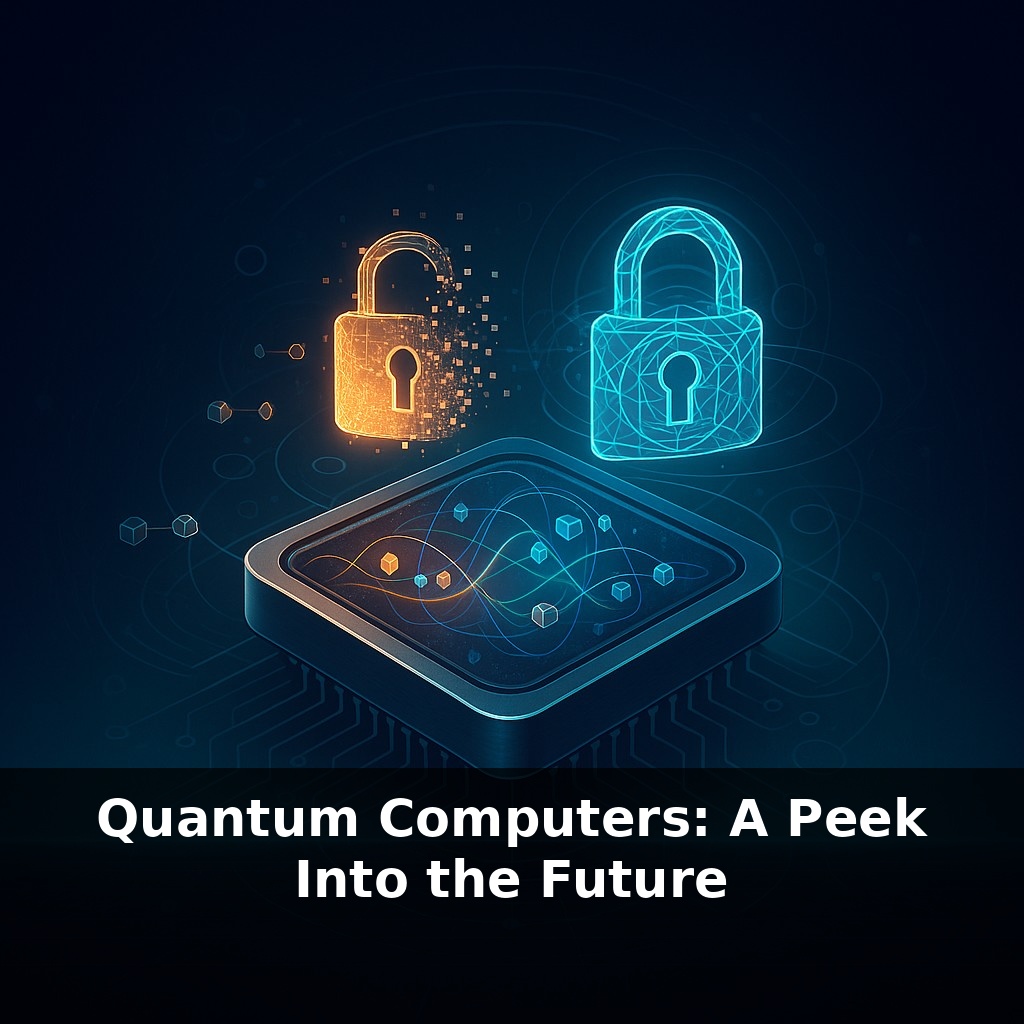
“Quantum computers don’t just crunch numbers faster—they can, in theory, break the locks that protect almost every online bank and private message on Earth. Now here’s the twist: those same machines might also help design safer locks we haven’t even invented yet.”
In the last episode, we saw how quantum machines could both shatter today’s digital “locks” and help invent stronger ones. This time, let’s zoom out and look at what else they might rewrite.
Right now, scientists are already using early quantum chips—far from perfect—to probe problems that stump powerful supercomputers. Think drug molecules with thousands of interacting electrons, or global supply chains with billions of possible configurations. Classical machines must explore these possibilities one after another; quantum processors can, in specific cases, weave many of them into a single calculation and let interference highlight the most promising answers.
That’s why tech giants, national labs, and startups are racing to scale up qubits, even though fully fault-tolerant systems are still on the horizon. The real question is no longer “if” quantum computers will matter, but “where” they’ll quietly reshape our future first.
In practice, today’s prototypes already live in the cloud, rented by chemists, logistics planners, and AI researchers who treat them as exotic co‑workers rather than crystal balls. Instead of solving entire problems end‑to‑end, they tackle especially nasty subroutines—like a specialist you call in for the hardest move in a complex game. One team might probe new battery materials; another might tune delivery routes or train a smarter recommendation system. Piece by piece, these early wins hint at where large‑scale quantum systems could quietly become indispensable.
“On paper, a mature quantum computer could crack RSA-2048 in hours. In hardware, we don’t yet have the ~4,000 error‑corrected qubits that would make that possible. Bridging that gap is where the real story is happening.”
Right now, progress is less about flashy “supremacy” headlines and more about three quiet revolutions.
First, scale. Devices like IBM’s 433‑qubit Osprey are early milestones in learning how to wire, cool, and control ever larger arrays without drowning in noise. Researchers are testing new qubit types—trapped ions, neutral atoms, spins in silicon, even topological designs—to see which can be manufactured reliably, linked into networks, and integrated with conventional chips. The race isn’t just “more qubits,” but “more useful qubits.”
Second, reliability. Raw qubits are error‑prone; a single stray vibration or stray photon can flip their state. To build one “logical” qubit robust enough for long calculations, you may need around a thousand physical ones today. That overhead sounds brutal, but it’s shrinking as error‑correction codes improve and gate operations become cleaner. Think of it like constructing a stadium roof: you start with heavy scaffolding and supports everywhere, and gradually refine the structure until most of what’s left is usable space for the game itself.
Third, algorithms. Not every task gets a quantum boost, and many everyday problems don’t benefit at all. The big speed‑ups target specific structures: factoring, unstructured search, certain optimization and simulation tasks. That’s why so much work now focuses on hybrid schemes, where classical code does most of the heavy lifting and a quantum routine only handles the “hard core” of the computation. In optimization, for instance, quantum routines can explore promising regions of a gigantic search space while classical heuristics guide and refine the search.
Meanwhile, the ecosystem around the hardware is maturing. Programming toolkits, domain‑specific libraries, and cloud access are lowering the barrier from “quantum physicist” to “curious developer.” Venture funding—over a billion dollars in 2023 alone—is seeding startups that target niches: logistics, materials, finance, climate modeling.
Taken together, these threads suggest a future less like a single breakthrough moment and more like Wi‑Fi: at first exotic, then quietly everywhere, powering things people barely think of as “quantum” at all.
A quantum advantage starts to feel real when you look at specific, messy problems. Volkswagen, for instance, has tested quantum‑inspired route planning for taxis in cities like Beijing, squeezing more efficiency from crowded streets. Drug companies are probing how future devices might sort through huge libraries of candidate molecules to spot a few promising cancer therapies far earlier in the pipeline. In finance, banks experiment with portfolio optimization, where countless combinations of assets must be balanced against risk, regulation, and market shocks.
Sports analytics offers a helpful metaphor here: a coach doesn’t replay every possible game sequence; they focus on a handful of high‑impact plays to review in detail. In a similar spirit, hybrid workflows hand classical machines the routine drills while reserving quantum subroutines for those “game‑changing” moments in a calculation. Over time, these narrowly targeted wins—in logistics, materials, climate modeling, and beyond—could add up to shifts we feel in everyday life, even if we never see the hardware itself.
Quantum’s ripple effects may sneak up on us. Power grids could self-balance like smart traffic lights, easing blackouts before we notice a flicker. Climate models might trial thousands of “what‑if” policies overnight, giving cities playbooks for floods and heatwaves. In hospitals, treatment plans could be tuned as precisely as a streaming service queue—constantly updated, oddly personal. The open question isn’t just what we can optimize, but who gets to decide the goals.
Your challenge this week: watch for headlines where “optimization” or “simulation” quietly appears—traffic, batteries, crops, even streaming. Each time, ask: if a chess engine explores futures for kings and queens, what happens when quantum tools start exploring futures for cities, species, and economies—and who gets a say in the next move?