By your mid–fifties, you’ll likely have worked more than ten different jobs—yet most of us still talk about our career as if it’s one fixed story. You update your phone more often than your professional identity. So here’s the puzzle: who are you at work, if you keep changing?
Careers now move more like weather systems than train schedules—shifting directions, changing intensity, surprising you with sudden fronts. The data backs this up: shorter job tenures, more internal moves, broader skill sets, constant skill gaps. Yet many people cling to a single, outdated self-description—“I’m a marketer,” “I’m an engineer”—long after their actual work has morphed into something more complex.
The tension is this: the market clearly rewards adaptability, but our sense of self often resists it. We treat past choices as permanent labels instead of early drafts. When that happens, you’re more likely to feel trapped by your résumé, threatened by change, or late to emerging opportunities.
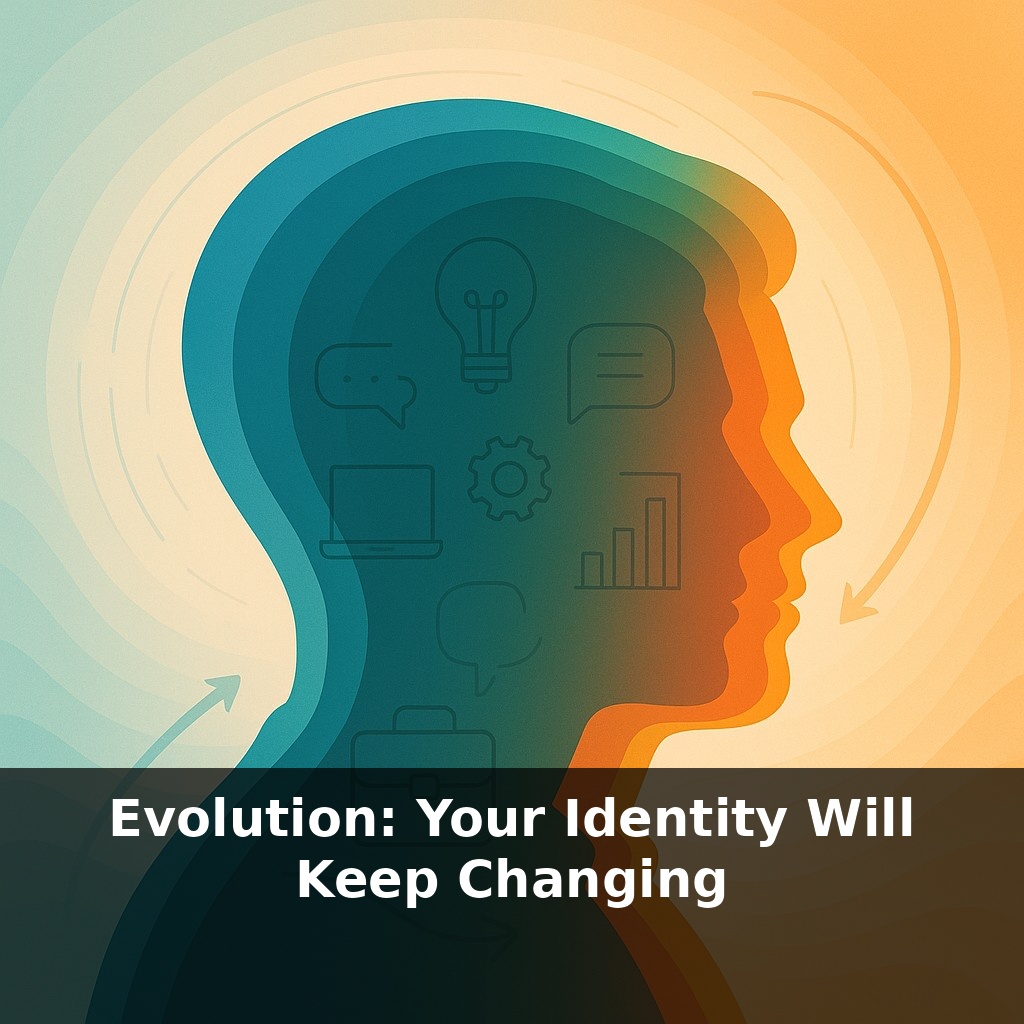
In this episode, we’ll explore how to treat your working self as a living prototype—something you’re allowed to revise—so each shift becomes momentum, not an identity crisis.
Most people only notice their identity has shifted when something big happens—a promotion, a layoff, a career change. But it’s actually rewiring itself quietly in smaller moments: the project you volunteered for, the conflict you handled differently, the tool you finally learned. These micro-updates often stay invisible because you’re busy, focused on output, not on who you’re becoming. The risk isn’t just missing a chance to “rebrand.” It’s making decisions today based on a version of you that no longer exists—and saying no to paths that now quietly fit.
Think about three different “you” versions you’ve already been at work: the newbie trying to decode acronyms, the competent contributor others rely on, and the person people now ask for advice. None of those felt like a dramatic reinvention while you were living them—yet each one came with different reflexes, beliefs, and default choices. That’s identity in motion.
What quietly drives those shifts isn’t just new knowledge; it’s how you answer three ongoing questions, usually without noticing:
1) What am I allowed to do? 2) What am I good at? 3) What people like me do in situations like this.
That last one is especially powerful. A designer who starts thinking “people like me lead cross-functional projects” will volunteer differently, speak up differently, even disagree differently than a designer who thinks “people like me polish what others decide.” Same job title, different identity—and eventually, different career.
This is why treating your role as a fixed box is so limiting. When you over-identify with a single version of yourself (“I’m the detail person,” “I’m the closer,” “I’m the tech one”), you start editing your behavior to match the label. You decline stretch assignments that don’t fit the story. You downplay new interests because they feel “off brand.” You say things like “that’s not me,” when in reality it might be a future you trying to get a foothold.
The flip side: you can steer the next version of you by deliberately feeding it different experiences. Not random ones, but targeted “identity experiments” that test alternative answers to those three questions.
Notice how this already happens around you:
- The customer-support rep who shadows product once a week and slowly becomes “the person who translates customer reality for the team.” - The accountant who runs a lunch-and-learn on data tools, and over time is treated as “our internal analytics lead,” long before any title changes. - The nurse who starts mentoring new hires and is gradually seen as “the informal educator,” paving the way into training or leadership.
In each case, skills followed identity as much as identity followed skills. They acted “as if” a slightly more expanded version of themselves was already true—and reality slowly caught up.
Think of small, concrete shifts you’ve seen in real workplaces: the barista who starts tweaking the workflow so lines move faster and gradually becomes “the ops brain” of the café. Or the junior developer who quietly keeps the team’s documentation organized, then gets pulled into planning meetings because “they see the whole system.”
Professional evolution often starts as a side-path that doesn’t look important enough to put in a job description yet. A salesperson who keeps helping new hires with their first deals might be rehearsing for a future in enablement or training. A lab technician who volunteers to present results to non-technical stakeholders is testing a version of themselves who might later thrive in product or regulatory roles.
One useful lens is to notice where others already “typecast” you in helpful ways. Are you the one people ask to simplify complex info, to calm tense rooms, to fix broken spreadsheets? Those repeated requests are often early signals of an emerging identity—evidence of where the next version of you could grow if you leaned in on purpose instead of by accident.
Your future “you” may look less like an employee and more like a mini ecosystem. As AI and new industries spin up, you might juggle a part-time role, a paid side project, and short sprints of retraining—more like rotating crops in a field than planting one lifelong tree. Credentials could arrive as small, stackable stamps from different platforms, while employers search portfolios instead of résumés. The real edge becomes noticing early when it’s time to replant.
So instead of asking “Who am I, really?” you can start asking “What am I becoming next?” Look for faint signals: tasks that feel strangely energizing, feedback that repeats, curiosities you keep bookmarking. Treat them like trail markers. Follow a few, ignore a few, compare where they lead. Your identity won’t settle—but it can still move in a direction you choose.
Before next week, ask yourself: 1) “Where in my life am I still acting like the ‘old me’—sticking to past goals, labels, or stories—even though my interests, values, or energy have clearly shifted in the last 6–12 months?” 2) “If I fully accepted that my identity is supposed to evolve, what’s one commitment, role, or expectation I’d gently retire this week, and what new experiment (a different way of working, creating, or relating) would I give myself permission to try instead?” 3) “When I notice fear or guilt about changing—worrying what others will think or that I’m ‘quitting’—how can I reframe that moment as evidence of growth, and what specific sentence could I practice saying to someone who still expects the ‘old’ version of me?”