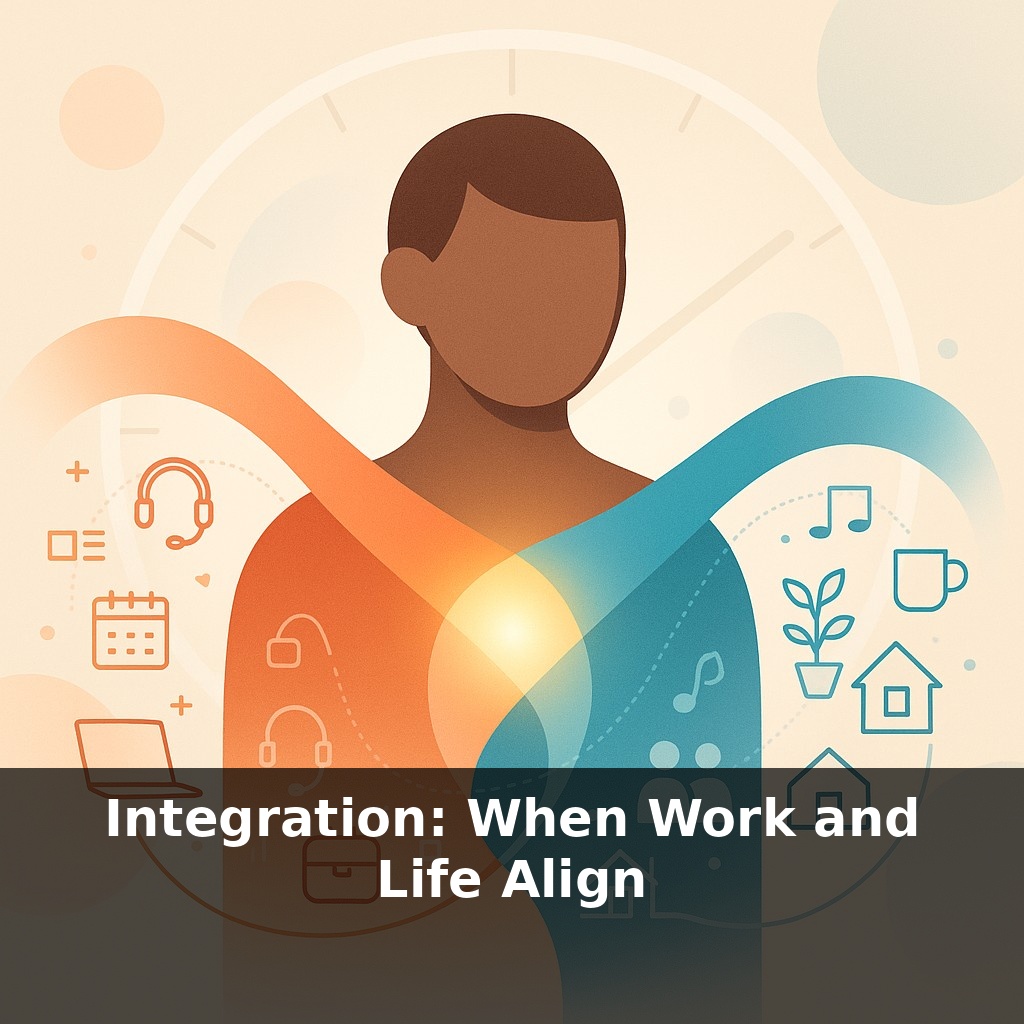
“Work–life balance” might be the wrong goal. Research shows people who blend their work and personal selves—not just juggle them—are happier and less burned out. You’re answering emails at a kid’s game, or brainstorming in the shower. The real question is: are those worlds serving the same values?
Twenty-one percent. That’s how much more productive people are when their work and personal lives actively enrich each other, not just peacefully coexist. And this isn’t theory—Microsoft Japan saw a 40% productivity jump when they restructured time, not ambition. Patagonia kept 91% of new moms by reshaping work around family, not asking parents to “balance” at the margins.
So the question shifts from “How do I protect my life from work?” to “How could my work make my life better—and my life make my work better?”
Think less about drawing a harder boundary, and more about redesigning the overlap: the projects that express who you are, the colleagues who share your causes, the ways your calendar reflects what you say matters. Integration isn’t a perk; it’s a performance and mental health strategy in a world where burnout is now an official occupational hazard.
Integration looks different for everyone. For some, it’s choosing projects that echo a personal cause; for others, it’s shaping schedules around when their mind is sharpest and their family most present. Alignment shows up in small, concrete choices: a manager who holds one meeting-free afternoon so people can coach a team, study, or rest; a parent who turns a child’s practice into a quiet reading block instead of doom-scrolling. The key pattern: your time, relationships, and energy start reinforcing each other, instead of competing for whatever scraps are left.
Research on identity shows a big driver of well-being isn’t *how much* you work, but *who you get to be* while you’re working. People feel more energized when the same “you” can show up in multiple places: the friend who loves mentoring is also the colleague who coaches new hires; the parent who cares about nature is also the employee working on a sustainability initiative.
One practical lever is values visibility. Most job descriptions talk about tasks, not beliefs. But your day-to-day is full of tiny values signals: which Slack channels you join, which problems you volunteer for, what you say no to. A numbers-driven analyst who also cares deeply about fairness might gravitate toward pay equity audits, promotion data, or customer access gaps. The role hasn’t changed; the *through-line* has.
A second lever is time patterning. Instead of only asking, “How many hours am I working?” notice *when* different kinds of hours happen. Many people accidentally reserve their best focus for low-impact tasks and squeeze what matters—exercise, learning, relationships—into leftover slots. Integration flips that: design recurring “anchor blocks” where a personal priority and a professional one can coexist. For instance, a weekly walking 1:1 with a teammate supports both connection and movement, without adding another item to your list.
A third lever is relationship curation. Not everyone at work needs to share your deepest convictions—but it’s powerful to have at least a small circle where you don’t have to translate yourself. That might be a parents’ ERG, an open-source community you contribute to, or a cross-functional group that cares about the same customer problem. These ties often become bridges: someone who pulls you into a project that fits your strengths, or covers for you so you can protect a personal ritual.
Crucially, integration is not about cramming more in; it’s about designing fewer, richer overlaps. That often starts with subtraction: a recurring meeting you opt out of, a side obligation you retire, a “pseudo-urgent” task you automate. Every obligation you release creates space to align what remains.
A designer blocks off Friday mornings for “lab time.” Some weeks she experiments with AI tools for her team; other weeks she prototypes a community art project. Same slot, two identities fed. A nurse who’s also in grad school swaps one night shift for an early-morning rotation so she can join a research group meeting that fuels her curiosity and opens doors for future roles.
A manager who cares about the environment bikes to work with a colleague once a week, turning a commute into a rolling check-in. They arrive with decisions already made, inbox lighter, body more awake. Another person who lives far from family schedules a standing video lunch with siblings, then blocks the hour after for “deep work,” riding the emotional lift straight into a demanding task.
Think of this like adjusting a recipe: you’re not adding more ingredients to your life, you’re changing when and how you combine them so that each one brings out the best flavor in the others.
As automation spreads, your calendar becomes less about hours filled and more about *which parts of you* are in the room. Roles will stretch: a marketer might host community circles; an engineer could mentor students as part of their job, not after it. Think of careers evolving like city maps—old borders between “office,” “home,” and “community” soften into mixed-use spaces where one activity can nourish several priorities at once. The hard part—and the opportunity—is deciding which lines you redraw first.
Treat this as an ongoing draft, not a finished blueprint. The next tweak might be as small as shifting one meeting, swapping one commute, or inviting one person into a shared ritual. Over time, those tiny edits work like gentle tectonic plates, slowly reshaping the landscape of your days until your calendar starts to sound more like you.
Here’s your challenge this week: Choose ONE current work project and deliberately integrate ONE personal value or interest into how you execute it—for example, if creativity matters to you, redesign part of the process to allow for a brainstorming walk or visual mapping instead of another Zoom call. Block a 30‑minute “integration session” on your calendar for three different days this week, and during each session, adjust something practical (your environment, your schedule, or your communication style) so that work and life feel more aligned, not separated. By Friday, send a short Slack or email update to a colleague explaining one specific way this integration experiment changed how you felt about your work.