Understanding Political Disillusionment
📝 Transcript
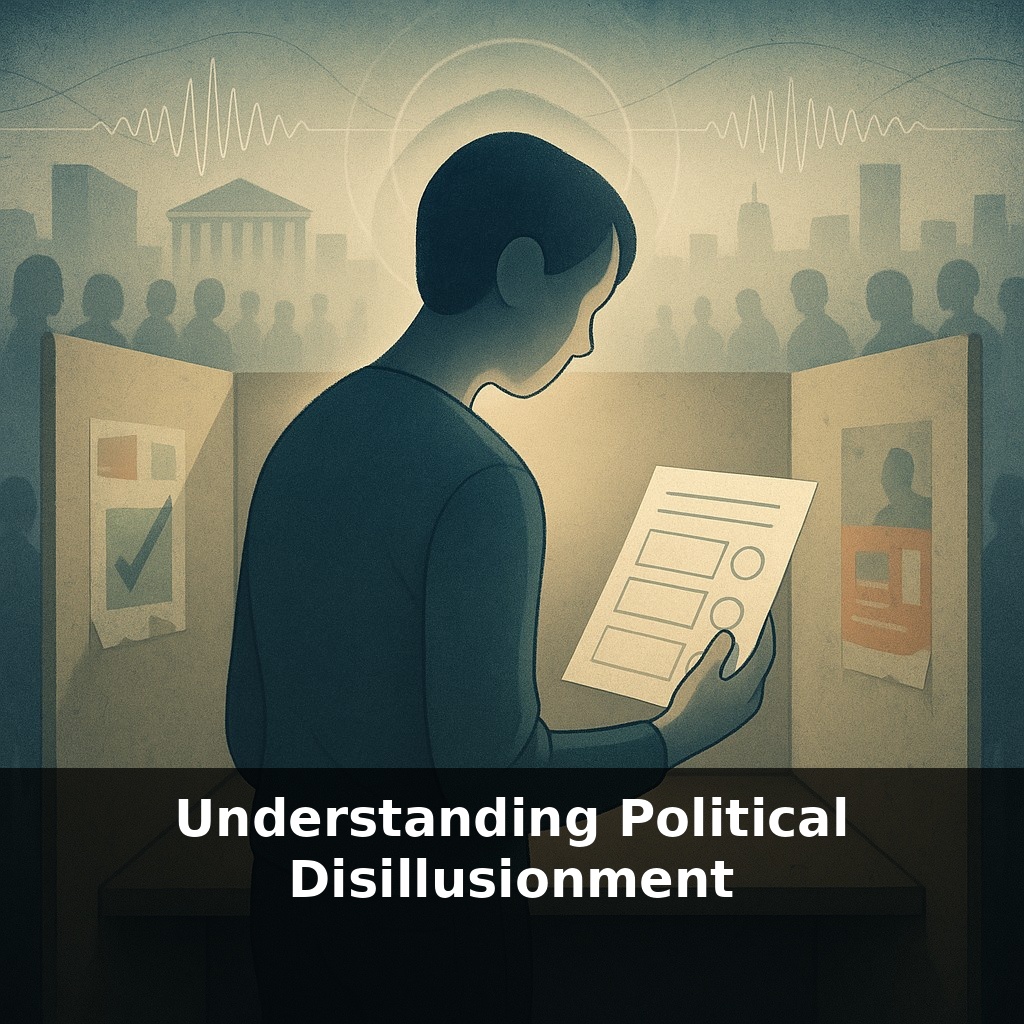
In many democracies today, fewer than four in ten people say they trust their national government. You’re standing in a voting booth, staring at the ballot, and a quiet thought cuts through the noise: “Does any of this actually change anything for people like me?”
Maybe you still show up on election day, but the rest of the year politics feels like background noise—loud, constant, and weirdly irrelevant to your actual life. Rent goes up, wages stagnate, public services fray at the edges, and yet the headlines cycle through the same faces trading the same accusations. It starts to feel less like self‑government and more like watching a game where the rules are written in a language you were never taught.
That creeping sense—“they’re playing something, but it’s not my game”—is the seed of political disillusionment. It’s not just disappointment with a result; it’s the suspicion that the whole process barely registers your existence. Over time, many people respond the only way that seems rational: by emotionally checking out, even if they still participate on autopilot. In this series, we’ll slow that process down, look at where it comes from, and explore how to rebuild a political identity that actually fits your lived reality.
Zoom out for a second from your own frustration and look at the wider pattern: across rich countries, trust in government has dropped notably in the last decade and a half, and barely one in five people worldwide feel that politicians listen to “people like me.” That means your unease isn’t just personal; it’s statistical. But numbers can blur the details that actually matter. Political disillusionment doesn’t land the same way for a gig worker, a small business owner, or a public‑sector nurse; it seeps into different corners of daily life like a slow leak in an apartment building, warping each floor in its own way.
Zoom in again, this time not on elections or institutions, but on the moment disillusionment actually *forms* in a person. It rarely arrives as a thunderclap. More often, it’s a pattern your brain quietly starts to track: you send an email to a representative and get a form reply, you watch a scandal unfold and see no real consequence, you hear bold promises that evaporate between campaigns. Each incident alone is annoying; together, they begin to rewrite an internal script about what is and isn’t possible.
Psychologists call this kind of rewrite a shift in “efficacy”—your sense of whether effort leads to outcomes. When that drops in politics, people don’t necessarily become ignorant or lazy. Many become *selectively* engaged: they might boycott brands, join mutual‑aid groups, or throw themselves into online arguments, while cutting back on anything that smells like official process. From the outside, this can look like apathy. Inside, it feels more like triage: if the formal channel never works, route your energy somewhere else.
This helps explain a core paradox: disillusioned citizens can be highly informed and even hyper‑vigilant, yet deeply skeptical about conventional participation. Think of a friend who tracks every policy change on social media but shrugs at the idea of attending a local council meeting. The issue isn’t knowledge; it’s expectation. They’ve internalized a forecast about impact: “Nothing I do there will register.”
That forecast doesn’t emerge in a vacuum. It’s shaped by class, race, gender, and prior experiences of being dismissed or punished for speaking up. For someone who's been ignored by school administrators, landlords, or managers, it’s not a stretch to assume political gatekeepers behave the same way. Disillusionment then becomes less a single feeling and more a lens—coloring how you interpret each new headline or proposal.
Yet the same research that tracks this erosion also points to cracks in the story. When people are given tools that clearly show a trace from their input to a concrete change—like real‑time feedback systems or direct say over a slice of a budget—their sense of efficacy nudges upward. Not because they were naïve, but because their mental model updates: “Under these conditions, my voice did matter.” That shift is small, but it’s where any realistic rebuilding has to start: not with pep talks about participation, but with experiences that contradict the learned expectation of futility.
A useful way to probe your own response to politics is to notice where you *do* still believe effort pays off. Maybe you’ll fight the landlord, negotiate with your boss, or learn a new skill because those struggles feel “worth it,” yet anything involving a council meeting or public hearing feels like pushing on a locked door. The contrast between those domains is data: your mind is quietly running cost–benefit calculations about where agency lives.
Look at concrete experiments elsewhere. In some cities, residents directly decide how to spend part of the public budget, and suddenly people who never attended a rally show up to argue for bus routes or playground repairs. In digital pilots, simple tools that show whether representatives even opened a message can change how willing people are to write the next one. You’re not watching abstract “civic innovation”; you’re watching how small, visible feedback loops can start to compete with years of accumulated “nothing ever changes” evidence.
Rising disillusionment doesn’t only thin out queues on election day; it reshapes how communities solve problems. As formal channels feel less useful, people reroute energy into workarounds: neighborhood mutual‑aid, encrypted group chats, issue‑specific campaigns that flare up and vanish. Think of a city where more “politics” happens in side streets than in the main square—messier, harder to see, but also full of experimental norms that could either stabilize or further fragment collective power.
You don’t have to fix the whole system to start shifting your relationship to it. Often the hinge is smaller: a local housing rule, a transit decision, a school policy. Your challenge this week: pick one concrete irritation in your daily routine and trace who actually decides it. Map names, offices, and timelines until you can see the path from your doorstep to their desk.
From this course
Redefining Your Political Identity
5 episodesUnlock all episodes
Full access to 5 episodes and everything on OwlUp.
Subscribe — $1.99/monthLess than a coffee ☕ · Cancel anytime