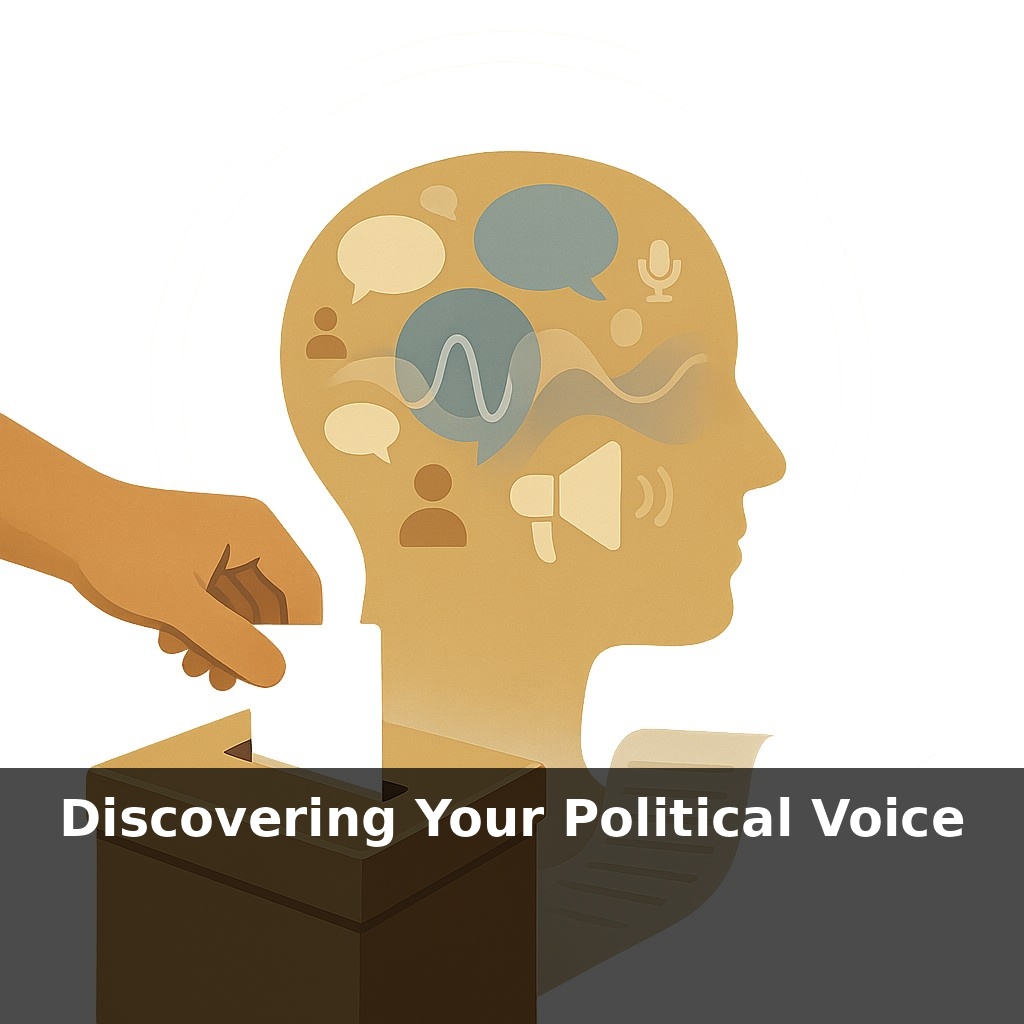
About four minutes. That’s how long most people actually spend voting. Now, here’s the strange part: many of those same people will argue about politics for hours. So why does our loudest political voice show up where it often counts the least—at the very moment our ballot is cast?
Those four minutes in the booth are really just the last scene of a much longer story—one most of us never bother to write on purpose. The real work of discovering your political voice happens in the days and years before a ballot, in quiet moments when no one is arguing with you, no cameras are rolling, and no comment sections are open.
Research in political psychology suggests your views are less like a spreadsheet of “pros and cons” and more like a layered neighborhood you’ve grown up in—shaped by family stories, cultural norms, and the issues that have personally brushed your life. You may think you’re “not political,” yet you probably have strong reactions to fairness at work, safety in your community, or how your friends are treated. Those reactions are clues. In this episode, you’ll learn how to trace them back to the values underneath—and turn those values into a voice you can actually use.
Think about the last time a headline made you angry, a policy made you hopeful, or a comment online made you instantly defensive. Under each of those flashes is a pattern, and patterns are where a political voice starts to take shape. You don’t need a degree in history or a perfect label on the left–right spectrum to start; you need curiosity about why certain issues stick to you while others slide past. In this episode, we’ll map those “sticky” moments across your daily life, so you can see not just what you react to—but what you’re quietly willing to stand up for.
Think of this step as moving from “I feel something” to “I know what that feeling is trying to tell me.” Start with the concrete, not the abstract. Instead of asking, “What are my political beliefs?” ask, “When did I feel a sharp yes or no in the last month?”
Maybe it was when your rent went up, when a friend was treated differently because of their accent, when a local park was renovated, or when your workplace changed its parental leave policy. These aren’t “big P” politics on a debate stage, but they’re the raw data of how power, resources, and rules touch your life.
Here’s where research helps: people rarely think in terms of “left” or “right” first. They respond to moral intuitions—care/harm, fairness/cheating, loyalty/betrayal, authority/subversion, liberty/oppression, sanctity/degradation. You don’t need those labels, but you can use the underlying idea. When something hits you hard, ask: did this feel unfair? Unsafe? Disrespectful? Excluding? Wasteful? You’re tagging the emotion with a theme.
Next, widen the lens one notch. For any one moment, ask three questions:
1. Who had power here, and who didn’t? 2. Who made the rules, and who had to live with them? 3. Who was visible, and who stayed invisible?
Those questions quietly convert a personal irritation into a political clue. Your frustration with an understaffed bus route becomes a concern about public investment and mobility. Your pride in a successful community fundraiser becomes a signal you value mutual aid and local initiative.
Digital spaces complicate this because they constantly suggest what should matter to you. Algorithms amplify outrage that may have nothing to do with your lived priorities. Before you share or comment, pause long enough to ask: “Does this connect to something I’ve actually experienced or deeply care about, or am I being drafted into someone else’s script?”
As you notice patterns, you’re not trying to lock yourself into a fixed identity. You’re sketching a first draft. Expect contradictions. You might be skeptical of government in one context and want stronger regulation in another. Those tensions aren’t a flaw; they’re places where your voice can become more nuanced than a slogan.
Think about three everyday arenas: your wallet, your relationships, and your sense of time. In each, your reactions point to different parts of your political voice.
Start with money. Do you feel calmer knowing there’s a safety net—healthcare, unemployment, public programs—or more energized when people “eat what they kill” and keep what they earn? Your gut response to a sudden bill, a tax change, or a raise hints at how you think risk and reward should be shared.
Next, look at how you handle conflict in relationships. When two friends disagree, are you the mediator, the debater, or the quiet observer? Someone who instinctively gathers everyone for a group talk may lean toward consensus-style politics; someone who prefers clear rules and referees might favor strong institutions and enforcement.
Finally, notice how you treat time. Do you obsess over long-term consequences, or focus on fixing what’s right in front of you? That bias—future-building or crisis-managing—shapes whether you’re drawn to structural reforms, emergency aid, or both.
When news and policies are filtered by algorithms, clarity about what truly matters to you works like a compass in shifting fog. Instead of chasing every headline, you can ask, “Does this touch something I already know I care about?” As tools like digital town halls or AI-driven petitions spread, the loudest voices won’t necessarily be the most grounded ones. The people who’ve traced how their own rent, safety, health, and dignity connect to public choices will quietly steer the agenda.
As you follow those threads, your “I just feel this” reactions start mapping into a loose blueprint for action. You might spot one issue that keeps resurfacing—like a recurring melody in background noise. That’s a clue for where to plug in next: a local meeting, a specific vote, a story you share that helps someone else hear that same note.
Try this experiment: Pick one local issue mentioned in the episode (like school board decisions, zoning changes, or public transit) and spend 20 minutes tracing how a single decision about it actually gets made—look up the last meeting agenda, who voted, and what arguments they used. Then, choose one decision-maker (a specific council member, school board rep, etc.) and leave them a 2-minute voicemail or email responding directly to their stated position from that meeting—agreeing, disagreeing, or asking a pointed question. Notice how easy or hard it feels to speak in your own words about that issue, and jot down the exact sentence that felt most like “your political voice” as you said or typed it.