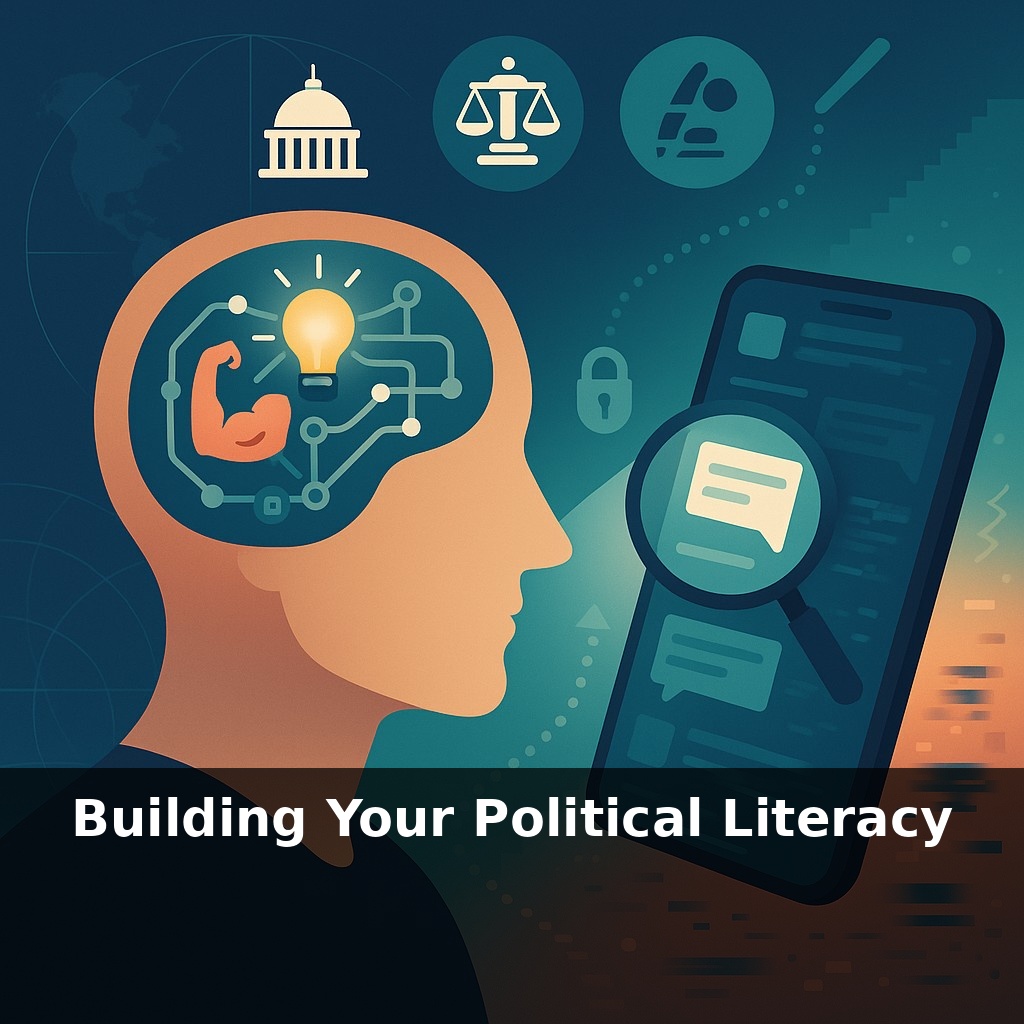
“Most people can name their favorite streaming show, but not all three branches of government—and those who can are far more likely to vote. You’re scrolling through headlines, heated posts, sharp slogans. Which of them deserves your trust, and which one is quietly rewriting how you think?”
In this episode, you’ll treat political literacy as a set of muscles you can deliberately train—not a talent you either “have” or “don’t.” Around the world, governments are quietly testing what works. In Finland, seven-year-olds practice verifying claims in news stories the way others practice multiplication tables. In Taiwan, a public fact-checking bot helped cut viral falsehoods on one major messaging app by roughly a quarter in just six months. And in global surveys, adults with stronger media-analysis skills show trust levels in public institutions that are more than 10–15 points higher than their peers. These aren’t just nice statistics; they’re clues. They show that your ability to question, cross-check, and contextualize information is measurable and trainable. Over this series, you’ll build a practical toolkit to do exactly that, starting with how you consume political content in your daily routine.
To start, zoom in on your actual information diet. The average adult now spends over 2 hours a day on social platforms and sees between 4,000 and 10,000 ad impressions, headlines, and micro-messages in that time. Yet very few of those moments get more than three seconds of attention, and even fewer get a deliberate check of source, date, or evidence. That gap—between exposure and inspection—is where persuasion quietly happens. In Finland’s classrooms and Taiwan’s civic labs, the training begins by slowing that gap down. You’ll do the same, beginning with one ordinary scroll through your feeds.
Scroll once through your main news or social app and count how many political items you see before you hit “something else”: a meme, a celebrity story, a personal update. For many people, that “politics count” is under 10 in a 5‑minute session—yet those few posts often carry the strongest emotional punch. That asymmetry is your first training ground: when the volume is low but the intensity is high, you need better filters, not more content.
Think of three layers every political item passes through before it lands in front of you:
1. **Platform layer.** Recommendation systems boost what generates clicks, comments, or watch time. On some platforms, as few as 4–6% of creators produce over 70% of political content in your feed. If you only react, and never deliberately search, your view of “what people think” comes from a narrow slice.
2. **Source layer.** In one U.S. study, 64% of adults said they had shared a headline without reading the full article at least once. When that happens, your real information source isn’t the outlet, it’s your friend’s caption or a stranger’s quote-tweet. Yet most people only check the logo, not who’s framing the story.
3. **Story layer.** Researchers analyzing thousands of posts across election cycles found that emotionally charged headlines (fear, outrage, moral condemnation) were up to 20 times more likely to be reshared than neutral ones, even when both were accurate. The result: your feed over-represents the most dramatic 5–10% of events.
Your task is not to eliminate these layers—they’re built into modern media—but to see them clearly enough that they don’t quietly set your political identity for you.
Here’s a simple structure you can apply in under 30 seconds per item:
- **Locate**: Where did this first appear? A local outlet, a national paper, a party account, a random screenshot on a meme page? - **Time‑stamp**: How old is it? A 3‑year‑old clip resurfacing during a fresh controversy can distort your sense of urgency. - **Evidence check**: Does the post link to data, documents, or named witnesses? Or does it rely on “everyone knows,” “people are saying,” or cropped images with no context? - **Counter‑scan**: Can you find at least one credible source that complicates, nuances, or directly challenges the claim?
These four moves turn a passive scroll into an active scan. Individually they’re small; together, used repeatedly across dozens of items a week, they begin to reshape how you form—and update—your political views.
A practical way to apply this is to run a “30‑second scan” on three real items from your last feed session. For the first, pick a short video clip. Pause and tap through to the full account page: how many followers does it have, how often does it post on politics, and are there links to a website or funding page? If you can’t answer those three questions in under 30 seconds, the clip is asking for more trust than it’s earned.
Next, grab a text post with a strong claim and at least 500 likes. Search one specific phrase from it in a separate tab. Do at least two independent outlets mention the same event, with similar basic facts? If not, mentally downgrade its confidence level.
Finally, choose a post that uses a chart or number. Screenshot it, then see if you can locate the original dataset or report. If you can’t find a source within 3–4 searches or clicks, treat that visual as opinion, not evidence.
In the next decade, political “reading” won’t be passive. By 2030, forecasts suggest over 60% of online content could be AI‑generated, forcing you to treat every viral claim as provisional until checked. Governments are testing live “integrity dashboards” during elections, flagging suspicious surges in paid messages in under 5 minutes. Workplaces and unions are piloting 2‑hour micro‑courses on platform algorithms so members can spot when targeted narratives try to fracture their coalitions.
Your challenge this week: pick 10 political posts you see and log them in a simple table: source name, topic, emotion they trigger (0–10), and whether you used the 4‑step scan. By the end, you’ll have a mini‑map of how just a few accounts and moods shape your views—often more than the other 200+ posts you scroll past each day.