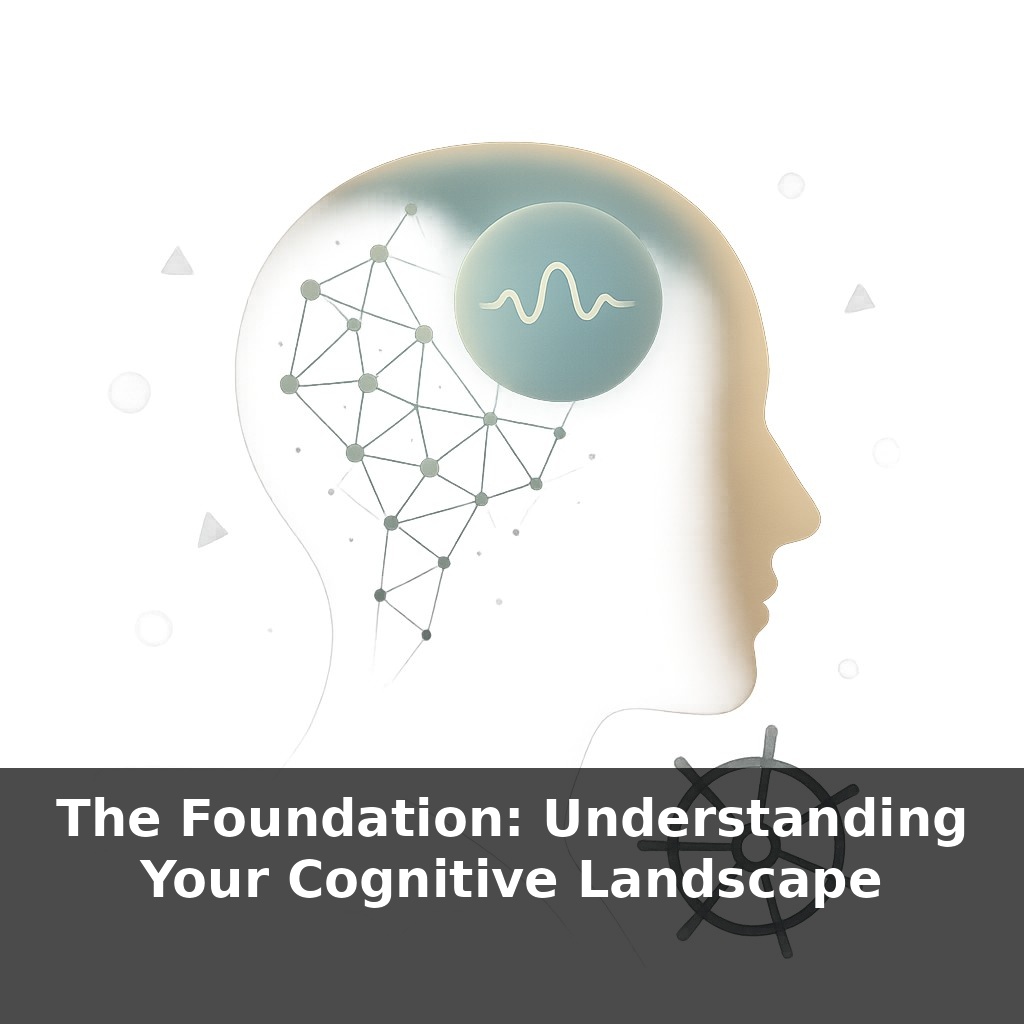
The Foundation: Understanding Your Cognitive Landscape
📝 Transcript
Right now, as you listen, your brain is quietly burning about a fifth of your body’s energy—without your permission and mostly without your awareness. You think you’re steering the wheel. But what if the real driver is a set of hidden mental habits you never chose?
You also carry a running narrator in your head—an almost constant stream of commentary about you, other people, and what things “mean.” Neuroscientists call the network behind much of this the Default Mode Network; philosophers might just call it the background hum of “I, me, mine.” It colors how you read a text from a friend, how you walk into a meeting, how you interpret a silence. And it rarely shuts up.
Yet this narrator isn’t neutral. It leans on shortcuts, cultural stories, and old experiences: “People like me aren’t good at this,” “That look means they’re annoyed,” “This always happens.” Those aren’t just thoughts; they’re habits of interpretation.
In this episode, we’ll start mapping that inner terrain—not to control every thought, but to recognize the patterns that quietly decide what feels possible to you.
Most of this inner activity runs on “auto-configured” settings you never consciously picked. Evolution left you with quick-and-dirty survival rules. Family, school, and culture layered on stories about success, failure, gender, status, and what counts as “normal.” Over time, your brain compresses all that into fast pattern-recognition: who feels safe, what seems realistic, which risks feel unthinkable. That compression is efficient—but it’s also blunt. It can make old contexts feel current, past threats feel present, and borrowed values feel like your own. Before you can change it, you need to see it.
Think of your “cognitive landscape” as built from several overlapping layers, each doing a different job in the background.
At the fastest level are heuristics—mental shortcuts that answer questions like “Is this safe?” or “Have I seen this before?” in fractions of a second. They’re why you can cross a busy street without solving physics equations. Useful, but crude. When life gets more complex than “avoid cars,” the same shortcuts can misfire: you might reject a new opportunity because it “feels wrong,” when all that’s really happening is unfamiliarity.
Then there are schemas: structured templates for “how things go.” You have schemas for a first date, a job interview, a family argument. They quietly load expectations: who speaks first, what counts as polite, how conflict ends. When a schema fits the moment, you feel fluent. When it clashes, you feel awkward, irritated, or confused—often without knowing why.
Biases are what show up when heuristics and schemas lean in particular directions. Confirmation bias nudges you to notice data that agrees with you. Status quo bias makes “how it’s always been” seem safer than it is. Availability bias makes vivid stories—one bad flight, one failed startup—outweigh dry statistics. None of this asks for your consent.
On top of that sits culture: the shared stories that tell you which questions are worth asking. Are you supposed to stand out or blend in? Is emotion a private event or a public signal? Research on holistic vs. analytic perception shows that people literally see scenes differently depending on these background stories: more context vs. more objects, more relationships vs. more traits.
Finally, there’s your personal history. Repeated experiences carve “default paths” for attention. A child praised only for achievement may grow into an adult whose thoughts orbit metrics and rankings. Someone who learned early that anger leads to punishment may become hyper-attuned to others’ moods, scanning for the slightest sign of disapproval.
All these layers interact. A cultural script about success shapes the schemas you build for “a good life.” Those schemas guide which heuristics fire in ambiguous situations. Biases then filter what you notice, reinforcing the original script. Over time, the loop hardens: it doesn’t just interpret your world; it edits what you can imagine.
Your challenge this week: once per day, deliberately disrupt one tiny element of that loop. Change a routine context (work in a different spot, take a new route, ask an unusual question in a familiar meeting) and then, for two minutes, note what your mind predicts, where your attention goes, and which quick judgments appear first. Don’t argue with them; just tag them: “prediction,” “schema,” “bias,” “cultural script.” You’re not trying to fix anything yet. You’re training a new capacity: to see the gears turning while they turn.
Think of a product team at a tech company debating a new feature. One designer keeps saying, “Users will hate extra steps.” That’s a heuristic, shaped by countless past projects. Another insists, “Our brand is about bold moves; we shouldn’t copy competitors.” That’s a schema for what “our kind of company” does. Meanwhile, the VP mostly notices data that supports last quarter’s strategy—classic bias at work. None of them woke up deciding to think this way; the patterns simply load when the meeting starts.
Or take a friend who grew up moving countries every few years. In conversations, they instantly scan for shared references—music, memes, slang—to find connection points. Someone raised in a tight-knit hometown may instead track subtle shifts in group mood. Same room, same conversation, different cognitive landscapes highlighting different “obvious” facts.
As you start noticing this in others—teams, families, online communities—it becomes easier to spot your own invisible defaults, not as flaws, but as particular configurations that can be re-tuned.
As tools get better at mapping thought patterns, the question shifts from “How do I think?” to “Who gets to tune my thinking?” Recommendation systems already nudge attention like invisible stagehands, deciding which mental “actors” get the spotlight. Future education, therapy, even workplace training may offer dashboards for your own patterns—useful, but also tempting for employers, platforms, or governments to steer. Learning this inner terrain now is practice for negotiating that future.
As you keep noticing these patterns, you’re not trying to become a perfectly rational robot. You’re learning to add “advanced settings” to a device that used to run on factory defaults. Over time, you can choose which alerts to mute, which channels to boost, and which old scripts to archive—so your inner landscape fits the life you actually want to live.
Start with this tiny habit: When you open your phone for the first time each morning, whisper to yourself one thought you’re noticing in your mind and label it out loud as “story,” “fear,” or “fact.” Then, before you tap any app, take one slow breath and ask, “Is this thought actually helping me today?” That’s it—no journaling, no long reflection—just a 5-second check-in that starts training you to see your cognitive landscape instead of being dragged around by it.
Unlock all episodes
Full access to 5 episodes and everything on OwlUp.
Subscribe — $1.99/monthLess than a coffee ☕ · Cancel anytime