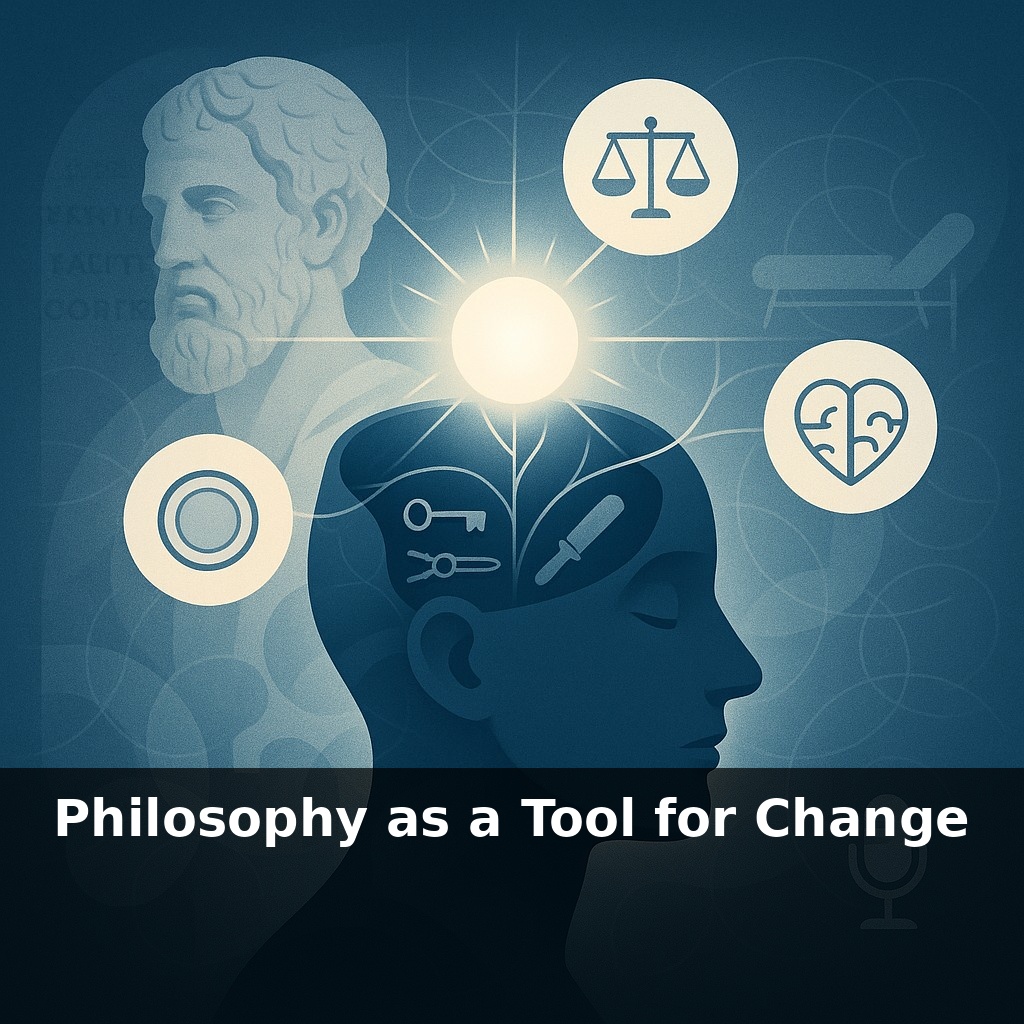
A therapist treats anxiety using ideas from a philosopher who died almost two thousand years ago. A charity moves hundreds of millions of dollars based on a theory written in dense Latin. Here’s the twist: the same tools shaping those decisions are already in your everyday thoughts.
That’s the quiet power of philosophical tools: they’re already steering choices about money, justice, and even mental health, usually without us noticing. When you tell yourself “I should just push through this” or “People never change,” you’re not just having a mood—you’re applying a crude, half-hidden worldview. And like using a blunt knife in the kitchen, you can kind of get the job done, but you’ll waste effort and occasionally cut yourself. In this series, we’ll surface those background assumptions and ask: who put them there, and are they actually helping you? We’ll look at how movements from civil rights campaigns to effective altruism were built on explicit arguments about what matters—and how you can borrow those same patterns to revise your habits, relationships, and long-term plans, starting from the inside out.
Think of this as moving from using whatever apps came pre-installed on your mind to actually choosing what runs the system. In therapy, disputing a thought like “I always fail” isn’t just self-help—it’s a refined descendant of Epictetus. In politics, calling a policy “unfair” quietly leans on centuries of debate about justice. Even scrolling past a crisis headline because it feels “too far away” reflects a hidden ranking of whose suffering counts. In this episode, we’ll slow those micro-moments down, trace the arguments beneath them, and test how small conceptual tweaks can redirect both feelings and behavior.
When people say philosophy is “just talk,” they’re often noticing something real: talk without any pressure from reality does drift into empty cleverness. But the tradition we’re drawing on has always been tested where the stakes are high: prisons, hospitals, exile, political collapse. The question isn’t “Is this interesting?” but “Does this actually change what happens next?”
Take two areas where that’s been measured, not just admired.
First, personal change. When Aaron Beck and Albert Ellis were building what later became CBT, they weren’t trying to revive ancient texts; they were trying to stop people from collapsing under despair. They borrowed a simple but ruthless move: treat your own thoughts as claims that must survive cross-examination. A belief like “No one respects me” isn’t a mood to marinate in; it’s a hypothesis. What’s the evidence? What would count against it? Could there be an alternative explanation? That pattern—turning inner monologue into something you can interrogate—comes straight from the Stoic habit of asking, “Is this in my control? Is this really bad, or just unpleasant?” Once formalized and tested, it produced therapies that outperform placebo and many older treatments across hundreds of trials.
Second, large-scale change. When Enlightenment writers pushed “Dare to know,” they weren’t merely praising curiosity. They were attacking inherited authority: if you can demand reasons from priests and kings, you can also withdraw obedience. That slogan fed reforms in science, law, and education because it licensed ordinary people to say, “Show your work.” Something similar happened when Gandhi fused non-violence with a disciplined account of truth and dignity. Marches and boycotts were visible; underneath them sat a worked-out view of what counts as legitimate power and what kinds of suffering are acceptable in resisting it.
Even in today’s data-saturated world, the same pattern holds. GiveWell doesn’t just “feel” that some charities are better; it treats every dollar as a question: “Where does this do the most good, by the best lights we currently have?” That frame channels hundreds of millions of dollars differently than they’d flow under habit, guilt, or glossy marketing.
Notice the common thread: in each case, a vague discomfort (“Something’s off—inside me, in this institution, in this policy”) is upgraded into a precise, arguable claim. Once you can state that claim clearly, new options appear: experiments to run, habits to tweak, institutions to redesign. Without that sharpening step, you’re mostly left with venting and vibes.
The 2021 finding that guided reflection reduces dogmatism gives you a clue about what’s happening under the hood. When you practice asking, “What exactly do I believe here? Why this, rather than the alternatives?” you loosen the grip of slogans, tribal loyalties, and half-remembered quotes. That doesn’t guarantee you’ll become wiser, or kinder. It does make it harder to stay rigid for purely inertial reasons.
So the project here is modest but radical: not to turn you into an academic, but to help you catch those moments where a tiny shift in how you frame a question could, over time, cascade into different choices about how you think, vote, work, and respond to other people’s pain.
Your challenge this week: pick one recurring thought that annoys you or drags you down—something like “I’m terrible at conflict” or “People are basically selfish.” Don’t try to fix it. Instead, each time it appears, do three things:
1. **Label it as a claim.** Silently add: “That’s a sentence, not a fact.” 2. **Ask for its source.** Where did you learn this—an experience, a person, a story, a group you wanted to belong to? 3. **Generate exactly one rival claim.** Not a cheerful opposite, just a plausible alternative interpretation.
At the end of the week, look back and see whether the original thought still feels as inevitable as it did before—or whether it’s begun to look more like one option among several, something you can choose to endorse or quietly retire.
A software engineer, stuck in a loop of “management never listens,” tries a week of treating that line as a testable sentence. She notes when it appears: after rushed meetings, ignored emails, public praise for others. Then she drafts a rival: “Management listens selectively under time pressure.” That small tweak shifts her from simmering to experimenting: sending shorter proposals, asking one precise question per meeting, tracking which get answers. The complaint turns into a probe of the system.
A community organizer, convinced “our town doesn’t care about climate,” traces the claim back to low event turnout and cynical comments. His rival: “People care, but the cost feels too high and the benefits too distant.” Instead of more moralizing posts, he pilots a no-cost action: a tool library that lowers barriers to small repairs. Attendance data over months gives him something sharper than frustration.
Both are doing more than “being positive.” They’re quietly upgrading hunches into hypotheses about how minds and groups actually behave.
Soon, the same habits you used on one stubborn thought will be tested on bigger fronts: AI making decisions about loans or bail, cities choosing between short-term growth and long-term habitability, schools debating what children should learn about power and history. Your private “Why this and not that?” becomes a civic skill, like basic coding or reading charts. The more people can do it, the less our future is steered only by slogans, hunches, or whoever shouts loudest.
Over time, this kind of questioning can leak into places you don’t expect: how you scroll news, react to a friend’s silence, or choose a project at work. Instead of auto-pilot, you get a slight pause—like noticing a road sign before a turn. That pause is tiny, but it’s where new paths enter: different words, bolder requests, quieter exits.
Start with this tiny habit: When you unlock your phone for the first time each morning, whisper one “why” question about something you normally take for granted (like work, money, or success), and pause for just one slow breath before you do anything else. Later in the day, when you stand up from your chair, quietly ask yourself, “What would I do differently here if I really lived by my values for the next 5 minutes?” At night, when you turn off the light, recall one moment where you questioned a default assumption (even slightly) and just say to yourself, “That’s me practicing philosophy as a tool for change.”