Right now, somewhere in an R&D lab, two teams face the same hard problem. One was trained on just a few familiar methods. The other learned a dozen different ways to think. The surprising part? The second team finishes noticeably faster—and makes fewer bad calls.
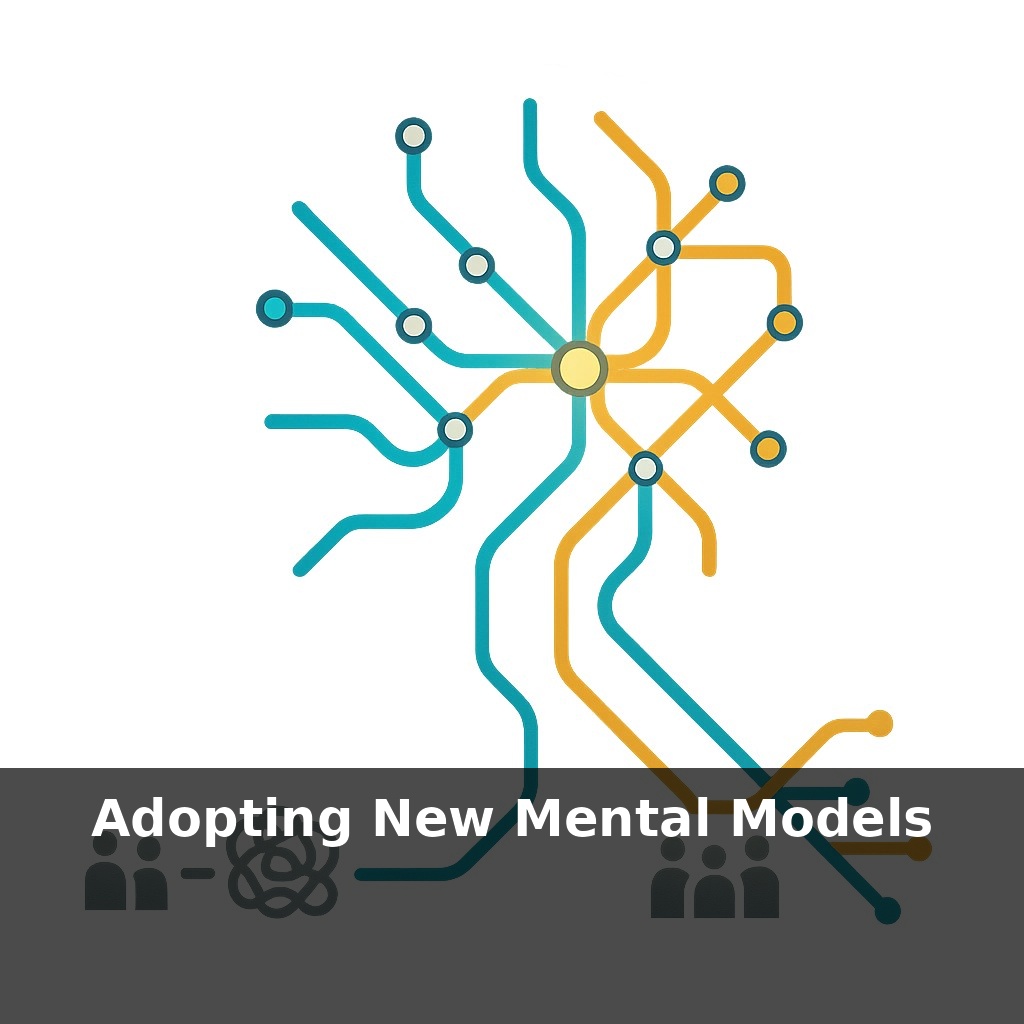
That speed gap between teams isn’t magic or talent—it’s infrastructure. Not in their building, but in their heads. One group walks into the problem with a single default route; the other arrives with a mental transit map: alternative lines, detours, and express tracks they can switch between when one path jams.
This is what adopting new mental models actually does: it quietly rewires the options available in the moment, especially when stakes or uncertainty are high. A founder staring at conflicting metrics, a teacher handling a disruptive class, a doctor facing ambiguous symptoms—all of them are, in practice, choosing which internal “route” to trust next.
In this episode, we’ll explore how to deliberately install new models, how to avoid collecting them as trivia, and how to make them show up when you need them most.
Most of us don’t notice which “route” our mind is on until something breaks—an argument that always escalates the same way, a project that stalls at the same stage, a decision loop you keep replaying. What’s really happening is that one familiar pattern keeps winning the internal popularity contest. Not because it’s best, but because it’s loudest and most practiced.
So the task isn’t to chase endlessly clever ideas. It’s to change what your brain treats as “normal.” That means choosing a few powerful models, wiring them into daily situations, and letting experience sand them into intuitive tools you can trust under pressure.
MIT’s 22% speed boost wasn’t just from handing teams a slide deck of models; it came from how those models were *used*. The researchers didn’t say, “Here are 12 cool ideas, good luck.” They built rituals around them: structured debriefs (“Which model did we use today?”), pre‑mortems framed by models, and rotating “model stewards” whose job was to ask, “What lens are we missing?”
That detail matters, because adopting new models is less like downloading an app and more like changing office workflows. The value appears when the whole system starts routing through them by default.
Three levers make that shift more likely:
1. **Compression.** A model sticks faster when you can state it in a short, sharp sentence. OODA loop becomes “don’t just decide—keep updating.” In practice, compression lets you *carry* more in your head than working memory alone would allow. A trader glancing at volatile markets doesn’t juggle twenty variables; they lean on “optionality” or “second‑order effects” as compact handles for complex patterns.
2. **Contrast.** New models take root when they clearly *disagree* with something you already do. Confirmation is weak glue; contradiction is strong glue. Tech firms often teach “inversion” (“plan how this fails”) precisely because it grates against the usual “plan how this wins.” That friction creates recall: the next time a project review feels too rosy, “What would kill this?” surfaces uninvited.
3. **Context tagging.** The brain stores “when to use” along with “what it is.” Investors at top funds don’t just learn discounted cash flow; they learn triggers: “If narrative and numbers conflict, run this.” Teachers do it too: “If energy drops after lunch, switch to active recall.” Over time, a phrase, mood, or metric becomes a cue that summons a specific model.
Neuroscience backs this up: model‑switching practice doesn’t just build a bigger library; it forges faster links between “context pattern” and “tool to try.” That’s why military strategists rehearse under stress—so the right loop turns on *before* panic does.
The risk is thinking “more is better” and flooding yourself with loosely held concepts. The useful path is narrower: sharpen a small set until they become reflexes in specific, well‑marked situations—and only then expand the library.
A software team hits recurring delays. Instead of another generic “work harder” push, they adopt just three models: “single bottleneck first,” “shorten feedback loops,” and “default to small bets.” In planning, someone asks, “Where’s the bottleneck?” In stand‑ups, they check, “Did we shrink any feedback cycle today?” During roadmap debates, they ask, “What’s the smallest real bet here?” Over a month, calendars, code reviews, and even Slack threads quietly reshape around those prompts.
An athlete trains similarly. They don’t memorize every coaching cliché; they pick a few lenses: “economy of motion,” “position over submission,” “win the setup.” Before each drill, they choose one lens to foreground. After, they quickly note, “Where did this lens change what I did?” Soon their body “remembers” to stabilize before exploding, or to improve position before chasing a highlight play.
In both cases, new models don’t float above life. They fuse with routines, language, and micro‑choices until they feel less like concepts and more like instinct.
Models don’t just sharpen choices; they can quietly shift identity. As you practice calling up different lenses, your “default self” becomes less fixed: the cautious colleague finds a bolder gear, the big‑vision planner can suddenly zoom into details. Over time, this fluidity spreads socially. Teams start to expect that any thorny issue will be met with multiple perspectives, the way a good newsroom routinely pulls in different editors before a headline goes live.
As you expand your library, notice which models quietly change how you see yourself. Maybe you stop being “the overthinker” and become “the one who tests assumptions,” or trade “I’m bad at conflict” for “I run structured disagreements.” Like updating a phone’s OS, the interface looks similar—but new menus appear every time you open your day.
To go deeper, here are 3 next steps: Explore Shane Parrish’s *The Great Mental Models* (Volumes 1 & 2) and pick one model mentioned in the episode—like Inversion or Second-Order Thinking—then run a current work or life decision through that lens using the free Farnam Street decision journal template. Open up Mental Models apps or libraries (like Brainiac or Notion templates shared by the Mental Models community) and build a simple “Mental Model Stack” for one recurring problem discussed in the show (e.g., career moves, investing, or relationships), tagging each model you’ll use together. Watch one of the specific talks referenced in the episode—such as Charlie Munger’s “The Psychology of Human Misjudgment” on YouTube—and pause every 5–10 minutes to add his mental models into your stack, noting exactly where you’ll try them this week (e.g., your next 1:1, product decision, or budget review).