Why Ethics Matters: When Intuition Isn't Enough
📝 Transcript
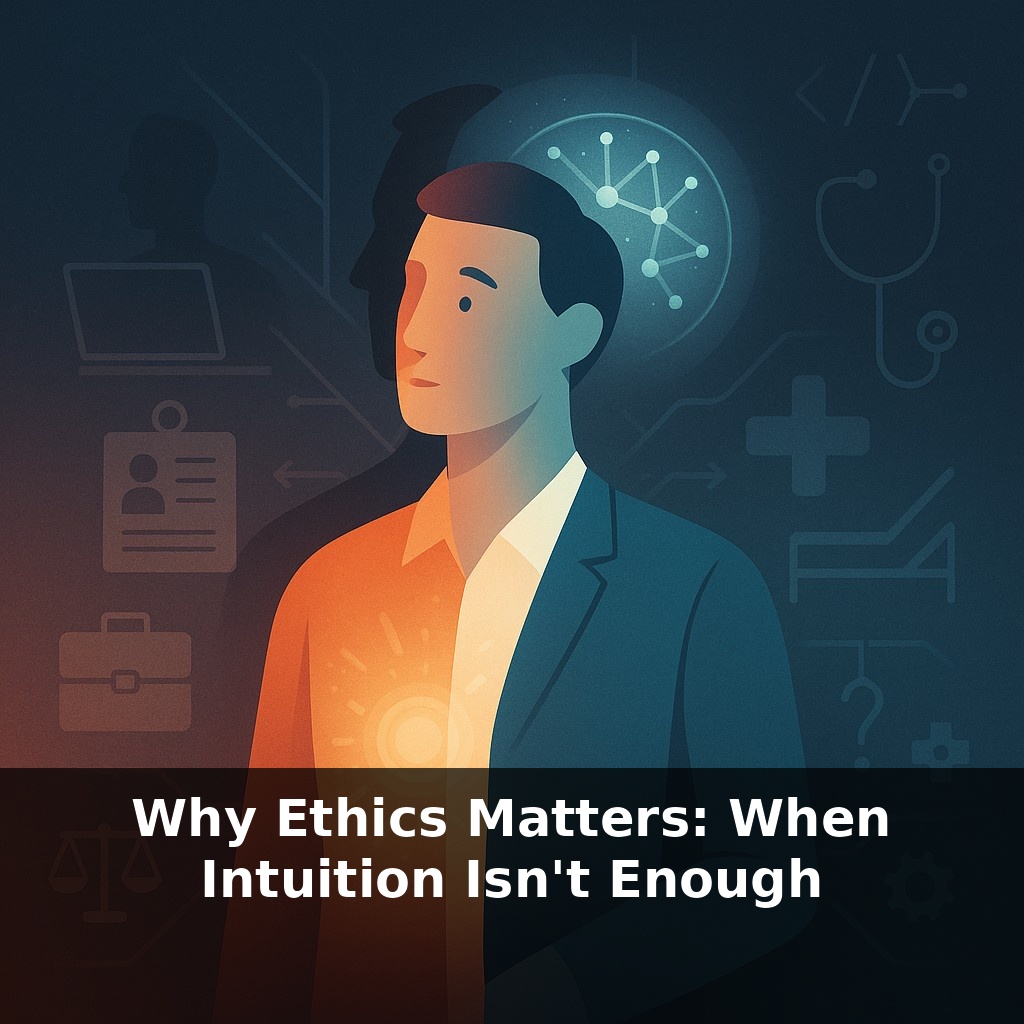
About seven out of ten people, including ethics professors, carry hidden biases they don’t believe they have. Now listen in on three quick scenes: a hiring manager under pressure, a doctor in a crowded ward, an engineer tweaking an algorithm. In each case, their gut says “yes”—but should we trust it?
Think about how often we face moral choices while doing something else entirely: replying to email, closing a ticket, approving a budget, shipping code. Ethics doesn’t arrive with a dramatic soundtrack; it hides inside routine clicks and casual “sure, that’s fine” replies. That’s where the trouble begins. Research in cognitive science shows that when we’re rushed, tired, or juggling tasks, our minds lean harder on fast, automatic judgments. Those snap calls feel smooth and efficient—like choosing the default option in an app—yet they can quietly steer us toward unfair or shortsighted outcomes. The stakes aren’t only personal. In organizations, thousands of unexamined “small” decisions can aggregate into systemic patterns: who gets promoted, whose complaints are believed, which risks are ignored. In this episode, we’ll ask: when is our first moral impulse trustworthy—and when do we owe the situation something more deliberate?
Here’s the twist: our quick reactions aren’t just personal quirks; they’re shaped by training, incentives, and the tools around us. A rushed manager isn’t only following a hunch—they’re following a calendar invite, a KPI, a company norm. That means the “feel” of a decision can be engineered, nudged, or distorted. In tech teams, for instance, shipping fast can start to feel morally right simply because delay is punished. Law, policy, and culture work the same way, quietly steering what seems “obvious.” To see when intuition isn’t enough, we need to notice the forces that are quietly coaching it.
Consider three tools people reach for when they try to move beyond “it just feels right”: rules, consequences, and character.
Rules first. Deontological approaches ask, “What are we obligated to do here, regardless of how we feel?” Professional codes in medicine, law, or engineering don’t wait for a practitioner’s mood; they spell out duties like informed consent, confidentiality, or safety margins. That can be uncomfortable. A doctor might feel compassion urging them to bend the truth to calm a patient, yet a duty to honesty pushes against that urge. The value isn’t that rules are perfect, but that they force us to articulate boundaries before we’re in the heat of the moment.
Consequences come next. Utilitarian-style thinking asks, “Who will be affected, and how much, in the short and long run?” Instead of stopping at “this option feels efficient,” it presses: efficient for whom? A social media team deciding whether to tweak a recommendation system can map likely outcomes for teenagers, advertisers, moderators, and even future regulators. That mapping often reveals “costs” our first reaction barely registers—like long-term trust, mental health, or environmental impact.
Then there’s character. Virtue ethics shifts the question to, “What kind of person or organization are we becoming if we keep choosing this way?” A manager choosing between spotlighting one star performer or crediting a whole team isn’t just picking a tactic; they’re shaping a culture that either prizes cooperation or relentless competition.
Contemporary tools braid these strands together. Stakeholder analysis, for instance, walks through: Who is touched by this decision? What do we owe each group as a matter of respect or fairness? What patterns of behavior will this normalize? Used well, it can surface quiet voices: contractors, future users, local communities, or even people who can’t easily leave feedback—like children or patients in constrained settings.
One helpful way to see these frameworks is to treat them like a debugging suite for values: each one catches a different class of error. Rules flag where we’re about to cross a line we promised not to cross. Consequences highlight harms we’ve underweighted. Character-focused questions expose slow drifts in who we are. None replaces moral sensitivity, but together they create a habit of stepping back, asking structured questions, and making our reasons shareable—and therefore challengeable—by others.
A product team rolls out a new feature that quietly boosts engagement. Internally, it’s a win: charts go up, bonuses look closer. Months later, support tickets spike from people saying they can’t stop scrolling late at night. No single decision felt dramatic, but a pattern emerges: short-term metrics kept trumping long-term wellbeing. Now the team has to ask: if they keep choosing like this, what sort of company are they becoming?
Or take a hospital deciding visiting policies during an outbreak. One option maximizes infection control; another prioritizes family presence for dying patients. Different ethical lenses spotlight different stakes: duties to protect staff, outcomes for patients and families, the kind of care culture the hospital stands for. None gives an automatic answer, but together they force leaders to name whose interests are on the table—and whose are missing. That naming is where real disagreement, creativity, and sometimes better options begin.
Soon, many “right or wrong” calls will be made long before any person feels a twinge of concern—inside code, protocols, and default settings. Think of school districts quietly adopting AI tutors, or cities syncing traffic lights to predictive systems. Each choice bakes in priorities: whose time matters, whose data is worth collecting, whose risk is acceptable. The open question is whether we treat that shaping as a public craft, or let it evolve like unregulated high‑speed trading.
So the live question isn’t “rules or feelings?” but “what habits keep our snap choices from quietly drifting off-course?” Think of it like tuning a guitar: play by ear if you like, but check against a tuner often enough that every string—personal values, laws, long‑term impacts, quieter voices—stays in harmony as the song of daily life gets faster.
Try this experiment: For the next 48 hours, pick one recurring decision at work (like handling customer complaints, allocating overtime, or prioritizing features) and run it through two “filters” before you act: first, your gut reaction, and second, a simple ethics check with three questions—“Who could be impacted?”, “What harm could this cause if everyone did it this way?”, and “Would I be comfortable explaining this choice to the person most affected?”. Commit to follow the ethics-based answer at least once when it conflicts with your intuition, and note what actually happens—does trust, clarity, or fallout change compared to your usual approach? At the end of the 48 hours, compare: in which situations did intuition serve you well, and in which did the explicit ethical questions clearly improve your decision?
From this course
Right and Wrong: A Practical Guide to Ethics
7 episodesUnlock all episodes
Full access to 7 episodes and everything on OwlUp.
Subscribe — $1.99/monthLess than a coffee ☕ · Cancel anytime