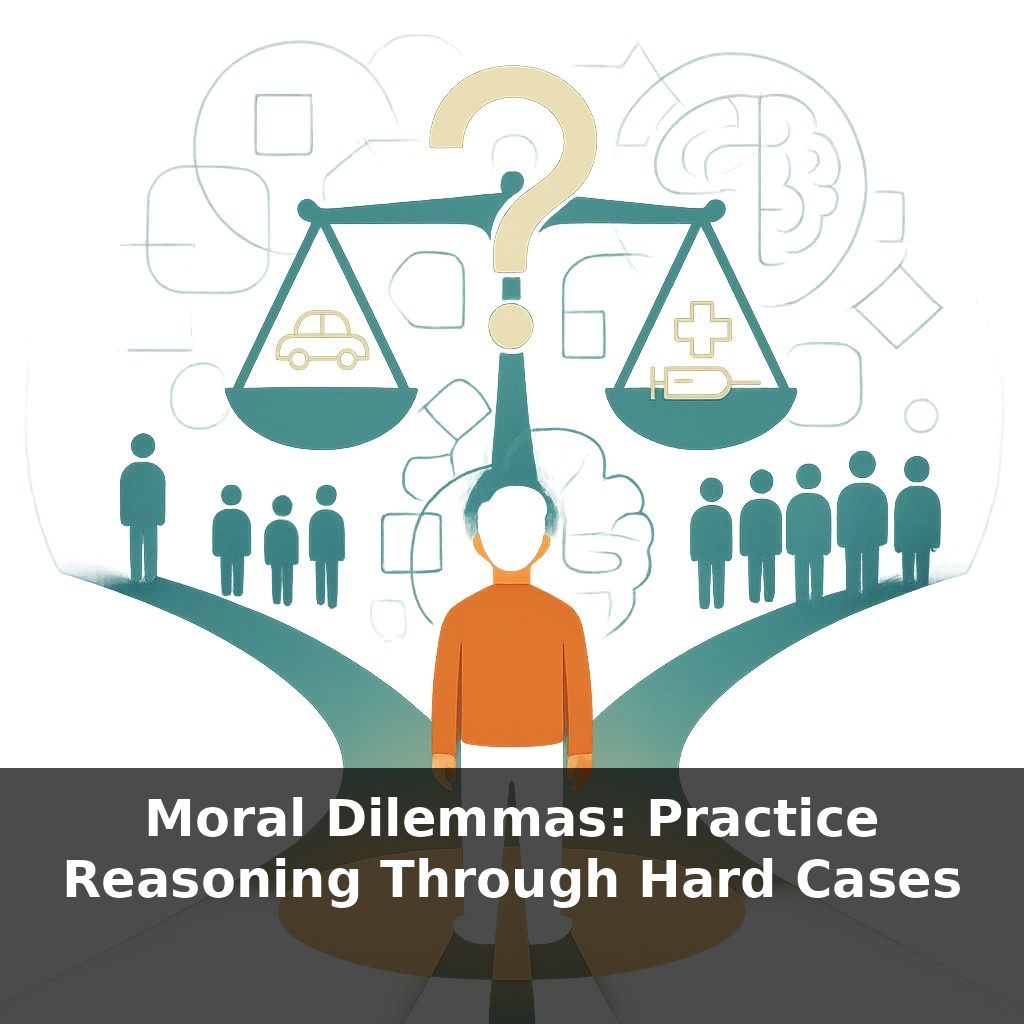
About eight out of ten big companies now put employees through ethics scenarios—yet most people still freeze when a real moral crisis hits. A self-driving car swerves toward one person or five. A hospital has one ventilator and two patients. Which way do you turn?
Ten to fifteen percent: that’s the average jump in moral reasoning scores after just a handful of deliberate dilemma sessions. Not after a life-changing event, not after a philosophy degree—after sitting down, on purpose, with messy cases and working them through. Meanwhile, real institutions are already doing this at scale: during the pandemic, many U.S. states quietly adopted triage rules that rank patients by survival odds; MIT’s Moral Machine data shows entire cultures leaning one way or another when trade‑offs get sharp.
So here’s the unsettling twist: you already *have* patterns of response to hard choices—you just rarely see them until they’re running the show. Practicing with dilemmas is how you drag those patterns into the light, tune them, and decide which ones deserve to stay.
Think of today’s topic as upgrading the “operating system” behind your snap judgments. Beneath every tough call, there’s usually a quiet clash of values: loyalty versus fairness, short‑term harm versus long‑term good, rules versus relationships. Different ethical frameworks highlight different “settings” in that clash. Consequentialism asks, “What brings the best overall outcome?” Deontology presses, “What must never be done?” Virtue and care ethics ask, “What kind of person—or community—are you shaping with this choice?” Our goal isn’t to pick a winner, but to learn how each lens changes what you see.
When people first practice with dilemmas, they usually discover two surprises. First, their “gut answer” can flip the moment the case is reframed. Second, even when they *don’t* flip, they often can’t clearly say *why* they’re so sure. That gap—between confidence and clarity—is exactly where serious ethical growth happens.
Consider three moves you can make whenever you face a hard case:
**1. Surface the hidden value conflict.** Don’t ask “What’s the right answer?” Ask “Right *by which value*?” Is the real tension fairness vs. loyalty? Safety vs. autonomy? Honesty vs. kindness? The more precisely you name the clash, the less mysterious your discomfort feels—and the easier it is to see alternatives beyond the obvious two options.
**2. Run the case through multiple lenses.** You already know how one lens shifts attention. Add two more: - A deontological pass: “Are there lines here that must not be crossed, no matter the payoff?” - A virtue/care pass: “What kind of character or relationship does each option cultivate?” You’re not hunting for a magic algorithm; you’re mapping where each lens pulls *against* the others. Those tensions are diagnostic: they reveal where your own priorities really lie.
**3. Stress‑test your instinct.** Take your initial choice and tweak the details. Would you still choose it if the people involved were strangers instead of friends—or vice versa? If the stakes were slightly lower? If you had to defend the decision publicly, or to someone you respect but who disagrees with you? Watching where your conviction weakens tells you whether you’re tracking a principle or just a preference.
A useful exercise is to keep the structure of a dilemma but swap the setting: move it from medicine to finance, from family life to workplace policy. If your judgment whipsaws just because the scenery changed, something other than your stated values is probably doing the driving.
Working this way is less about landing on “the philosopher’s approved answer” and more about building a repeatable process: name the values at war, rotate the lenses, then deliberately test whether your chosen path holds steady when the surface details shift. Over time, you’re training yourself not only to decide, but to *own* the reasons behind your decisions—especially when none of the options feel clean.
A concrete way to practice is to treat everyday tensions as “mini‑cases” rather than background noise. Say you lead a project and discover a teammate made an error that will mildly hurt results if reported, but quietly fixing it means bending a transparency rule. Value clash: honesty vs. loyalty. A deontological pass might highlight your duty to accurate reporting; a virtue/care pass might focus on modeling courage while protecting your colleague from humiliation by how you communicate the mistake, not whether you admit it.
Shift domains: you’re in personal finance, choosing between investing in a profitable fund with poor environmental records or a modestly returning sustainable option. Here, the pull is between financial security and ecological responsibility. Stress‑testing might involve asking whether you’d feel comfortable explaining your choice to a future child—or if the numbers changed only slightly, would your principle evaporate? These quieter dilemmas become low‑stakes rehearsals for harder calls later.
Ethics drills may end up mattering as much as math drills. As tools like AI quietly make choices about hiring, credit, or policing, someone has to decide whose risk, whose privacy, whose future gets prioritized. Regularly training citizens on structured cases could become a civic norm, the way fire drills are for schools. Not to produce saints, but to create a public that can argue about trade‑offs without pretending there weren’t any in the first place.
Dilemmas won’t hand you tidy answers, but they will sharpen your questions. Treat them like debugging your inner code: each “why this, not that?” exposes another hidden line. Over time, you’re not chasing perfect purity; you’re learning to live with trade‑offs more honestly—like tuning an instrument that never quite reaches, but keeps approaching, resonance.
Before next week, ask yourself:
1) “The next time I face a real-life moral dilemma—like noticing a coworker cutting corners or seeing a friend lie to someone—how will I pause and map out the competing values (e.g., honesty vs. loyalty vs. harm-avoidance) instead of just going with my gut?” 2) “Thinking about one concrete scenario from the episode (like whether to tell a difficult truth that could really hurt someone), what would I actually do if it happened tomorrow, and what trade-offs am I honestly willing to accept?” 3) “Who is one trusted person I can practice ‘moral rehearsal’ with this week—actually talking through a tough hypothetical from the episode—and how might their pushback help me stress-test my reasoning before I’m in a real high-stakes situation?”