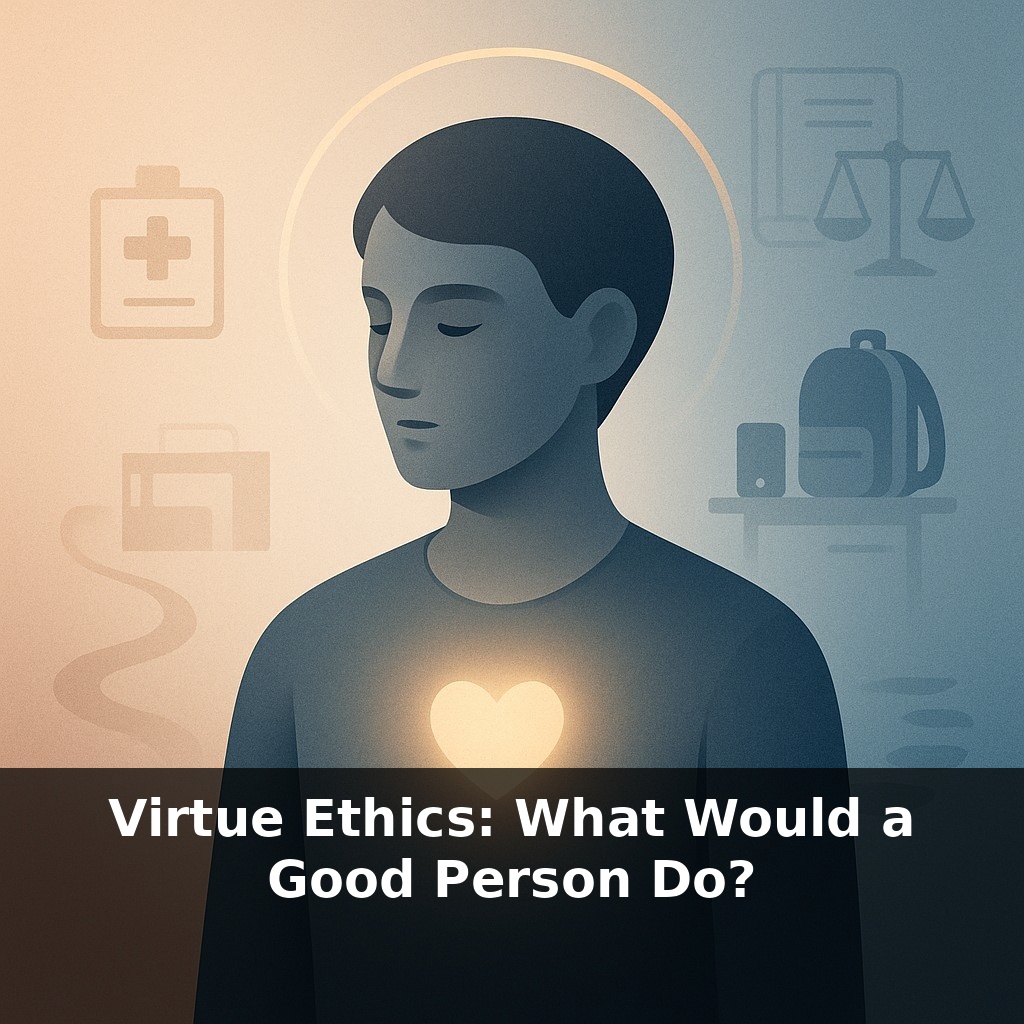
A strange fact: ethics professors cheat on conference forms about as often as everyone else. Now swap scenes. A nurse choosing whether to report a colleague. A manager tempted to hide a mistake. A teenager deciding whether to lie. What makes a *good* person in those moments?
Aristotle thought the answer wasn’t hidden in a rulebook or a calculator of pleasures and pains, but in the kind of person you steadily become. Not in the one dramatic choice, but in the thousand quiet ones: how you talk about a rival when they’re not in the room, how you handle being cut off in traffic, whether you credit a colleague when it would be easy to take the praise. Virtue ethics shifts the spotlight from “Is this act right?” to “Who am I turning myself into by doing this?”
This is a demanding lens, because it won’t let us hide behind “technically allowed” or “no one got hurt.” It presses a sharper question: If someone watched a week of your unedited life, what traits would they say you’re practicing? And would you be proud to see those same traits take root in your closest friend—or your kid?
Virtue ethics adds a twist: it cares not just *what* you do, but *how* your motives, emotions, and habits line up. Two people might return a lost wallet; one is terrified of being caught stealing, the other feels a calm sense that “this is simply what an honest person does.” Outwardly identical, inwardly very different. The first is white‑knuckling against temptation; the second has trained their character so the honest choice feels almost natural. That inner alignment—between feeling, thinking, and acting—is where virtue ethicists think real moral maturity shows up.
Aristotle’s key move was to ask: what qualities does a fully developed human life need in order to go well? That’s where his list of virtues comes in—not as a moral personality quiz, but as a map of strengths we refine over time.
Each virtue, for him, is a kind of calibrated excellence between two tempting mistakes. Take courage. At one extreme is rashness: charging into every risk, ignoring fear, confusing recklessness with bravery. At the other is cowardice: avoiding all danger, even when something important is at stake. Courage lives in the difficult middle: you still feel fear, but you face the right dangers, for the right reasons, in the right way.
It works similarly with generosity. Give everything away impulsively and you can’t meet your own responsibilities; cling to every resource and you become stingy. The generous person learns *how much* to give, *to whom*, and *when*. That “how much / to whom / when” rhythm runs through Aristotle’s whole account. Virtues are less about always doing more of something and more about getting the *fit* right.
Notice how different this is from a simple rule like “never lie” or a calculation like “maximize total happiness.” A strict rule can’t handle all edge cases; a calculator can miss what kind of person you’re becoming by making certain choices. Virtue ethics says you need a cultivated sensitivity—*phronesis*, practical wisdom—to read the room, the stakes, and your own blind spots, then steer toward the best you can see from where you stand.
Modern research adds an intriguing twist. Character traits aren’t perfect predictors of what we’ll do, but they matter a lot. Across many situations, people who score higher on traits like honesty or compassion are significantly more likely to act that way when it’s costly or no one is watching. That means the “kind of person you are” doesn’t guarantee your choices, but it does tilt the field.
And that tilt is exactly what virtue ethics cares about. It’s less obsessed with catching every single right move and more with shaping a person for whom acting well becomes steadily less forced, less rare, and less dependent on having the perfect circumstances.
A useful test case isn’t a life‑or‑death drama, but an ordinary workday. Think of a programmer under deadline who spots a bug right before release. No policy covers *this exact* situation, and fixing it means missing the launch. A purely rule‑following mindset might look for a loophole; a purely outcome‑focused one might ship and hope. Someone shaped by honesty and responsibility feels an inner tug toward slowing down the release, even if no one else would notice the shortcut.
Or take a friend group planning a vacation. One person quietly tracks who can actually afford the fancy rental and suggests a cheaper option before anyone has to confess money worries. No one praises them as “virtuous”; they just experience the trip as relaxed and inclusive. Virtue shows up there too—in the background, as the invisible design of a better shared life.
In that sense, working on your character is like refactoring legacy code: you’re not just patching bugs, you’re reshaping the system so cleaner decisions become the default.
Some ethicists think the next frontier isn’t new rules, but new *roles*. What if we treated leaders as custodians of shared character, not just KPI‑chasers? Or designed social media so “trending” favored posts that model patience and generosity, not outrage? In finance, a firm could score investments not only on risk and return, but on whether they reinforce traits a community wants its children to see as normal. Your feed, your boss, your city budget—all quietly training who we become.
So the live question becomes less “Am I good enough yet?” and more “What am I rehearsing today?” Every email you soften, every confession of a mistake, every time you really listen is like making a small deposit in an ethical savings account—quiet, boring, and powerful when a real crisis withdraws everything you’ve built. Your life is already your ethics lab.
To go deeper, here are 3 next steps: 1) Grab a copy of Aristotle’s *Nicomachean Ethics* (Irwin or Crisp translation) and read Book II with this episode in mind, then use the free “Virtue Ethics” entry on Stanford Encyclopedia of Philosophy to compare how each explains courage, temperance, and practical wisdom. 2) Pick one real moral exemplar you admire (e.g., a specific nurse, teacher, or community organizer) and listen to an interview or talk by them on YouTube or a podcast, pausing to note where they display the specific virtues discussed in the episode (like honesty, justice, or generosity). 3) Install a habit-tracking app like Streaks or HabitBull and create a “virtue streak” for one concrete practice tied to virtue ethics from the episode—for example, a daily “truth-telling check” in hard conversations or a deliberate act of generosity—and track it for the next 7 days.