From Kings to Republic: The Birth of Roman Political Systems
📝 Transcript
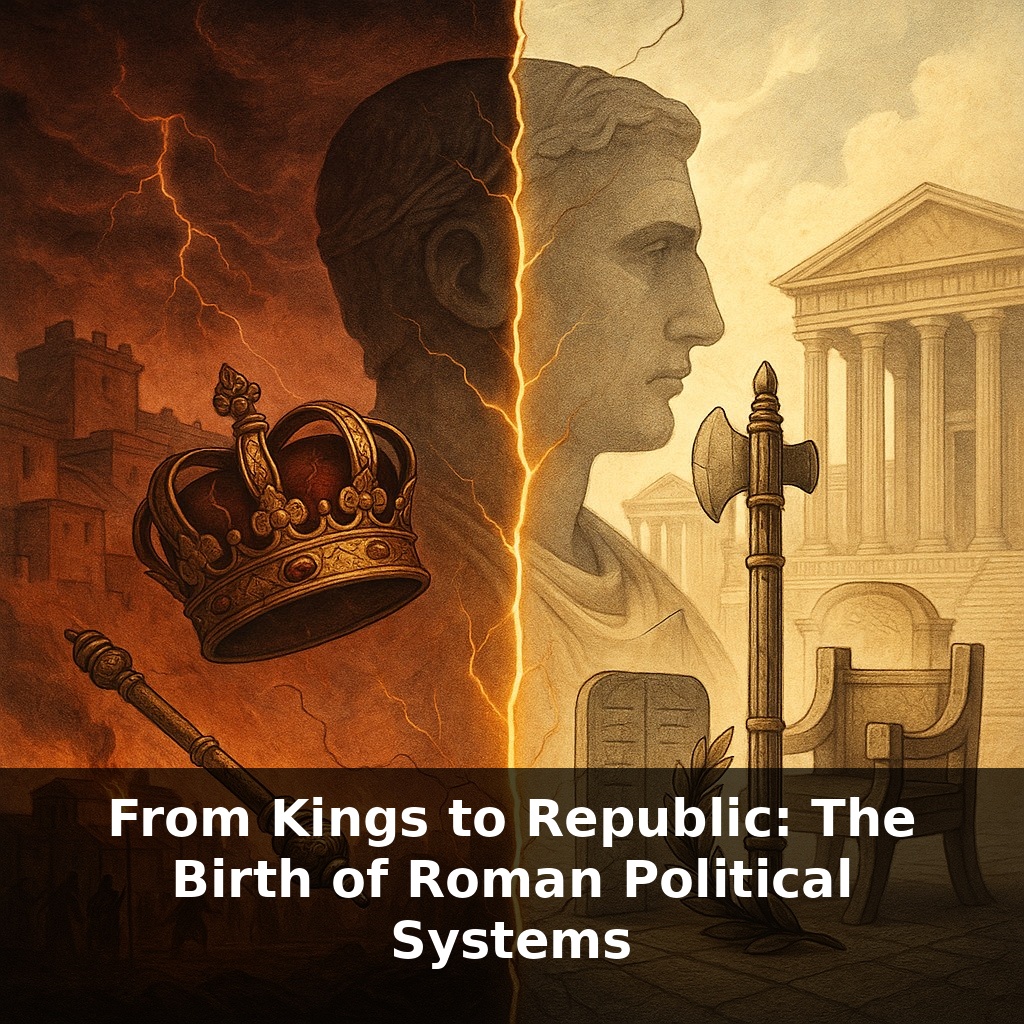
A city that once swore it would never have a king again later worshipped emperors as gods. In this episode, we drop into the chaos of Rome’s final royal scandal and trace how rage, fear, and ambition hardened into the political blueprint of the Roman Republic.
The twist is that Rome didn’t simply “get rid of kings” and call it a day—it had to invent something to fill the vacuum. Overnight, Romans faced a question with no easy precedent: how do you govern a city too large for town-hall consensus, but too proud to kneel to one man again? Their answer unfolded piece by piece, more like updating software in live production than unveiling a finished product.
Old royal tools were stripped for parts, rewired, and redistributed: command of armies, control of courts, stewardship of religion, guardianship of tradition. New roles emerged, each carving off a slice of the king’s former power. Some posts protected wealth and lineage, others defended the ordinary citizen from being steamrolled. Across decades, these offices jostled, overlapped, and occasionally collided, slowly teaching Romans—and later the world—what a “republic” could practically look like.
Some of the most important early choices weren’t written as grand theories; they were crisis patches. Romans worried less about abstract “liberty” and more about stopping specific abuses they’d seen up close—rigged trials, surprise taxes, soldiers loyal to one man instead of the community. So they tinkered with who could convene an army, who could propose a law, who could sit in judgment. Slowly, patterns formed: terms were shortened, offices multiplied, and veto points appeared like circuit breakers in an electrical grid, meant to trip before any one line overheated.
The first big experiment was the consulship. Instead of a single ruler, Romans chose two consuls each year, then wrapped them in limits: they could command armies, enforce laws, and preside over major rituals, but they served briefly, shared authority, and could be called to account once they stepped down. This made high office less like a throne and more like a rotating assignment with built‑in exposure to criticism.
Yet consuls didn’t rule alone. An older institution, the Senate, stepped into a new role. No longer simply a king’s council, it became the city’s memory and strategic brain. Former magistrates filled its benches, bringing experience in war, finance, diplomacy, and religion. The Senate didn’t formally pass laws, but it shaped what was thinkable: it advised on treaties, budgets, and emergency measures, creating a kind of long-term “operating system” beneath the annual churn of elections.
Further down the social ladder, ordinary citizens met in assemblies that could vote on laws and elect officials. These gatherings were carefully structured: votes were grouped, procedures formalised, omens consulted. Wealth and status tilted the field, but the principle that laws needed some form of popular assent took root. That expectation became a powerful brake on backroom deals, at least when citizens were mobilised enough to show up.
Crucially, new offices emerged to plug specific gaps. Praetors specialised in justice, developing formulas for contracts and property disputes that merchants from Spain to Syria could predict and trust. Censors appeared to manage the census and public morals, deciding who counted as a citizen in good standing and who should be demoted. These roles didn’t just distribute power; they professionalised it, carving governance into domains that demanded sustained expertise.
The sharpest innovation, though, came from below: tribunes of the plebs. Born out of street-level standoffs, they operated outside the normal hierarchy, called their own assembly, and could interpose themselves physically—and legally—between a magistrate and a citizen. Their presence forced elites to negotiate, not merely command.
Your challenge this week: whenever you hear a modern leader talk about “checks and balances,” trace one concrete feature—term limits, legislative committees, judicial review—back to a Roman ancestor, and note how that ancient solution still shapes political conflict today.
Think of the early Republic’s offices as an architectural experiment in weight‑bearing design. Each new role was another support beam added after a crack appeared. When consuls clashed with citizen expectations, Romans didn’t write essays—they added tribunes with the power to halt a decision in progress. When legal disputes grew too complex for part‑time judges, they created praetors, whose rulings slowly formed a reusable toolkit for merchants and landowners who needed predictable outcomes.
Look at how modern systems echo this layering. The way a city council can block a mayor’s project recalls how assemblies could stall elite plans. Ethics committees and bar associations faintly mirror censors, policing reputation and eligibility without rewriting basic laws. Even “lame duck” periods after an election feel like a distant cousin of Rome’s insistence that office be temporary, with an expectation of scrutiny afterward.
Your challenge: pick one modern institution you live under—a school board, union, homeowners’ association—and map which part resembles consul, senate, or tribune.
Rome’s shift away from kings also shows how systems age. Every new office or law was like adding a software patch—fixing one bug, sometimes creating another. As states today tweak constitutions or expand executive power, the Roman lesson is less “copy this model” than “assume drift.” Rules that once protected can harden into barriers, or be quietly bypassed. The real test is whether societies keep updating their code before a crisis forces a total reboot.
Rome’s early redesign never fully settled; each crisis rearranged the furniture again. Later, dictatorships, extended commands, and charismatic generals stretched those careful limits like rubber bands. As you watch modern institutions strain under pressure, you’re glimpsing the same pattern: rules work—until personalities and emergencies press against their edges.
Try this experiment: For one day, run your household or workplace like the early Roman Republic. This morning, assign two “consuls” (you and one other person) who must jointly approve every significant decision, and create a tiny “senate” of 3–5 people who must be consulted on any “public” matter (scheduling, shared resources, group plans). Set a simple “veto” rule—anyone in the senate can reject a proposal once per day, like a tribune defending the plebs. At day’s end, notice what changed: Did shared power slow things down, prevent bad decisions, or surface new voices the way it did when Rome shifted from kings to a republic?
From this course
Roman Political Structures: From Republic to Empire
8 episodesUnlock all episodes
Full access to 8 episodes and everything on OwlUp.
Subscribe — $1.99/monthLess than a coffee ☕ · Cancel anytime