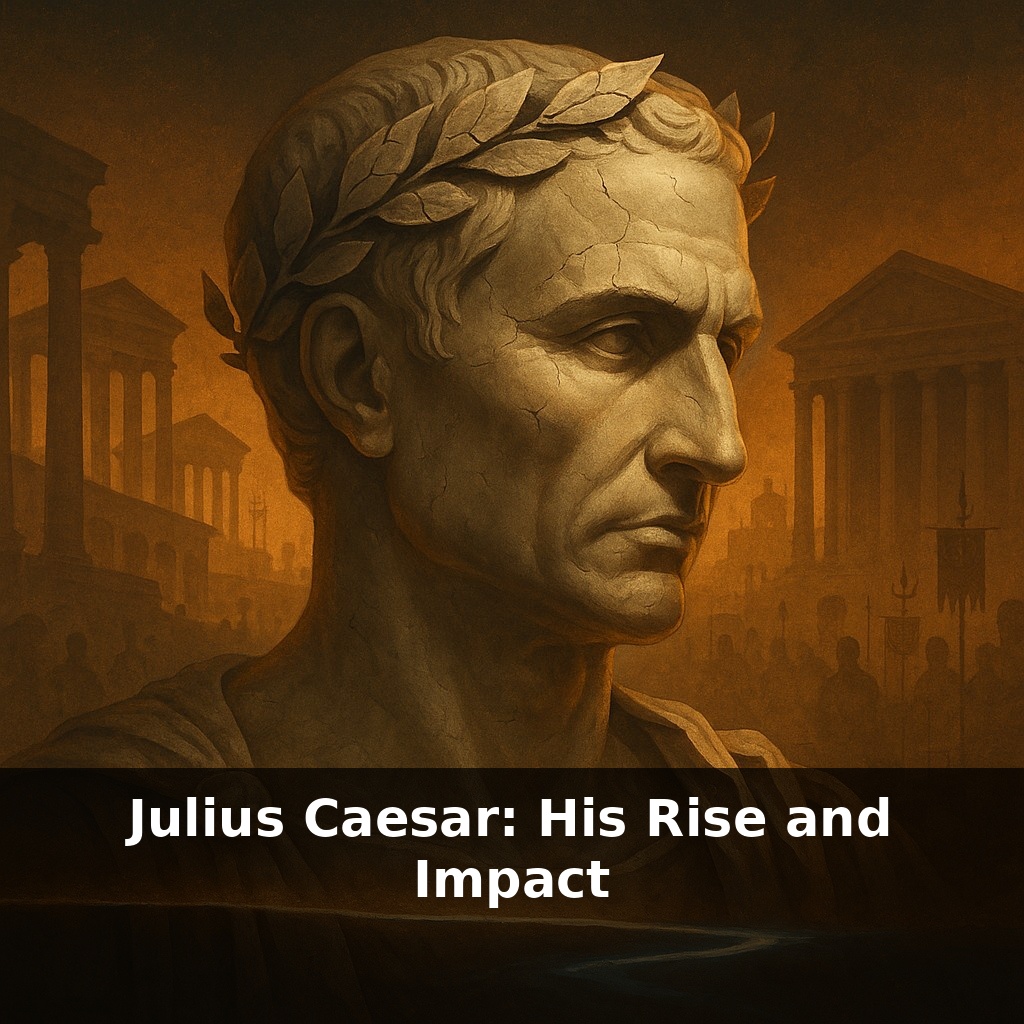
A man elected to save a republic ends up burying it. In one lifetime, Julius Caesar goes from ambitious noble to war hero to “dictator for life.” Today, we’ll step into the streets of late Republican Rome and follow how his rise quietly rewired its entire political system.
By the time Caesar crossed the Rubicon, his power wasn’t just about legions and victories—it was about how he rewrote the rules of access to power. He didn’t simply compete within existing structures; he bent those structures around himself, using them as scaffolding for something new. Take his relationship with the urban poor and army veterans: instead of relying only on aristocratic networks, he turned mass public support into a durable political resource, trading land, citizenship, and spectacle for loyalty. At the same time, his expansion of the Senate and redistribution of offices blurred old boundaries between “insiders” and “outsiders.” In this episode, we’ll trace how those moves—popular reforms, institutional tinkering, and calculated risks—combined to turn a competitive republic into a system that could tolerate, and then require, one-man rule.
Caesar’s rise didn’t unfold in a vacuum; it collided with a Republic already straining under inequality, corruption trials, and waves of veterans needing land. Foreign wars had poured wealth into a narrow elite while hollowing out small farmers. Courts were packed, elections soaked in bribery, and emergency commands kept being renewed because “temporary” crises never seemed to end. Into this mix, Caesar added something new: he treated military glory, legal innovation, and mass spectacle as parts of one integrated strategy, layering them like a carefully engineered stadium where every tier channeled attention toward a single central figure.
When Caesar first stepped onto the senatorial stage, his path looked conventional: rise through offices, win glory abroad, come home for honors. What changed the trajectory was how he fused three arenas—law courts, provincial commands, and public ritual—into one mutually reinforcing system.
In the courts, he backed laws that sped up corruption trials and targeted governors who had plundered their provinces. On paper, this looked like moral cleanup. In practice, it weakened rivals who depended on provincial loot while making Caesar the patron of provincials and Roman equites who wanted more predictable conditions for business. Legal change became a weapon and a recruitment tool at once.
His provincial command in Gaul then turned that political capital into hard power. Years of continuous command meant years of uninterrupted recruitment, promotion, and enrichment of his officers. The legions he formed there were not just units of the state; they were career ladders and social worlds that tied thousands of men’s futures directly to him. When the Senate tried to end his command without granting him legal protection, those ties made the “unthinkable” choice—marching on Italy—militarily and psychologically possible.
Back in Rome after civil war, his reforms targeted bottlenecks that had paralyzed decision‑making. He pushed through debt adjustments rather than a full cancellation, trying to relieve pressure without detonating the credit system. He sent surplus urban populations and veterans to colonies in places like Corinth and Carthage, turning potential unrest into seeds of Roman influence abroad. These moves were not just generosity; they thinned out disruptive blocs in the capital while extending his loyalist footprint across the Mediterranean.
Even symbolic changes carried structural weight. The Julian calendar didn’t merely fix scheduling; it anchored public life to a stable, predictable framework that would outlast individual magistrates. By controlling which festivals, elections, and commemorations appeared where in the year, Caesar quietly inscribed his version of political time into everyday routines.
Collectively, these measures blurred an old line: the difference between serving the Republic and managing it from above. Actions that solved real problems—land, debt, calendar chaos, corrupt governors—also trained Romans to look to a single figure as the default fixer when institutions jammed.
Caesar’s methods are easier to see if we compare them to how modern power‑builders operate. Think of how some leaders pair legal reform with media presence and patronage networks. For example, a reformer today might sponsor tough anti‑corruption laws that genuinely punish graft, while also using those laws to sideline rivals and reward allies who “cooperate.” Publicly, it looks like cleanup; privately, it re‑wires who owes whom.
You can track a similar pattern in his management of veterans and urban crowds by looking at contemporary leaders who tie welfare or public works to personal branding. When a mayor’s name is on every construction sign, each bridge or subway extension doubles as both infrastructure and advertising. The benefit is real, but so is the quiet shift in loyalty—from abstract institutions to a single figure who “delivers.”
The closest parallel today is when executives centralize decision‑making during a crisis, then never quite give that control back once the emergency fades.
Caesar’s career invites a question that still matters: how do systems “remember” a leader after he is gone? His mix of legal change, military loyalty, and public ritual left grooves that successors could slip into, even if they claimed to restore norms. Your challenge this week: when you follow current events, note every time leaders use emergency language to justify new powers. Ask: what habits might remain once the crisis ends?
Even after his death, the structures he bent didn’t snap back; they held the new shape. Later rulers could “log in” to powers once stitched together for one person. Your challenge this week: watch how leaders where you live combine roles—legislator, communicator, crisis‑manager. Which fusions feel temporary, and which are quietly becoming the new normal?