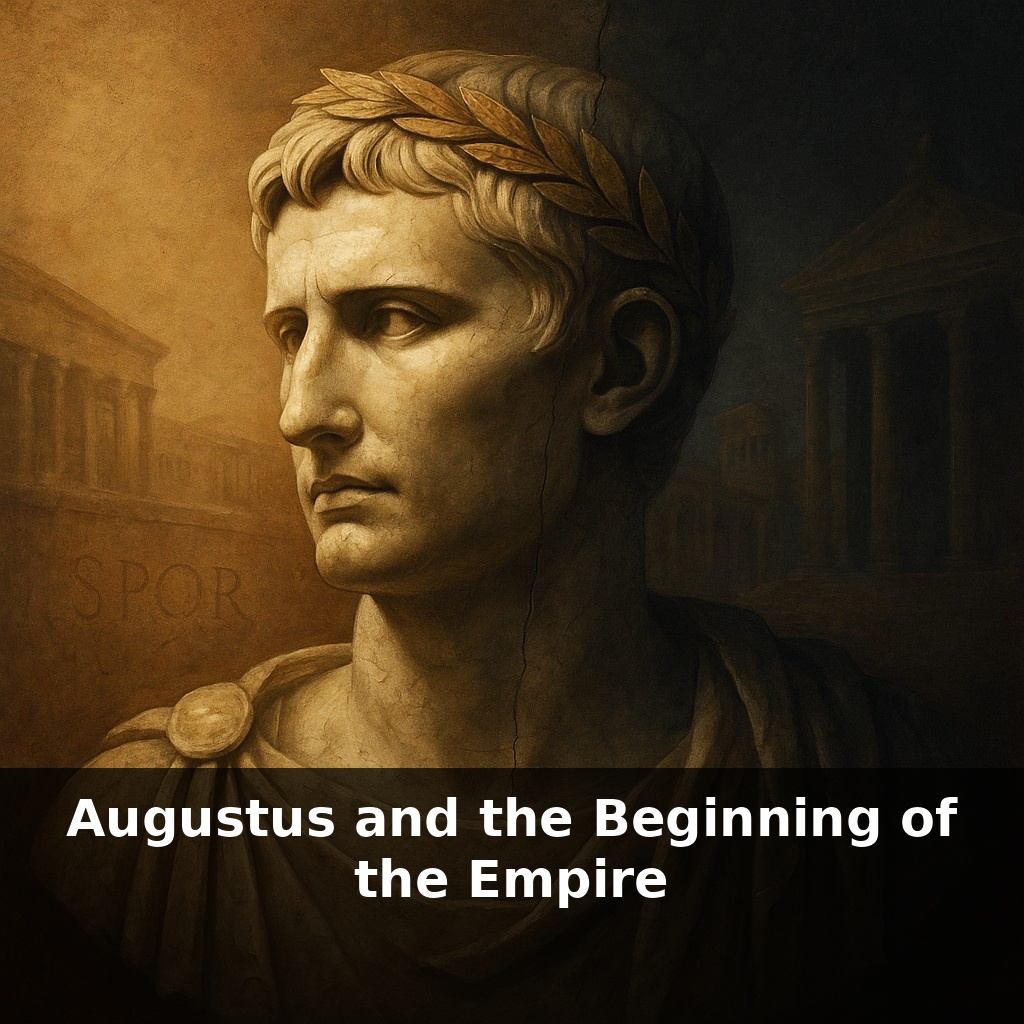
A teenager from a minor Italian town becomes, within one turbulent generation, the man who quietly ends a centuries‑old Republic—without officially abolishing it. In this episode, we step into that contradiction: how Rome kept its old titles while slipping into empire.
“On the day he gave up power,” writes Tacitus, “he was more powerful than ever.” That paradox sits at the heart of Augustus’ political genius. Publicly, he staged a grand renunciation: returning provinces, offices, and honors to the Senate, praising ancestral customs, and posing as the reluctant statesman. Quietly, he was rewiring how decisions were made, who controlled the legions, and how loyalty flowed through Roman society.
Rather than tear down existing institutions, Augustus learned to bend them—stacking offices, stretching precedents, and timing reforms so that each change looked like a safeguard against chaos, not a grab for supremacy. Like a skilled architect reinforcing an old building from within, he made Rome’s familiar façade carry an entirely new internal structure. In this episode, we’ll trace how those choices turned temporary emergency powers into a durable new normal.
Senators, veterans, and ordinary townspeople all saw a different Augustus—and that was the point. To senators, he was the deferential colleague who let them debate and decorate him with honors. To soldiers, he was the steady paymaster who guaranteed retirement benefits through the new military treasury. To city crowds, he was the provider of games, grain, and grand building projects stamped with his name. Rather than ruling from a single visible throne, he spread his presence through rituals, monuments, and laws, so that “Augustus” became woven into daily Roman life.
“Augustus did not create new offices; he created new combinations of them.” That’s how some modern historians summarize what happened after 27 BCE. The Senate still met, consuls still wore their striped togas, elections still took place—but key levers had been quietly rewired.
The core of this new wiring was *scope*. Other magistrates held power in a city or province; Augustus held overlapping powers that stretched over almost everything that mattered. In 27 BCE he accepted long‑term control over the most militarized provinces—Spain, Syria, much of Gaul—where the bulk of Rome’s legions were stationed. Legally, governors there ruled in Rome’s name; practically, they answered to him. Peace in the capital was suddenly inseparable from his personal command in the field.
Then came a second layer: tribunician power, renewed each year. He did not need to be a tribune to veto legislation, propose laws, or claim to protect “the people” against abuse—those powers were bundled to him permanently. On paper, he was not above other magistrates; in effect, he could overrule any of them while insisting he was merely exercising traditional rights.
A third layer reached into everyday life. Augustus launched regular censuses and used them not just to count citizens, but to rank them for military service, tax obligations, and honors. Property qualifications tied men to particular roles; marriage and morality laws tied families to state expectations. Being a Roman was increasingly a status managed through categories he helped define.
This was supported by new forms of dependence. The *aerarium militare*, funded by special taxes and personal contributions, professionalized the legions with predictable pay and retirement. Veterans settled in colonies that owed their land and layout to his decisions. The result was a political culture where careers, fortunes, and even social respectability were channeled through one figure who claimed to be restoring, not remaking, Rome.
Your challenge this week: track moments in modern politics where leaders expand the *scope* and *duration* of existing powers rather than inventing new ones. Note how they justify it—security, stability, reform—and ask yourself: would a Roman senator have recognized the move?
Think of a modern software platform that keeps its familiar interface while the back‑end is completely replaced. Users still click the same buttons, but data now flows through a single, central server that logs every action. That’s close to what Augustus did with authority: he didn’t abolish old titles; he rerouted their practical effects so that decisions, careers, and honors increasingly had to pass through him.
Concrete example: his censuses weren’t just headcounts; they sorted citizens into finely graded classes that determined who could serve where, pay what, and qualify for which public roles. The same ritual that once merely registered eligibility for service now quietly tied whole lifepaths to criteria he shaped.
Or take the standing army. Earlier commanders raised forces for specific wars; Augustus locked pay, postings, and pensions into stable routines. A legionary no longer depended on a short‑term patron’s success, but on a predictable system—one that just happened to radiate from the *Princeps*’ arrangements.
Augustus shows how quietly changing *where* decisions are routed can reshape an entire society’s future. The real implication for us lies in systems that feel “normal” because they’re slow. Think of how a phone’s operating system updates in the background: permissions, data flows, default options all shift while icons stay put. In politics, similar invisible updates—longer terms, new data registers, “temporary” security tools—can lock in habits that outlive any single leader. The puzzle is spotting these pivots before they harden into the new baseline.
Augustus also reshaped time itself: fixed terms for soldiers, regular censuses, ritualized access to honors. Power now moved on timetables he set, like trains running on tracks he’d laid. Later emperors inherited not just offices, but a clock and calendar of rule—raising the question of how far any successor could step outside that schedule.
To go deeper, here are 3 next steps:
1. Watch the BBC documentary “Rome: Rise and Fall of an Empire – Episode on Augustus” on YouTube and pause to compare how it portrays the Battle of Actium and the propaganda around it with what you heard in the podcast. 2. Grab a copy (or audiobook) of Mary Beard’s *SPQR*, then read the chapters on the late Republic and Augustus back-to-back, underlining every time she mentions how he blended “restoring the Republic” with actually centralizing power. 3. Open the free online text of Suetonius’ *The Twelve Caesars* (Perseus Digital Library or LacusCurtius) and read the sections on Augustus’ public image and personal habits, jotting down 3 ways his carefully crafted persona echoes modern political “rebranding” you’ve seen in the news.