Right now, your brain can juggle fewer ideas at once than you have fingers on one hand—yet you’re drowning in messages, meetings, and tabs. In one typical morning, you promise three people three different things… and remember maybe one. Where did the other two disappear to?
Global data creation is on track to hit 181 zettabytes by 2025. Your brain’s job is to make sense of that firehose—while also remembering the slide your boss liked, the story that landed well in last week’s meeting, and the half-idea you had in the shower that might be your next big win.
This is where the gap appears: your environment is scaling exponentially, but your brain’s capacity is essentially flat. Every new app, meeting, and document adds more “open loops” your mind quietly tracks in the background.
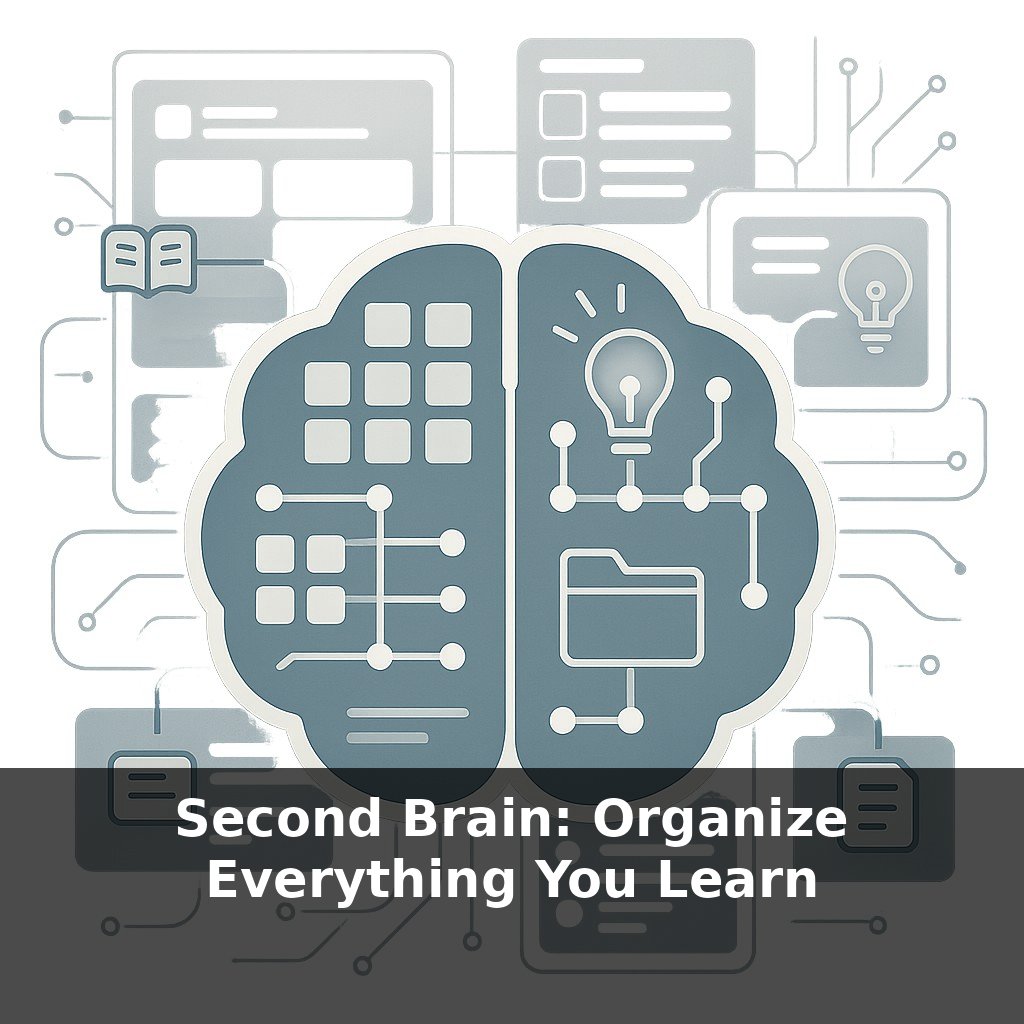
A Second Brain steps in as your personal command center. Instead of trusting that you’ll “remember it later,” you route ideas, references, and unfinished thoughts to a place designed to store and resurface them. Over time, it becomes a living record of what you’ve seen, thought, and learned—so your attention can move from scrambling to curating, from reacting to actually directing where your thinking goes next.
Most people treat information like a junk drawer: everything crammed in, nothing findable when it counts. A Second Brain flips this by favoring retrieval over storage. The question stops being “Can I capture this?” and becomes “How quickly can I get it back in a useful form?” That shift matters when your boss asks for last quarter’s numbers, or a client calls and you need their context *now*, not after 20 minutes of searching. Over time, patterns emerge: recurring problems, reused slides, repeat decisions. Your notes stop being static archives and start acting like reusable building blocks for your work.
Most people don’t fail at collecting information—they fail at *reusing* it.
You paste links into chat threads, dump PDFs into “To Read,” star emails, screenshot slides. In the moment, it feels productive. But when it’s time to write a proposal, design a workshop, or make a decision, you’re back to staring at a blank page. The raw material exists; the problem is that it’s scattered, noisy, and disconnected from the work you’re doing today.
A functional Second Brain changes that by favoring *movement* over inertia. Notes don’t just sit; they travel through stages that mirror real work: noticing, capturing, shaping, and deploying. The power isn’t in having “everything saved”—it’s in having the *right* pieces surface at the moment they can actually change your behavior.
Think about how Lin-Manuel Miranda built Hamilton. He didn’t wait for a free year to “research properly.” For nearly a decade, he collected lyrics, historical snippets, rhythms, and stray lines on his phone and laptop while working on other projects. Those fragments became reusable tiles he could snap together when the opportunity appeared. That’s the subtle shift: your future projects are already hiding in fragments you’ve captured—but only if you can find and combine them.
This is also where people confuse a Second Brain with digital hoarding. Hoarding is defensive: “I might need this someday.” A Second Brain is opportunistic: “What outcome could this accelerate or improve?” That question forces selectivity. You keep the email template that closed a tough client, not every email you’ve ever sent. You keep the three most telling customer quotes, not pages of raw transcripts.
Over time, those choices turn your notes into a kind of personal “playbook library.” Each article you save, each meeting takeaway, each half-written paragraph becomes a candidate play: a way to respond faster, argue more clearly, or build something new with less effort. And just like an elite athlete reviews game tape, you’re not collecting for nostalgia—you’re collecting to perform better the next time it counts.
A product manager keeps a “win vault” in her Second Brain: every successful experiment summary, key screenshot, and customer quote tagged by theme. When a new feature request lands, she isn’t starting from zero—she scans past launches with similar patterns, borrows the best positioning, and assembles a pitch in an afternoon instead of a week.
A freelance designer saves before/after shots of client projects, notes on what the client *really* cared about, and snippets of feedback. Months later, facing a tricky brief, he filters for “brand refresh + low budget” and instantly sees three prior solutions that worked under similar constraints.
Your own setup can be equally pragmatic: a tag for “numbers I’ll reuse,” a folder for “phrases that landed in meetings,” or a running list of tiny scripts and email replies that solved persistent headaches. Over time, those fragments turn into quiet leverage—evidence, language, and moves you can redeploy whenever the stakes are high and the clock is short.
Your future Second Brain won’t just wait for queries—it will *nudge* you. Drafts may appear before you sit down to write, based on patterns in past projects. Bi-directional links could let ideas travel with you between tools and jobs, almost like a transferable “creative passport.” Employers may care less about résumés and more about how you’ve grown, connected, and applied knowledge over time—and how responsibly you manage that power.
Your challenge this week: pick one active project and create a “future you” folder or space just for it. For seven days, whenever you finish a meeting, draft, or experiment, drop in only the 1–3 most reusable bits: a sharp sentence, a key metric, a surprising lesson. Don’t organize perfectly—just label lightly. Next week, start a related task and *force yourself* to pull from that folder before you begin anything from scratch.
Treat this less like building a filing cabinet and more like composing a playlist: you’re curating tracks you’ll actually play again, not archiving every sound you’ve ever heard. As your “future you” folders grow, you’ll notice patterns—preferred moves, phrases, even blind spots—which quietly become a feedback loop, sharpening how you think, decide, and create next.
Before next week, ask yourself: “What information am I constantly re-googling or re-learning (articles, meeting notes, ideas from this podcast) that clearly belongs in a trusted place outside my head?” Then ask: “If I opened my ‘second brain’ today, what 3 concrete things from this week—one work insight, one personal idea, and one long-term project—would I want future-me to find instantly, and where would I store them (e.g., a Notes app folder, Notion page, or Google Doc)?” Finally: “When I capture something—like a quote from this episode, a project idea, or a useful link—how can I save it in under 60 seconds with a short label my stressed, future self will actually understand?”