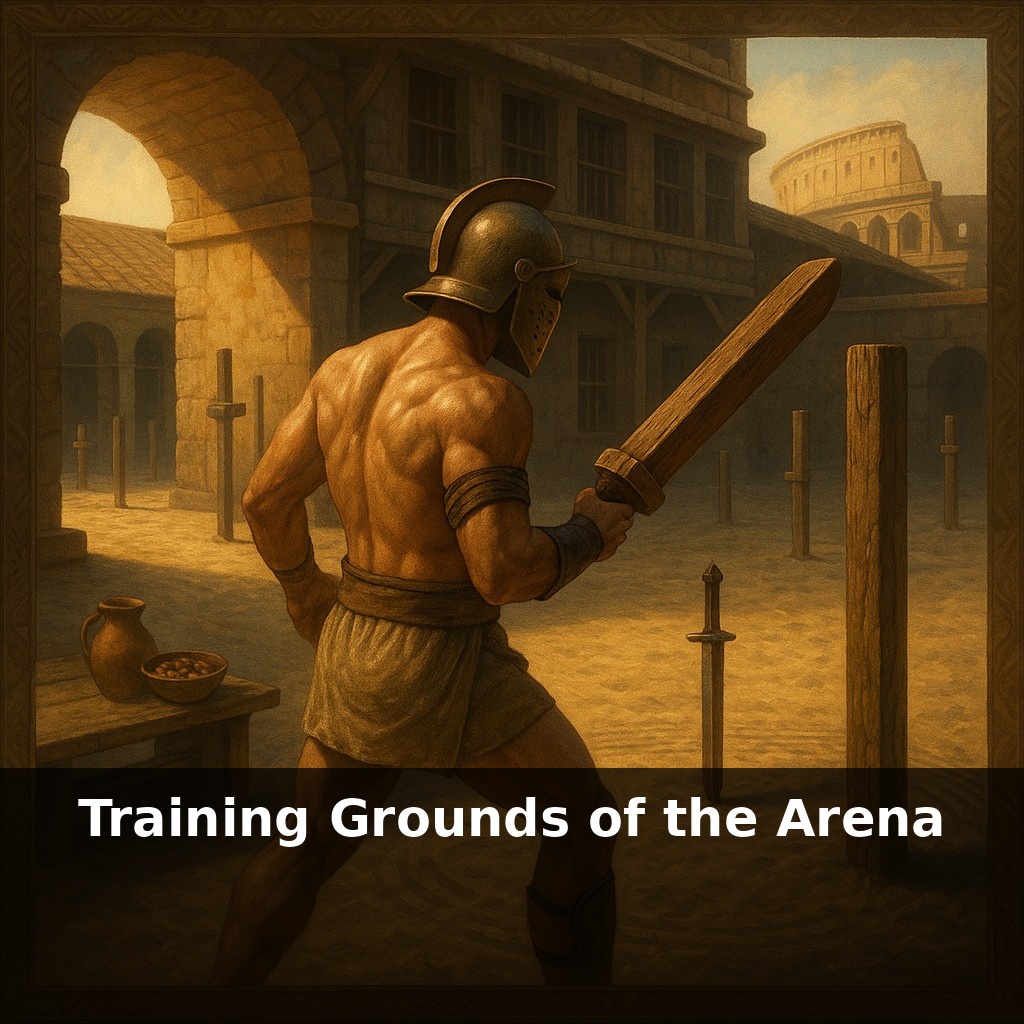
A gladiator’s best chance of staying alive wasn’t in the arena—it was in the gym. In Rome’s fighting schools, men trained with heavy wooden swords, ate mostly plants, and were guarded by doctors, all to keep them alive just long enough to risk death for the crowd again.
Step through the gates of the Ludus Magnus and the first thing that hits you isn’t the roar of a crowd—it’s the rhythm of a machine. This is less a barracks than a human factory: rows of cramped cells stacked like server racks around a central yard, every body inside owned, cataloged, and optimized. Here, men aren’t just trained; they’re processed.
Each courtyard drill, each shouted order from a doctor or trainer, is part of a careful calculation: how far can a body be pushed without breaking the investment it represents? Inscriptions tell us some of these fighters could earn in a single bout what ordinary soldiers might never see in a year, yet those same “stars” slept behind locked doors to prevent escape. This is the paradox of the arena’s training grounds: a world where you are both prized asset and disposable part, depending on who’s doing the counting.
By dawn, the central yard is a grid of choreographed violence. Pairs move in measured patterns, blows stopping a finger’s width from skin, like code running in strict test mode before deployment. Each recruit is assigned a fighting style—net and trident, short sword and shield, curved blade—then drilled until his movements match a template refined over decades. Behind the walls, scribes keep rosters and records: wins, wounds, specialties. This isn’t just practice; it’s data. The better a man fits his role, the easier he is to market, match, and bet on in the arena outside.
The rhythm of that morning drill hides how carefully each man has been sorted. New arrivals don’t just get thrown a weapon; they’re assessed. Age, reach, natural speed, even personality quirks get noted. A tall, rangy recruit might be steered toward the thraex style with its curved blade; a compact brawler with strong legs might be trained as a murmillo, built to stand and absorb punishment. The goal isn’t fairness. It’s role‑design: crafting distinct “brands” of fighter that will create dramatic contrasts in the arena.
Once a style is chosen, the environment tightens around it. Specialized instructors—retired fighters who survived long enough to teach—take over. Their job isn’t inspiration; it’s transmission. Every feint, every shield angle, every safe way to fall has been paid for in scars by somebody else. That knowledge is now a kind of intellectual property, guarded inside the school’s walls. When a trainer dies, a whole library of tricks can vanish with him.
Training ladders up in controlled layers. Recruits first work with heavy practice gear, then lighter equipment at higher speeds, then finally with live steel under strict supervision. Sparring pairings are deliberate: veterans with rookies, left‑handers against shield specialists, quick stylists against methodical grinders. The aim is to expose fighters to as many patterns as possible before those patterns appear, unpredictably, in front of tens of thousands of paying spectators.
Outside the yard, another system is humming. Administrators log every match result, every serious wound, every style combination that drew an especially loud reaction from the crowd. Certain pairings become hot properties; others quietly disappear from the booking lists. Over time, a fighter’s public persona—fearless killer, stoic survivor, crowd‑pleasing showman—emerges as much from these records as from his own choices. In a sense, the school is running continuous A/B tests on human beings.
Even punishment folds back into optimization. A man who breaks discipline might be chained, put on reduced rations, or forced into extra drills, but rarely simply discarded. Only when a fighter is no longer profitable—too injured, too disobedient, or too old—does the calculus shift. Until that point, everything inside those walls, from the shouted corrections in the sand to the ink on the rosters, serves one purpose: to make sure that when the gate finally lifts, the risk to the school’s investment has been reduced as far as Roman ingenuity can manage.
In one corner of the yard, you might see a rookie circling a wooden post, striking it hundreds of times along a chalked‑on pattern. Each impact leaves faint dents that trainers later read like a log file: where his arm drops, where his stance collapses under fatigue. Nearby, another recruit runs footwork drills over a grid scratched in the sand, forced to step only on certain lines while keeping his eyes locked forward. Miss a square, repeat the sequence. Miss twice, start again from zero.
Inside, the school’s scribes don’t just note wins and losses; they track how long bouts run, which wounds recur, who fades late. A man who always tires in the final exchanges might find his evenings suddenly filled with weighted climbs on stairwells and extra time on the practice track. Think of it like a prototype lab in an engineering firm: failures aren’t just punished, they’re dissected. A mistimed lunge, a dropped shield edge, a flinch at the wrong feint—all become tickets in a never‑ending queue of fixes to push before the next “release” into the arena.
As researchers map gladiators’ origins through isotopes and DNA, the schools start to look less like isolated gyms and more like a wired network, pulling in bodies and techniques from across the empire. Planned VR reconstructions of training hubs could act like “time‑travel interfaces,” letting users stand where recruits stood, replay bouts from multiple angles, even stress‑test theories about tactics. The arena’s past becomes a sandbox for experimental history, not just a spectacle to watch.
In the end, those sandy yards doubled as laboratories of control: contracts inked, stage names crafted, even walk‑on music replaced by choreographed chants and trumpet calls. Your challenge this week: treat any sports broadcast like a mini‑arena. Note how stats, entrances, and crowd cues are tuned—not just to find winners, but to keep you watching.