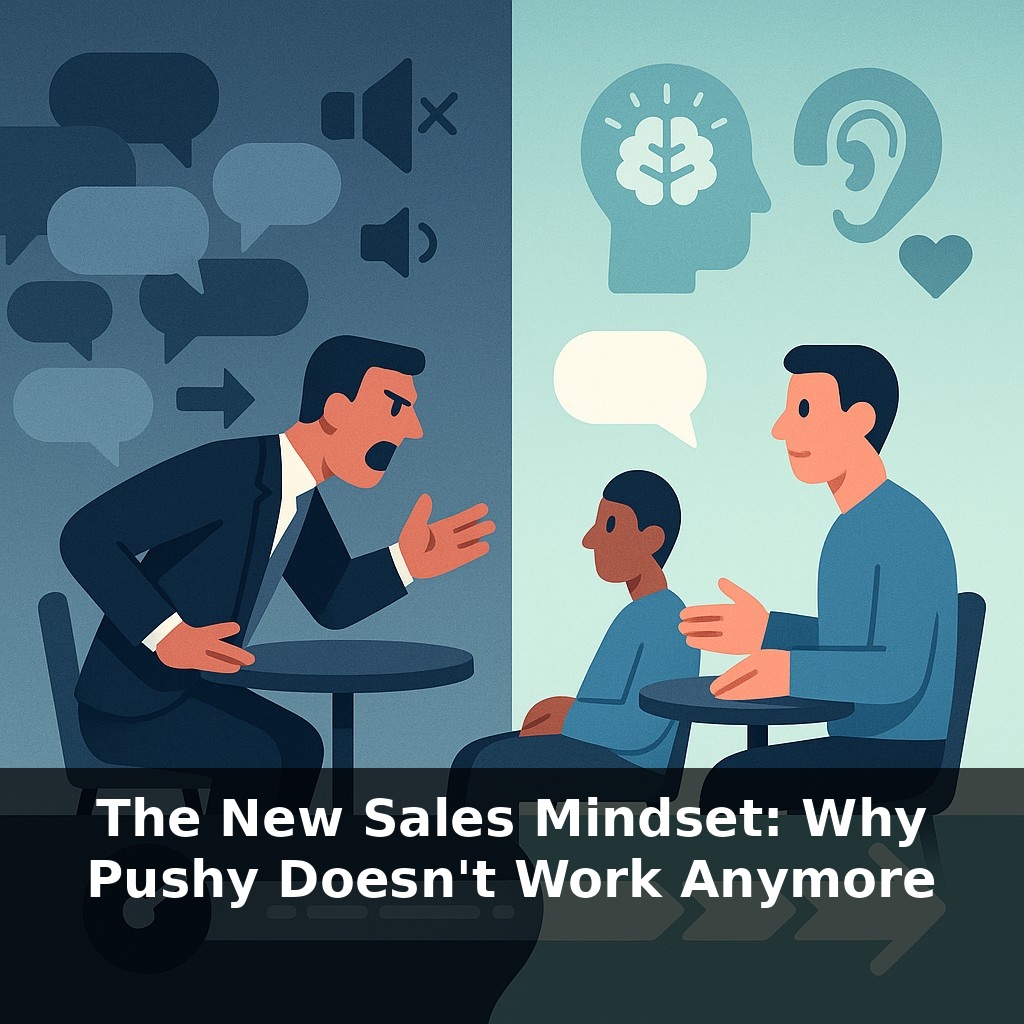
The New Sales Mindset: Why Pushy Doesn't Work Anymore
📝 Transcript
Right now, most buyers decide what they want *before* they ever speak to sales. Yet many reps still act like they control the conversation. In this episode, we’ll step into a sales call where pushiness backfires—and uncover the quieter mindset that actually wins.
If buyers are already halfway down the road before they meet you, then the real leverage point isn’t *what* you say first—it’s *how* you think before you say anything at all. That’s where the new sales mindset lives. Instead of scanning for openings to “overcome objections,” top sellers are quietly scanning for context: how this person’s world works, what they’ve already tried, and what they’re afraid will go wrong next. Think of it less like walking onto a stage with a script and more like stepping into a workshop with a rough sketch: you’re there to refine, not to bulldoze. This shift isn’t about being “nicer”; it’s about being more useful. When your default setting becomes curiosity over control, something interesting happens: buyers start volunteering information you could never pry out with techniques—and that’s where modern deals are really won.
That shift becomes even more powerful when you realize how much buyers now do *without* you in the room. They’ve compared vendors, read reviews, argued internally about budget—by the time you appear, they’re not asking, “What do you sell?” but “Can you help me make sense of what I’ve already found?” Your role quietly upgrades from promoter to thinking partner. And that’s where ethics stop being a “nice-to-have” and start becoming a performance advantage: people open up more to someone who clearly won’t exploit their honesty, especially when the stakes—career risk, team workload, political capital—are higher than the price tag.
Here’s the quiet irony of modern selling: the more “value” you push at someone, the less valuable you often feel to them. Not because your product is weak, but because your behavior trips alarms in their brain long before your slides are finished. Neuroscience calls it psychological reactance—when people sense their freedom to choose is under threat, they don’t just resist your message; they downgrade *you* as a source.
You can feel this on calls: the clipped answers, the sudden “we’ll circle back,” the cameras turning off. That’s not “no budget”; that’s a nervous system defending itself. And it happens fast—often in the first two or three moves you make.
Those moves are usually subtle:
- Jumping into “let me show you how it works” before you fully understand what “it” needs to do in their world. - Correcting their assumptions too early, instead of exploring how they arrived there. - Hunting for a close date before you’ve earned the right to ask what success would even look like internally.
Each of these shifts the spotlight from *their* problem-solving to *your* agenda. Once that happens, even perfectly logical arguments land like pressure.
The alternative isn’t to go soft or simply “be nice.” It’s to switch from performing certainty to performing *usefulness*. This shows up in small, concrete behaviors:
- Asking diagnostic questions that narrow the problem, not just qualify the budget. - Saying, “Based on what you’ve shared so far, here are two paths I see—and where each could break.” - Admitting when your solution is a partial fit, and clearly flagging the gaps instead of burying them.
Counterintuitively, naming limits increases your influence. It signals you’re optimizing for their outcome, not this quarter’s dashboard. That’s why consultative reps who emphasize education consistently outperform product-pitchers: they reduce fear, not freedom.
A simple test: after a good conversation, the buyer should feel *clearer* about their situation—even if they don’t pick you. If they only feel clearer about your product, you probably sold past the point of trust.
The numbers back this up in practice. In one SaaS company, two reps inherited similar territories. The first raced through demos, highlighting every feature. Calls felt like tightly packed monologues. Deals started fast, then stalled in “internal review.” The second rep slowed everything down. She began by mapping stakeholders, then asked, “Where does this go wrong for you today?” Her proposals were shorter, but each section labeled a specific risk the customer had named. Within two quarters, her win rate was 30% higher and her average discount was lower, because buyers trusted the alignment.
You can even see this in follow-up emails. Push-style messages sound like reminders: “Just circling back to see if you had a chance to review the quote.” Consultative messages move the thinking forward: “You mentioned concern about rollout risk—here are three minimalist launch options, including one that doesn’t involve us.” One is pressure to decide; the other is help deciding. Over a pipeline, that difference compounds into real revenue, not just nicer conversations.
As AI takes over routine discovery, your edge will come from the *quality* of the moments that are left. Think of it like weather patterns: automated tools handle the long-range forecast; you interpret the sudden local storm. Future roles will reward those who can orchestrate internal consensus, navigate politics, and link decisions to measurable success. Ignore this shift and you won’t just lose deals; you’ll quietly disappear from shortlists you never knew you were on.
When you drop the urge to steer every turn, you start noticing side roads buyers actually care about: politics, past scars, hidden constraints. That’s where modern deals live. This week, your mission is to utilize the 'sailboat' technique: during each conversation, identify one potential 'anchor' that could prevent progress internally (like 'budget limits' or 'stakeholder hesitation') and collaborate with your prospect to brainstorm ways to navigate or lift these anchors.
From this course
Sell Without Being Sleazy: Modern Persuasion
7 episodesUnlock all episodes
Full access to 7 episodes and everything on OwlUp.
Subscribe — $1.99/monthLess than a coffee ☕ · Cancel anytime