About eight out of ten customers walk away from a brand after just one high-pressure sales moment.
Now you’re mid-conversation with a prospect. They’re nodding, they’re engaged… and you feel that urge to push.
Here’s the twist: the less you push, the more likely they are to buy.
That urge to push usually shows up right when the prospect is quietly selling themselves. They’re weighing, “Does this really solve *my* problem? Will this actually work in *my* messy reality?” If you jump in too hard, you hijack that internal conversation—and they pull back.
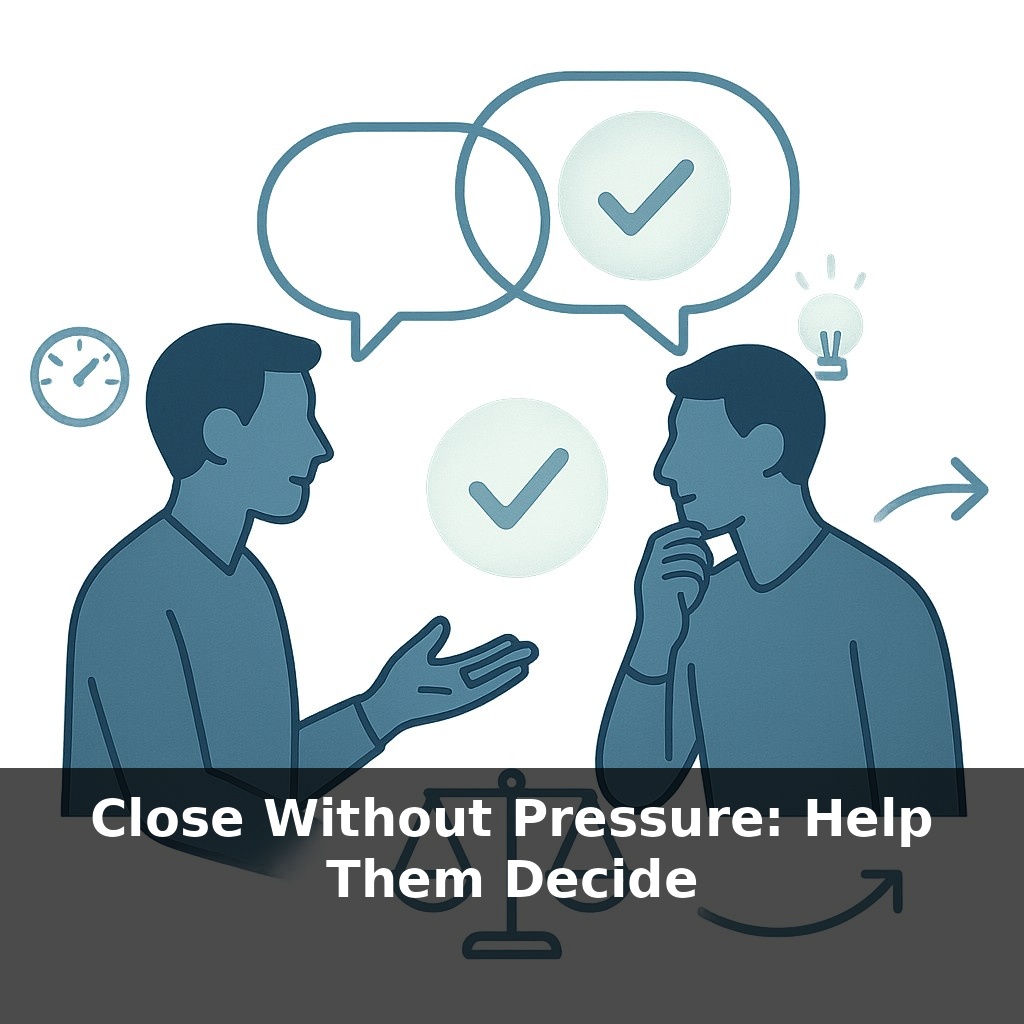
Pressureless closing is about doing the opposite: you create conditions where their own conclusions feel safe, smart, and genuinely theirs. That means trading the scripted “So, are you ready to move forward today?” for questions that surface fit, doubt, and risk out in the open.
Think of it like adjusting the lighting in a studio: your job isn’t to paint the picture for them, it’s to light the canvas so they can clearly see what’s already there—and decide if it belongs in their world.
So instead of steering the conversation toward *your* finish line, you stay curious about *their* decision-making process. How do they normally choose tools or partners? Who else gets a say? What’s burned them before? When you invite that story, you uncover the real forces that will decide the deal: internal politics, competing priorities, unspoken fears about looking foolish.
The win isn’t getting them to say “yes” in the moment; it’s helping them build a decision they can defend tomorrow—when a boss pushes back, a budget gets cut, or a shinier option pops up in their inbox.
The shift from “closing” to “helping them decide” starts earlier than most people think. It starts the moment you stop trying to convince—and start trying to **structure** their thinking.
There are three moves that separate pressureless pros from everyone else:
**1. Diagnose with ruthless clarity**
Instead of racing toward, “This would be great for you,” slow down around three questions:
- “What have you already tried to solve this?” - “What breaks if you do nothing for 6–12 months?” - “Who notices first if this gets better—or worse?”
You’re not hunting for surface pain; you’re mapping consequences. When they articulate what’s at stake in concrete terms—missed revenue, team burnout, reputation—you no longer have to “sell” urgency. They’ve built it themselves.
**2. Co-design the solution, don’t present it**
Replace the big reveal demo with a collaborative build:
- “Can I show you 2–3 ways people like you solve this, and we’ll cross off what clearly doesn’t fit?” - “Based on what you said, which of these trade-offs feels smarter for you: X or Y?”
Each decision point is a *micro-close*: they choose the problem framing, the priority, the trade-off. By the time you reach price and terms, you’re not asking them to buy a product; you’re validating the plan they helped assemble.
**3. Surface and normalize doubt early**
Pressureless closing isn’t the absence of tension; it’s directing tension at the *right* questions:
- “On a scale of 1–10, how confident are you this is the right direction?” - “What would have to be true for that number to move up by two points?”
Now doubts aren’t landmines at the end; they’re raw material you work with together. Sometimes that leads to a “no” today. Counterintuitively, those clear no’s create future yes’s—because you protected their autonomy instead of pushing past their hesitation.
Your silence matters, too. After you ask, “Do you want to move forward with this plan, or does it make more sense to pause here?” leave room. That quiet moment is where ownership forms.
Your challenge this week: in your next five sales conversations, **add one explicit micro-close** *before* you talk price—have them choose between two paths, define success in their own numbers, or rank their priorities out loud. Notice how often, by the end, “closing” sounds less like a pitch and more like them saying, “This actually feels like the right move for us.”
Think about a prospect who’s been burned by “transformational” tools before. They won’t say it outright, but you can hear it in how they hedge: “We’ve tried things like this…” Instead of reassuring them it’ll be different this time, you make space for specifics:
“Walk me through one that really missed the mark. What did it promise versus what actually happened?”
Now you’re in the details—implementation delays, no internal owner, leadership shifting priorities. As they unpack that story, ask:
“If we fast-forward six months and you’re calling this a win, what *actually* looks different for you and your team?”
They might say, “My reps spend 30% less time on admin,” or “Our onboarding ramp drops from 90 days to 60.” Those are *their* numbers, not yours.
Later, when you outline options, you can say, “Which version gets you closer to that 60-day ramp?” Instead of chasing enthusiasm, you’re tying choices back to changes they already care about—so the decision feels less like a leap of faith and more like following a trail they helped lay down.
Buying will soon feel less like “being sold” and more like having a smart co-pilot. As AI listens for subtle hesitation—tone shifts, longer pauses—it can prompt you with questions that invite clarity instead of compliance. Think of it as a weather radar for deals: spotting storms early so you can reroute together. Teams that log these moments and learn which responses rebuild confidence will create feedback loops competitors can’t easily copy, turning trust into a measurable performance edge.
When you practice this, you’re not just “being nicer”—you’re redesigning the moment of choice. Over time, patterns appear: which questions unlock stalled deals, which signals mean “not yet,” which paths lead to loyal fans, not just closed tickets. Treat each conversation like a draft, not a final painting, and your close rate becomes a by-product of better decisions.
Try this experiment: On your very next sales call, tell the buyer up front, “My goal today isn’t to convince you, it’s to help you decide if this is a fit or not—‘no’ is totally okay.” Then, halfway through the conversation, pause and ask: “Based on what we’ve covered so far, does this feel like it could solve [their specific problem], or are you leaning toward this not being right for you?” If they lean “no,” explore why without pushing; if they lean “yes,” simply ask, “What do you need to see or know to feel fully comfortable deciding either way?” After the call, quickly note whether this reduced your anxiety, changed their openness, and how it affected the outcome compared to your usual, more pressured close.