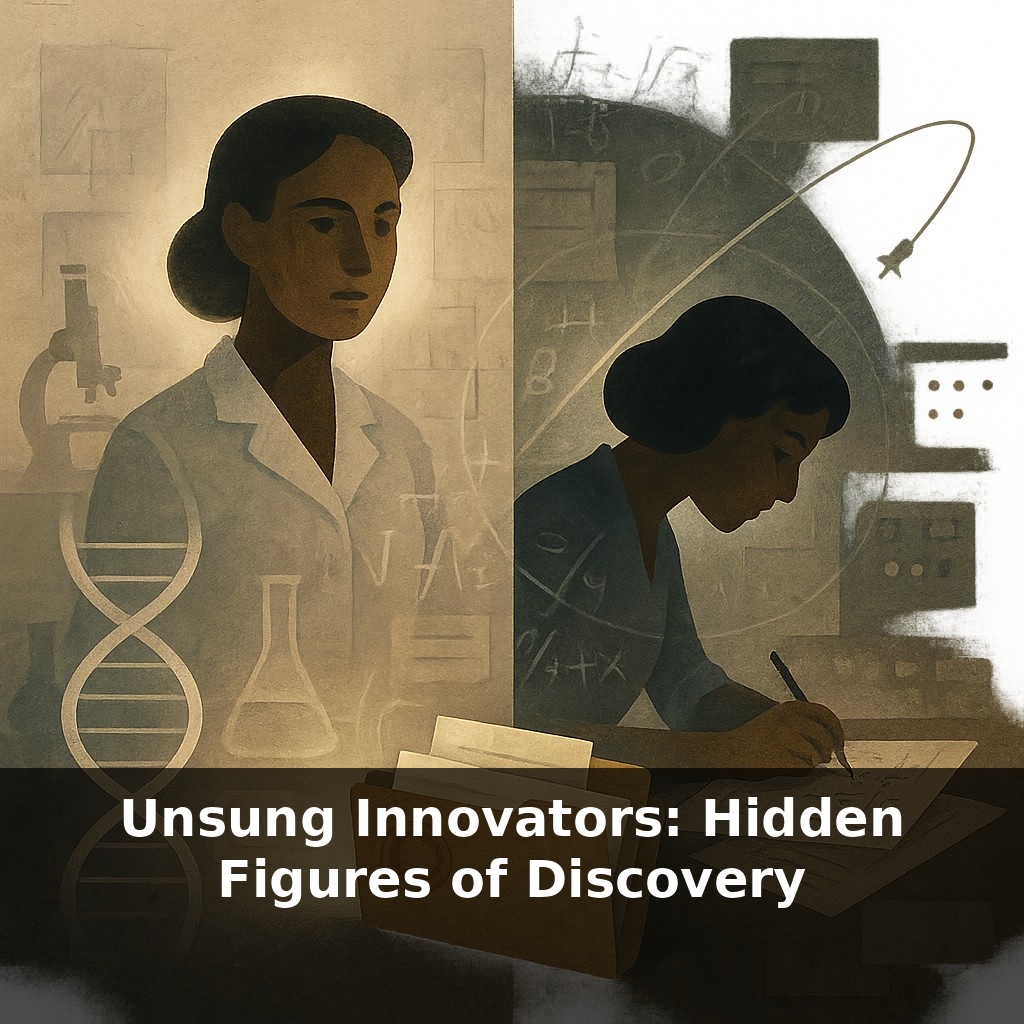
“History’s biggest breakthroughs are often misfiled under the wrong names. In one lab, a young scientist stared at a blurry X-ray pattern that would unlock the structure of life. In another, a mathematician’s quiet pencil marks decided whether an astronaut would live or die.”
Rosalind Franklin never got to see her famous image labeled a “smoking gun,” and Katherine Johnson’s name didn’t appear in the headlines that celebrated a flawless orbit. Their stories aren’t just about unfairness; they reveal how discovery actually works: as a relay race, not a solo sprint. One person refines the instrument, another perfects the method, a third spots the pattern—and someone else’s name ends up on the trophy.
Follow the trail of “hidden figures” and a pattern emerges. They’re often the ones building the tools, checking the math, or questioning the assumptions everyone else took for granted. They are the people whose contributions are essential but easy to miss in a quick historical summary. To understand how modern science and technology were really built, we have to widen the frame and slow the credits, so more names—and more kinds of stories—come into view.
Some of the most striking examples sit in the margins of famous stories. Rosalind Franklin refined experimental conditions until Photo 51 emerged—a 62‑hour exposure that captured the sharpest B‑form DNA pattern anyone had seen. Katherine Johnson filled 11 pages with elliptic integrals to validate John Glenn’s orbit, and he refused to launch until she confirmed the numbers. Chien‑Shiung Wu’s cobalt‑60 experiment shattered a 30‑year physics belief by revealing that the weak force breaks parity, quietly redrawing the rules other scientists thought were settled.
When you zoom in on how these “secondary characters” actually worked, a different script for innovation appears.
Rosalind Franklin didn’t just operate equipment; she redesigned process. She altered humidity, salt concentration, and fiber tension, then kept records so precise that colleagues could reproduce her setup years later. That kind of methodological craftsmanship rarely makes headlines, yet it’s what allows a result to survive skeptical re‑tests. In many labs, the person who quietly stabilizes the method determines which mysteries can even be asked.
Katherine Johnson’s role at NASA shows another under‑credited layer: translation. Engineers thought in hardware, mission planners in timelines, and astronauts in risks. Johnson moved between those worlds, turning orbital mechanics into trajectories that a pilot could trust with his life. Her handwritten pages were not just numbers but a negotiated truce between theory, machines, and human nerves.
Chien‑Shiung Wu exemplifies a third pattern: the experimental closer. The parity problem was a live argument until someone could design an experiment precise enough that nature had to answer unambiguously. Wu re‑engineered cryogenic systems, isotope preparations, and detection protocols until alternative explanations were stripped away. The Nobel went elsewhere, but the decisive test was hers.
Across fields, you can trace similar threads. In computing, programmers like Mary Allen Wilkes built the first interactive personal computer environment in a spare room, years before “PC” became a buzzword. In epidemiology, Alice Ball devised the first effective injectable treatment for leprosy, only to have a supervisor initially publish the method under his own name. In wireless technology, engineer Hedy Lamarr co‑patented a frequency‑hopping system to secure torpedo guidance—ideas that later echoed in spread‑spectrum communication.
These stories point to a consistent distortion: we tend to credit the person at the final, visible interface—the presenter, the CEO, the prizewinner—instead of the network of tool‑builders, system‑stabilizers, and translators underneath. Like an operating system that quietly manages memory and processes while an app gets all the praise, much of modern progress is sustained by people whose names most users never see.
In many labs, the people who never give keynote talks still decide what becomes possible. Consider Gladys West, whose meticulous geodesy calculations refined Earth’s shape models so precisely that GPS could someday guide everything from planes to food deliveries. Or Annie Easley, who rewrote propulsion code so rockets could use new fuels, long before “software engineer” was a glamorous title. Modern AI owes similar debts to researchers who “only” curated datasets or debugged training pipelines; their names rarely appear in press releases, yet flawed groundwork would topple the most brilliant model.
Corporate R&D tells the same story. At Toyota, production engineers who redesigned assembly steps quietly saved more fuel and waste than many headline-grabbing concept cars. Their experiments with timing, angles, and tolerances echoed the care of a great basketball point guard: they don’t always score, but they control the game’s flow. Look closely at any transformative project, and those quiet decision points—by people you’ve never heard of—start coming into focus.
Future implications stretch beyond overdue applause. As archives get digitized, algorithms will start flagging quiet co‑authors and lab notes that shaped whole fields. Funding bodies may shift from backing lone “stars” to backing ensembles that have a track record of sharing credit. Citations could become more like tracing a family tree than naming a single heir. And as classrooms surface these full casts, more students can see a role that fits how they think, not just who they resemble.
When we widen the frame, something else shifts: who feels entitled to tinker. A kid soldering in a garage, a nurse tweaking a dosing routine, a junior analyst quietly fixing a model—these are not side stories but draft chapters of the next archive. Your future tools may carry their fingerprints, even if the label only shows a brand name.
To go deeper, here are 3 next steps: 1) Pick one “hidden figure” from the episode and read a focused profile on them—start with Margot Lee Shetterly’s *Hidden Figures* (for NASA’s Black women mathematicians) or the chapter on Rosalind Franklin in Brenda Maddox’s *Rosalind Franklin: The Dark Lady of DNA*, then jot 3 ways their work was minimized and how it shaped the final discovery. 2) Explore the “Women in Science” or “Black in STEM” collections at the IEEE, Royal Society, or Smithsonian online archives, and bookmark 2–3 original papers or artifacts from lesser-known contributors mentioned in the episode. 3) Add the “Wikipedia: Women in Red” or “AfroCROWD” project pages to your browser and, using a person from the episode, improve or expand one article today by adding a citation, a missing award, or a better summary of their contribution.