By 1900, steel rails and copper wires had stitched America together so tightly that a message could outrun a train, and a train could outrun the sun. Tonight, we step into the control rooms and workshops where quiet men rewired how distance, power, and money actually worked.
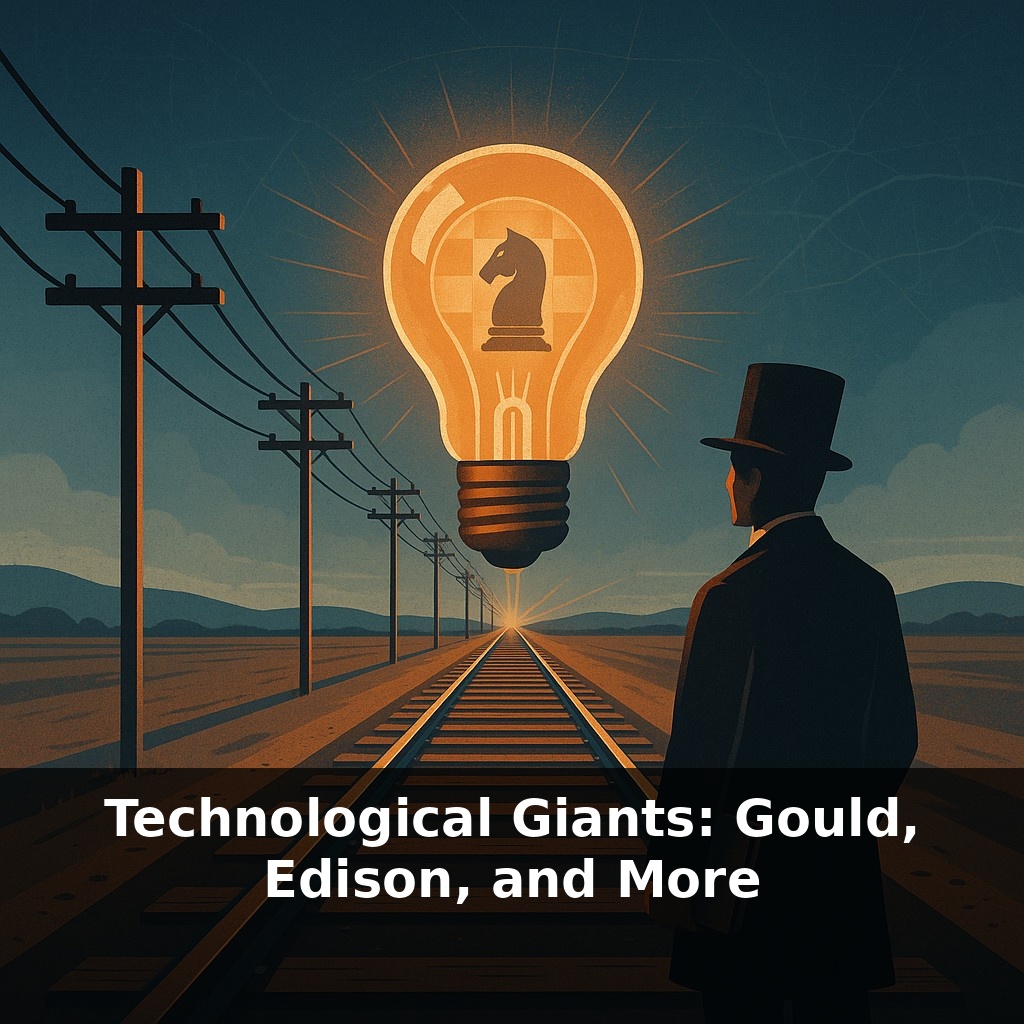
By the 1880s, the people shaping this new landscape split into two unusual camps. In one camp stood men like Jay Gould, who treated railroads and telegraph lines the way a grandmaster treats a chessboard—moving pieces, sacrificing some, combining others, always thinking three mergers ahead. In the other camp were engineers like Thomas Edison, obsessing over filaments, generators, and switches the way a watchmaker obsesses over springs and gears.
Their worlds looked different—Wall Street offices versus smoky laboratories—but their work constantly collided. A financier’s decision to reorganize a railroad could dictate where an inventor’s new power station would be profitable. An engineer’s breakthrough in current or signaling could suddenly make an entire business model obsolete. To understand how the modern world took shape, we have to watch both players at once.
Gould and Edison weren’t operating in a vacuum; they were maneuvering inside a country that was mutating almost month by month. Cities exploded upward and outward, swallowing farms at their edges. Factories learned to run not just on water and muscle, but on steam and then coordinated electric power. Farmers started checking commodity prices by telegraph before planting. Timetables for trains quietly forced towns to synchronize their clocks, so “local noon” gave way to standardized time. Out of these overlapping experiments, a new question emerged: who would control the platforms everyone else had to use?
By 1880, Jay Gould could influence where an entire region rose or fell on the map. Controlling about 15% of U.S. rail mileage meant he didn’t just own tracks—he could reroute prosperity. Towns that got a depot saw shops, banks, and factories cluster like iron filings around a magnet. Towns bypassed by his lines often withered, their main streets freezing in place while nearby cities accelerated into the new age.
His purchase of a majority stake in Western Union in 1881 extended that reach into the nation’s nervous system. Messages between banks, grain traders, and newspaper editors now pulsed through a network he could price, expand, or withhold. A single rate change on telegraph traffic could subtly tilt which markets thrived, whose news broke first, whose bids arrived in time. Control of movement and signals together gave Gould leverage that no single factory owner could dream of.
Meanwhile, Thomas Edison was attacking a different bottleneck: how to make electric light and power something you could rely on daily, not just marvel at in a laboratory. He didn’t conjure the first bulb from nothing; his edge was making one that lasted long enough, and cheaply enough, to be folded into ordinary life. Then he did something more radical: he treated electricity as a complete system. Generators, wiring, meters, switches, and lamps had to fit together like parts of a carefully engineered bridge, where every span and rivet shared the load.
When Pearl Street Station switched on in 1882, lighting 400 lamps across 59 customers, it was less a stunt than a proof of concept. A neighborhood in lower Manhattan became a pilot zone for a new way of organizing streets, work hours, and even sleep. Shops could stay open later; offices could cluster denser without relying on daylight; printing presses could run on tighter schedules. Once people experienced that reliability, they began planning around it, and that planning is where real power accumulated.
George Westinghouse pushed the experiment further by backing alternating current. AC could travel longer distances at higher voltages and then be stepped down, making centralized generation for entire regions possible. Lighting the 1893 Chicago World’s Fair in a blaze of electric glow wasn’t just spectacle; it was a public argument that this form of power could scale safely and impressively. Three years later, when power from Niagara Falls reached Buffalo over 26 miles of line, it signaled that natural landscapes themselves could be harnessed as long-term energy platforms.
Beneath the famous “war of currents” between Edison’s DC and Westinghouse’s AC lay a quieter reality: both systems demanded trust. People had to believe that unseen forces running through walls and overhead lines would be there when needed and not turn deadly without warning. That meant new codes, inspectors, and insurance models. Engineers evolved from solitary tinkerers into organizers of large technical teams, while investors learned to think not just in miles of track or wire but in grids, load curves, and long-term demand.
At the same time, railroad and telegraph consolidation turned entrepreneurs into tenants of someone else’s infrastructure. A manufacturer in Ohio suddenly depended on timetables, freight rates, and signal reliability set in distant boardrooms. By 1900, the U.S. had 193,000 miles of rail—enough to reach around the Earth nearly eight times—but most of those miles flowed through a few corporate arteries. If you wanted to move wheat, coal, or newspapers at scale, you negotiated with managers who thought in systems, not towns.
The paradox is that this concentration of control both constrained and enabled. On one hand, it created chokepoints: a dispute in New York could strand grain in Kansas. On the other, having standardized networks allowed smaller players to punch far above their weight. A Midwestern inventor could ship a new machine nationwide; a regional newspaper could flash headlines coast to coast via a single telegraph interface.
Gould’s empires showed how far you could go by mastering ownership and coordination. Edison’s and Westinghouse’s projects showed how far you could go by mastering complexity in physical systems. Together, they nudged the country toward a new pattern: whoever could define the standards—of track width, signal code, voltage, billing—could quietly tax everyone who relied on them.
Your challenge this week: trace one modern platform you use—maybe a delivery app, an online marketplace, or a cloud service—back through its dependencies. Ask: who owns the “tracks” it runs on, who designed the “power” behind it, and where a single decision far upstream could reshape how you live or work.
Think about how a sports league works. Team owners negotiate TV deals and stadium rights; coaches and trainers obsess over playbooks, nutrition, and practice reps. Neither side alone creates a championship season, but together they shape what fans experience on game day. Gould’s boardroom tactics and Edison’s lab work sit in a similar relationship: one sets the schedule and ticket prices, the other designs the play.
To see how this pattern survives, look at modern chip manufacturing. A handful of firms decide where to build fabs costing tens of billions, which in turn sets the horizon for what device designers can attempt. A new lithography technique in a cleanroom can suddenly make an entire pricing strategy obsolete; a shift in capital budgets can stall a promising architecture.
Urban transit offers another parallel. A city’s finance office structures bonds and public‑private deals; transport engineers plot routes, signaling, and vehicle specs. The resulting network quietly decides which neighborhoods thrive, who endures long commutes, and where new businesses find it viable to open their doors.
Today’s fights over AI, clean energy, and satellite networks repeat an old pattern: whoever sets the default rules quietly shapes everyone else’s options. Think of app stores deciding which tools reach your phone, or grid operators choosing whose solar output gets priority. As climate risks grow, control over chokepoints—rare minerals, launch capacity, key data sets—may matter more than headline inventions, forcing regulators to treat infrastructure choices as long‑term constitutional decisions.
Conclusion:
Before next week, ask yourself: “If I borrowed just one habit from Edison’s routine—like his relentless prototyping or his willingness to test ‘wrong’ ideas—what exactly would that look like in my current project today?” “Where am I behaving more like Gould’s ruthless monopolist—hoarding information, contacts, or tools—and what’s one place I could consciously ‘open the rails’ to collaborators instead?” And, “If I had to pick a single ‘big bet’ technology in my own life or work (the way these giants bet on electricity, railroads, or telephony), what would it be—and what’s one concrete step I can take this week to move from passive user to active shaper of that technology?”
We’re still adding layers to the same hidden scaffolding. Data centers hum like backstage machinery, quietly deciding whose voices load instantly and whose buffer. Standards for chips, code, and climate policy are today’s rulebooks; tweak them, and whole industries pivot. The open question is who gets a pen when the next set of rules is drafted.