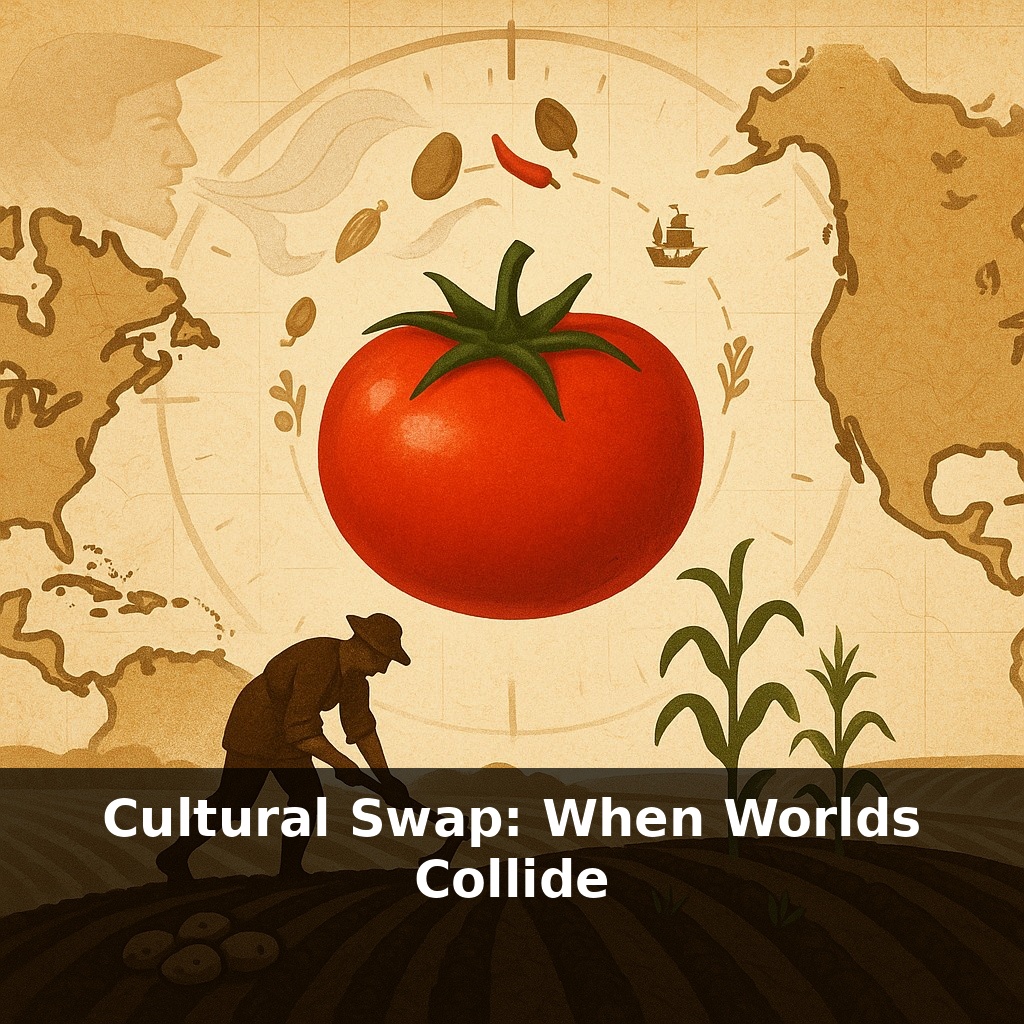
A fruit from Mexico becomes the soul of Italian cooking. A root from the Andes quietly doubles Europe’s dinner plate. And one invisible passenger on a sailor’s breath wipes out most people in entire regions. This isn’t sci‑fi; it’s what happens when distant worlds suddenly swap everything.
In this episode, we zoom in on the moment when that global swap stopped being abstract and started changing what people actually did every single day. Think of a European peasant in 1600 bending over a field, or an Andean farmer checking the sky for storms: their routines, tools, and even bodies were about to be rewritten by things they’d never seen, grown thousands of kilometers away. New foods didn’t just add variety to tables; they rewired labor systems, tax policies, and family size. Animals like horses and cattle didn’t simply move—ownership of them redrew maps of power and war. Meanwhile, silver mined in the Americas began pulsing through Asian markets, nudging empires to recalibrate their entire economies. We’ll follow these threads to see how an ordinary meal, a single coin, or a new animal could quietly tilt the balance of history.
So far we’ve sketched the big levers—crops, animals, and precious metals—but the real shock came in how quickly people hacked these new pieces into their daily lives. Recipes were reverse‑engineered in village kitchens; merchants redrew trade routes like players exploiting a newly discovered shortcut; priests and shamans scrambled to explain why some prayers no longer seemed to work against new plagues. Languages quietly absorbed loanwords for unfamiliar foods and objects, and even fashion shifted as dyes, fabrics, and adornments crossed oceans. In this episode, we’ll zoom into those on‑the‑ground adjustments and improvisations.
Start with a dinner plate. In 1400, a European farmer’s meal might be mostly local grain, a bit of vegetable, maybe cheese. By 1800, that same plate could contain American starches, Asian spices, and sugar from a Caribbean plantation—each item tracing a different story of conquest, creativity, or coercion.
Take sugar. Once a luxury for elites, it turned into a mass habit by hitching a ride on coffee, tea, and chocolate. European cafés and kitchens became the demand engine that locked millions of enslaved Africans into brutal Caribbean and Brazilian plantations. A spoonful in a porcelain cup in Paris was tied, directly, to whips and chains in the tropics. Everyday sweetness normalized an economy of extreme violence.
Or look at chili peppers. Originating in the Americas, they were so enthusiastically adopted across Africa and Asia that many people there now think of them as “native.” Indian vindaloo, Szechuan hotpot, Korean gochujang, West African stews—none of these iconic flavors exist in their current form without that botanical migrant. Local cooks did not just copy foreign recipes; they rebuilt entire cuisines around new heat.
The same improvisation played out on landscapes. In North America, Indigenous groups like the Navajo integrated sheep into textile production, creating rich weaving traditions and new trade networks. In the Southern Cone, the Mapuche leveraged horses and steel to resist Spanish expansion for centuries, turning imported tools into instruments of autonomy rather than submission.
Meanwhile, new crops bounced in unexpected directions. Maize and peanuts from the Americas helped sustain population growth in parts of Africa and China, especially in marginal soils where older staples struggled. That demographic resilience later influenced labor availability, military strength, and even internal migration, long before European powers carved formal colonies on maps.
Ideas and beliefs also travelled with these goods. Missionaries carried not just doctrine but alphabetic writing, which some Indigenous communities adapted for their own languages and political projects. African religious practices crossed the Atlantic with enslaved people and quietly fused with Catholicism in places like Haiti and Brazil, generating syncretic faiths that preserved older cosmologies under new names.
In effect, the exchange acted like a massive patch update to global culture: not a clean install, but millions of local tweaks, workarounds, and hacks that reshaped how people ate, worked, worshipped, and fought—often in ways no king or conquistador ever planned.
A market stall in 1700s Manila might sell Chinese porcelain, Mexican chocolate, and Indonesian spices side by side—proof that this wasn’t just an “exchange” but a kind of global mash‑up lab. Think of cities like Seville, Veracruz, and Goa as early “beta testing sites” where people stress‑tested strange combinations: Asian textiles bought with American silver, African musical rhythms meeting European instruments, new legal categories invented for people who didn’t fit old racial boxes. In port neighborhoods, sailors swapped slang; some of those words stuck and still hide in modern vocabularies. Sailors’ songs blended languages and beats, the ancestors of later Atlantic and Pacific music styles. Even time got re‑organized: plantation bells, mission schedules, and trading‑post opening hours began to sync distant regions to the pulse of global demand. We tend to picture kings and empires driving this change, but much of the real innovation came from dockworkers, cooks, healers, and smugglers quietly remixing the world at ground level.
Pandemics and platforms echo these older collisions. A lab tweak in one country or a code change at a tech firm can ripple through health systems or job markets half a world away. Climate‑stressed farmers already test drought‑tolerant seeds the way DJs test new tracks—blending old varieties with engineered ones and watching what the crowd (soil, markets, regulators) will accept. The lesson: before we unleash a “fix,” we should map who bears the glitches and who captures the upgrade.
Today’s menu, money, and music still carry these old collisions, like faint scar tissue under fresh skin. Sushi with avocado, smartphones built from ores and patents scattered across continents, remixed holidays that splice saints with shopping—all are descendants of that first turbulent swap. Your challenge this week: trace one object you use back through its global family tree.