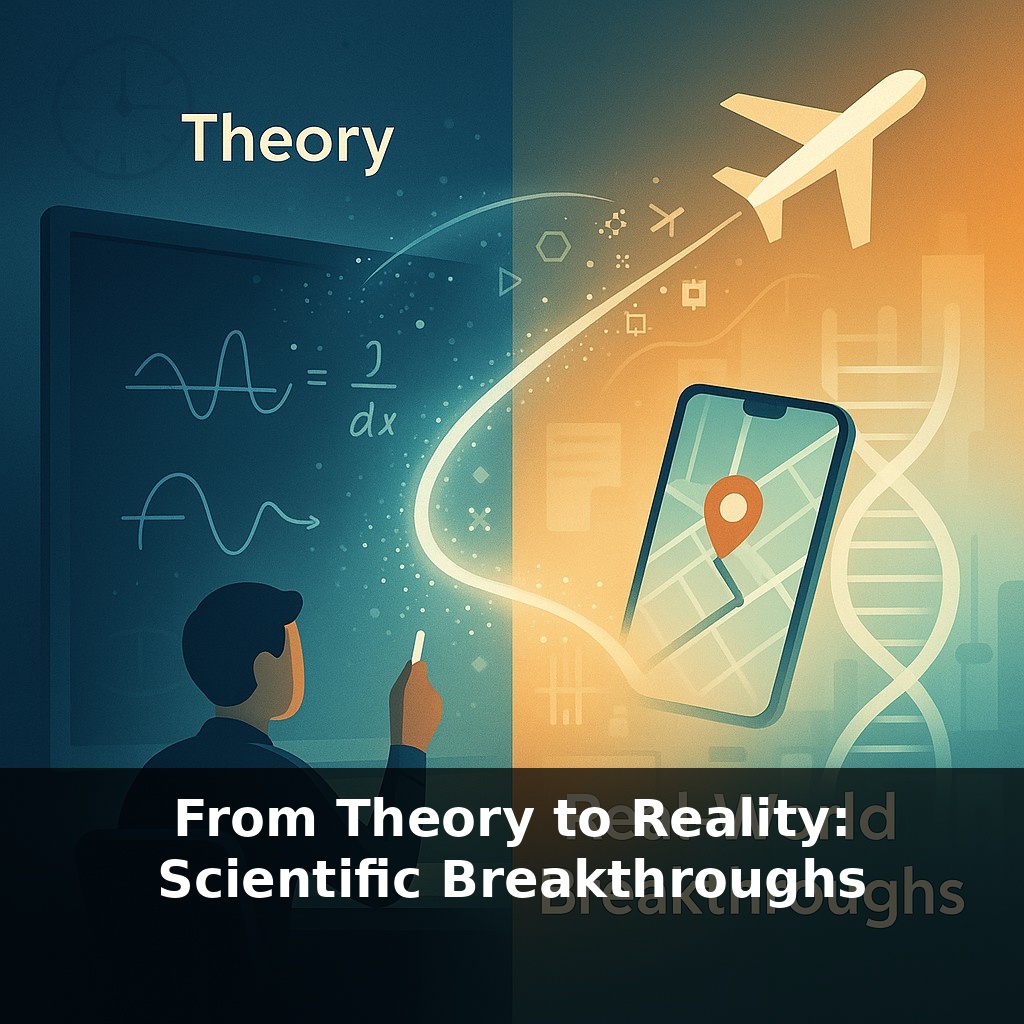
Roughly nine out of ten Nobel Prizes in physics reward ideas that came before the machines they powered. A lab theorist scribbles an obscure equation; decades later, that same idea is quietly steering planes, guiding your phone, and editing the DNA inside living cells.
By the time a breakthrough reaches your pocket or your hospital chart, it’s already survived a long, strange journey. The path usually starts in a place that feels almost useless: someone asking a “why” so narrow or abstract that it seems detached from real life. Why do certain bacteria defend themselves in such a precise way? Why does light behave both like a wave and a particle? Why do some metals hoard and release ions so efficiently?
Answers begin as symbols on a board or lines in a paper, fragile enough to be overturned by a single clever experiment. Then comes the trial by fire: years of replication, argument, and redesign in labs that look less like movie sets and more like cluttered garages for ideas. Only after that do engineers move in, treating those refined results as raw material. That’s how CRISPR left petri dishes for clinics, lasers left optics benches for fiber cables, and battery chemistry left notebooks for electric cars.
Sometimes the arc stretches across an entire lifetime. The scientists who first probed odd bacterial defenses or puzzling quantum effects rarely lived to see smartphones, genome therapies, or satellite navigation. Their work moved forward because other people, in other decades, kept tugging the same loose thread. And the process isn’t neat. False leads get funded; promising ideas stall for lack of data or tools. A clever theory can wait 30 years for a material pure enough, a magnet strong enough, or a sensor sensitive enough to put it to work in the real world. Progress depends on those tools catching up.
Some of the most “out there” ideas end up the most practical, but only after surviving three very different worlds: theory, experiment, and engineering. Each world speaks its own language and rewards different skills.
Start with the theory builders. They live in equations, simulations, and thought experiments. Their job is to notice patterns no one has named yet and to propose rules that make sense of them. They worry less about immediate payoff and more about internal consistency: does this idea contradict anything we already trust? Can it make risky predictions, not just explain old data? When a theory sticks its neck out with a prediction, it hands experimentalists a to‑do list.
Experimentalists then try to corner nature and ask, “Is this really how you behave?” They design setups that isolate one effect at a time, often building custom apparatus that barely works at first. Their success isn’t just confirming an idea; it’s also in finding the cracks. A small mismatch between prediction and measurement can signal a need to refine an equation—or, rarely, to rethink a whole framework. Crucially, experiments must be repeatable in other labs, with other teams, under subtly different conditions. That’s how a fragile claim becomes a durable result.
Only when results hold up under that kind of pressure do engineers start to treat them as reliable building blocks. But they face different constraints: cost, safety, manufacturability, user behavior, regulation. A phenomenon that’s glorious in a vacuum chamber may be useless in a sweaty pocket or a crowded city. So engineers translate precise lab conditions into messy reality, swapping exotic materials for cheaper ones, adding layers of control and redundancy, and anticipating failure modes.
Along the way, the flow of insight isn’t one‑way. Applied teams often push back new questions: a device fails in a pattern no theory predicted; a medical trial reveals side effects that don’t fit existing models. That feedback loops upstream, inspiring fresh measurements and updated equations.
This back‑and‑forth is why the average 20–30‑year lag from idea to product isn’t just bureaucracy or caution; it reflects the time needed for three different communities to argue, iterate, and eventually agree on what, exactly, we have learned—and how brave we can be in building on it.
Stand in a hospital, an airport, or a farm, and you’re surrounded by quiet case studies of this three‑stage journey. In medicine, monoclonal antibodies began as finicky lab curiosities, tailored proteins that could, in principle, target a single molecule among billions. Years later, they’re routine tools against cancers and autoimmune diseases, refined through trial after clinical trial to survive the chaos of real bodies. In the sky above, GPS owes its precision not just to satellites but to clock corrections drawn from relativity—tiny timing tweaks that only became trustworthy after years of orbital data and hardware tuning. On the ground, high‑yield crops and drought‑resistant seeds emerge from plant genetics mapped decades ago, turned into seed varieties that must germinate in real soil, not just growth chambers. The pattern repeats: today’s “too narrow” questions in quantum materials or RNA biology are already sketching the outlines of devices, therapies, and industries that don’t quite exist yet.
Soon, the same pattern will quietly rewrite our infrastructure. Quantum ideas may harden financial networks and power new kinds of search; synthetic biology could turn microbes into low‑carbon “chemical factories” for fuels or plastics. AI is already sifting candidate materials the way a coach scouts thousands of players, picking a few for real‑world trials. As these loops tighten, the gap between “wild hunch” and “everyday tool” will feel less like a lifetime and more like a single career.
So as headlines chase the next “revolution,” the real signal to watch is quieter: unfamiliar terms in papers, new instruments humming in the background, odd collaborations forming. Today’s obscure preprint or clumsy prototype may be your kid’s default tool—like maps on glass or music from the air felt magical, then quickly became background noise.
Before next week, ask yourself: 1) “Which ‘impossible’ idea in my own work or life—like the episode’s example of turning a decades-old theory into a working prototype—am I secretly excited about but keep postponing, and what’s one concrete experiment I could run this week to test even a tiny piece of it?” 2) “If I borrowed the mindset of the scientist who spent years refining that breakthrough instrument instead of chasing instant results, what specific daily habit or constraint (time block, tool, or collaboration) would I commit to for the next five days?” 3) “Looking at the unexpected failures and dead ends the researchers described, which recent ‘failed’ attempt of mine could I reframe as data, and what exactly will I change in my next trial because of it?”