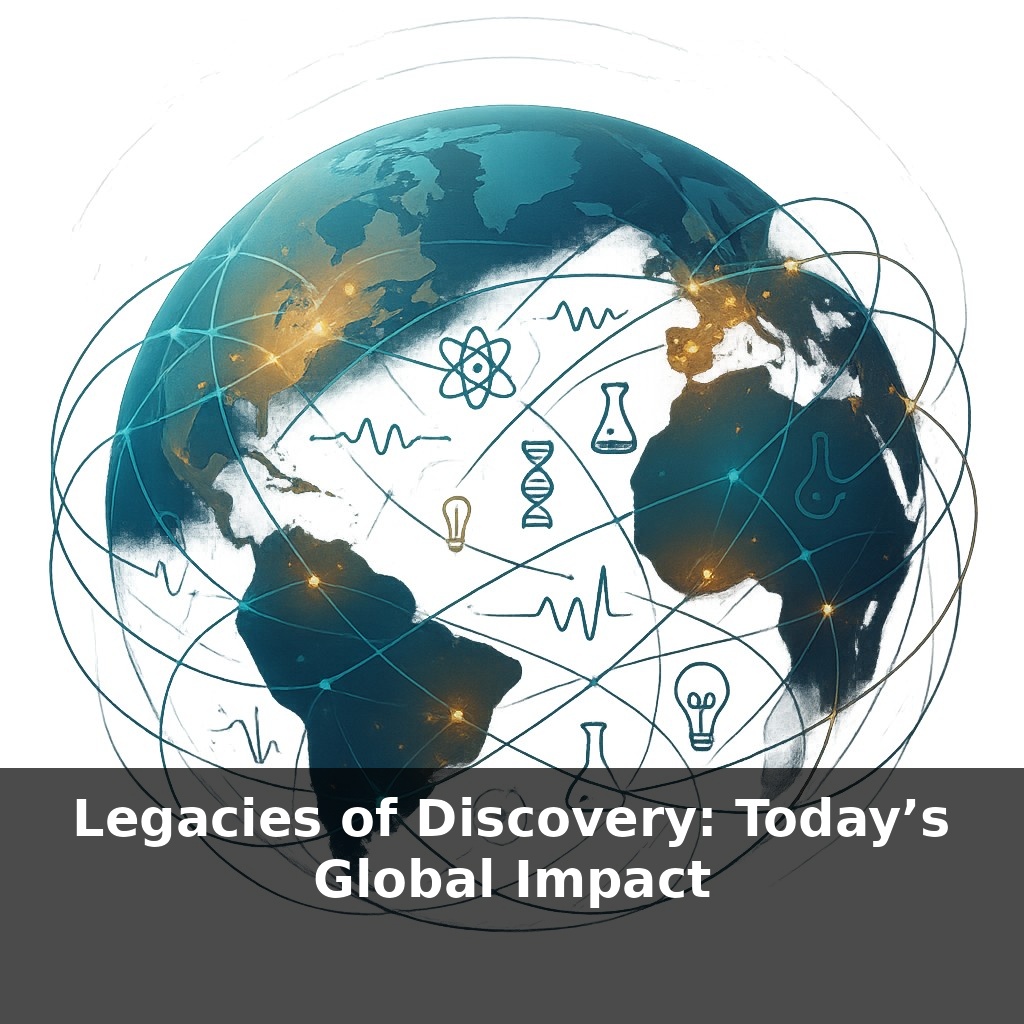
Right now, as you’re listening, roughly two‑thirds of humanity could hear this same episode—instantly. Different languages, different governments, same invisible web. The paradox is this: a few old lab discoveries quietly choreograph this hyper‑connected moment.
Open a map of the world and don’t look at borders—look at power grids, shipping routes, data cables, flight paths. They trace a handful of old breakthroughs still echoing through your day: the physics that moves electrons, the biology that tamed infection, the math that slices messages into packets and sends them across continents.
But here’s the twist: none of those discoveries arrived as fully formed “world-changers.” They were awkward, partial, even doubted. Their modern power comes from what happened next: decades of wiring cities, building hospitals, laying fiber, and negotiating standards, subsidies, patents, and public trust.
We’ll zoom in on that slow layering—how early insights hardened into systems so entrenched that your morning routine quietly depends on debates and decisions made a century ago.
Trace any one of those breakthroughs forward, and you don’t just get a gadget—you get an ecosystem of habits, rules, and expectations. Electromagnetism doesn’t only light a bulb; it shapes where factories are built, how long we work after dark, which regions industrialize first. Germ theory doesn’t only clean up surgery; it changes parenting, city planning, even how we shake hands. Packet‑switched networking doesn’t just move data; it rewires markets and friendships. In this episode, we’ll track how such “root” discoveries still steer today’s choices about power, health, and connection.
Stand in any city at night and look up: the lit windows are census data for electromagnetism’s legacy. But the glow is only the surface. Beneath it sits a path-dependent choice made in the late 1800s: which standards to back. Alternating current beat direct current not because it was morally better, but because it moved power farther with thinner wires and fit the business models of emerging utilities. Once that choice hardened into transformers, generators, and national regulations, later inventors had to design around it. Your phone charger, your laptop adapter—tiny negotiations with a century-old victory.
Health followed a similar arc, but with bodies instead of buildings. Germ theory didn’t just change what doctors believed; it reordered who lived long enough to learn, work, and vote. Penicillin’s role in World War II is one chapter: an 88% drop in bacterial deaths among Allied troops didn’t simply “save lives”—it preserved training investments, kept units intact, and altered postwar demographics. Vaccines extended that effect across peacetime: fewer childhood deaths meant larger, healthier cohorts entering schools and labor markets, helping generate those massive productivity gains economists now tally in the hundreds of billions.
Then there’s packet-switched networking quietly scripting culture. When you send a message, it’s diced, routed, and reassembled through standards hammered out by committees most of us never name. Those standards created expectations: that a video call “just works,” that money can cross borders in seconds, that news arrives before breakfast. Yet these gains are uneven. Two-thirds of humans online still leaves billions off the grid, and even among users, routing patterns favor some languages, markets, and platforms over others.
Here’s the crucial through-line: once these infrastructures take hold, they don’t just serve societies—they steer them. Cheap, reliable electricity favors data centers over paper archives. Effective antibiotics encourage surgery over long-term convalescence. Ubiquitous networking nudges work into inboxes and group chats. Each legacy discovery quietly narrows which futures feel practical, profitable, or even imaginable.
Open a ride‑share app, flick on a light, tap to confirm a vaccine appointment—each tap leans on those old discoveries, plus thousands of quiet upgrades since. A driver’s route is optimized by servers that assume stable grids; the car’s sensors rest on miniaturized electromagnetic tricks; the clinic’s booking system rides on protocols written before the web had pictures.
Consider modern logistics firms: they don’t just ship boxes, they choreograph antibiotics in cold‑chain containers, tracked by barcodes and satellites, paid for via secure online transfers. If one layer fails—a regional outage, a malware attack, a cold‑storage glitch—hospitals halfway around the world may feel it.
Tech companies know this path‑dependence cuts both ways. Once you anchor cloud services in a few regions, or standardize APIs a certain way, you’ve effectively voted on which cities become data hubs and whose laws shape global privacy. Choices that look “technical” quietly redraw economic maps.
Your challenge this week: pick one daily habit—coffee, commute, or scrolling—and trace how many steps in that chain rely on electricity, infection control, and digital networks. Stop when you hit something before 1950.
Markets, hospitals, and networks are now so intertwined that nudging one can jolt the others. Solid‑state batteries could make rooftops into neighborhood “power banks,” while CRISPR‑style tools might turn outbreaks into software‑like patch cycles instead of crises. A quantum Internet could fragment into rival “dialects” if standards splinter. Your challenge this week: watch for moments when a small tech tweak—an app update, a new sensor—quietly changes how people around you coordinate.
The next “electromagnetism” or “germ theory” might already be hiding in a lab preprint or an obscure pilot project. What turns it into a shared foundation isn’t genius alone but how we fund, regulate, and adopt it—like choosing where to lay train tracks. In watching those choices, you’re not just a passenger in history; you’re part of the steering committee.
Try this experiment: Pick one real historical “discovery” mentioned in the episode (like the mapping of trade routes, a medical breakthrough, or a navigation innovation) and trace its living impact in your own city over the next 24 hours. For example, if the episode talked about early vaccine research, visit a local pharmacy or clinic and ask a staff member how global vaccine supply chains affect what they do day-to-day. Then, note one concrete benefit and one unintended consequence you can see or hear about directly from that place. Finally, tell one friend or colleague the story of how that past discovery is literally touching your shared present, and see how it changes their perspective in real time.