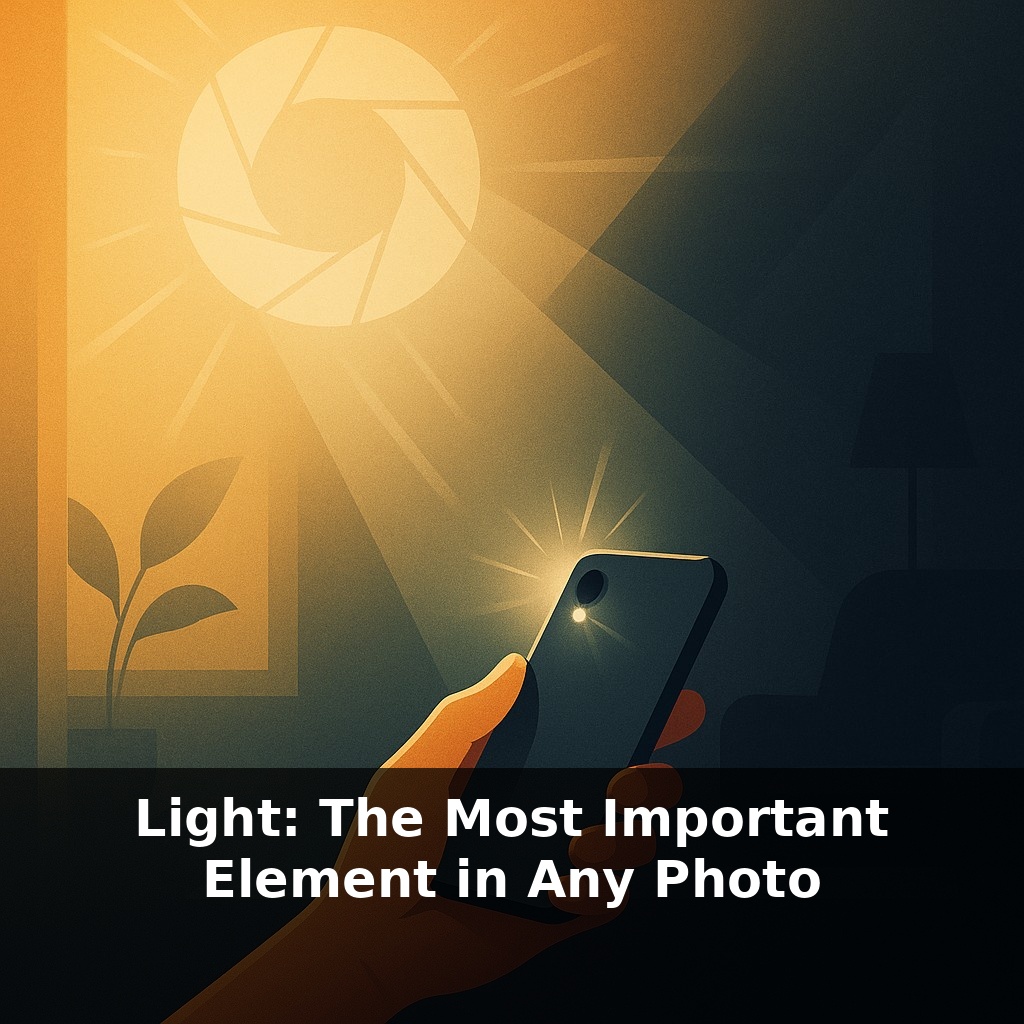
At high noon, the sun is blasting out tens of thousands of times more light than your cozy living room. Yet both scenes can make stunning photos—or terrible ones. The difference isn’t your camera. It’s how you notice, shape, and steal light in the split second before you tap the shutter.
Your phone’s camera app makes it feel like the tech is doing the magic: tap to focus, auto-expose, instant HDR, night mode. But underneath all that software, there’s a simple truth your phone can’t escape: it can only work with the light that’s already there. That’s why the same lens can make your dinner look flat at the table, then suddenly cinematic when you slide it closer to a window. The scene didn’t change—only the light did. As you start paying attention, you’ll notice how overhead office panels wash faces out, while a single bedside lamp can carve gentle shadows and give skin a glow. You’ll see how streetlights at dusk paint everything orange, while a cloudy afternoon turns the world into a giant softbox. Once you start spotting these patterns, you’ll realize your best edits happen *before* you even open the photo.
As you start to see how wildly different scenes are lit, you’ll also notice how your phone reacts to those changes. Point it at a bright window and the room goes dark; tilt down to the floor and suddenly everything brightens. That shift isn’t random—it’s your phone scrambling to balance brightness, color, and detail at once. Midday sun pushes it to protect highlights; a dim café forces it to boost exposure and smooth out noise. Mix in warm bulbs with cool daylight and skin tones can swing from healthy to weird in a single step. Learning to predict these reactions is the first step toward quietly taking control back.
Think of light in three dimensions: direction, size, and color. Your phone is reacting to all three at once, even if it only shows you a single brightness slider.
Direction first. Turn slowly in a circle near a window or under a streetlamp and watch how your own face changes in the preview. When light hits straight from the front, details flatten and skin can look a bit featureless. Rotate until it comes from the side and you’ll see one cheek brighten while the other deepens in tone; a tiny twist can turn a cheerful portrait into something dramatic. Light from above carves eye sockets; light from below (like a phone screen in a dark room) gives a spooky cast. You’re not changing locations—just the angle between you, the light source, and the camera.
Next is size. Not the wattage on a package, but how big the source *appears* relative to your subject. A bare bulb across the room is a tiny, sharp source: it cuts out crisp shadows and specular highlights. Pull a sheer curtain across that same bulb, or bounce it off a white wall, and it becomes a much larger source; edges soften, textures smooth, reflections spread out. Outside, a cloud layer does the same thing to the sun: it turns a blinding point into a sky-sized diffuser. On your phone, you’ll notice that “big” light makes transitions between bright and dark more gradual, which your sensor handles more gracefully.
Then color. Every light source leans warm or cool. Your phone tries to guess and correct, but mixed lighting will still trip it up. Step halfway between a cool window and a warm lamp and you may see one side of a face go slightly cyan while the other drifts orange. Skin is particularly unforgiving: a small shift can make someone look tired or ill. Watch how white objects in your frame change tone as you move—from bluish outside to golden inside—and you’re really tracking color temperature without needing any numbers.
The more you notice these three variables, the more deliberate you can be. Instead of “this café is dark,” you’ll think, “light’s high and small, and the color is very warm—where can I move to get a bigger, softer, cleaner source on this scene?”
Stand next to a window with someone you know well and study how their face changes as they take a single step at a time: closer, then sideways, then turning slowly. Each tiny move rewrites their mood—soft, harsh, mysterious, open—without them changing expression. Do the same under a neon sign, or in the glow of an open fridge at night. You’re not “trying poses”; you’re mapping how space itself sculpts their features.
Now flip the script and watch backgrounds. Shoot the same friend against a bright hallway, then a dark doorway, then a wall that’s catching late-afternoon light. Their face might keep the same brightness on screen, but the story around them shifts from airy to moody to graphic. You’re seeing how your phone quietly trades detail in one area for another.
For a week, treat different rooms like test labs. Cafés, bus stops, elevators—each one is a new experiment. A single step or tilt of the wrist can turn clutter into a clean frame, or chaos into something cinematic.
In a few years, your phone may treat lighting like a filter: tap to “move” a sunset, warm up faces, or turn flat midday scenes into something moody—all after you’ve shot them. That sounds like cheating, but it will also free you to focus more on timing and story. The catch: if you feed the sensor dull, cluttered scenes, no relight will save them. Just like a chef still needs fresh ingredients, future you will still need to notice where light falls, not just which slider to drag.
Your photos will change the moment you treat brightness like weather: always shifting, rarely neutral, full of microclimates a few steps apart. Your challenge this week: before every shot, move three times—forward, sideways, then rotate your body. Watch how faces, walls, and reflections react. Don’t fix anything yet; just learn how the scene rewrites itself.