Hannibal’s Masterstroke at Cannae
📝 Transcript
Fewer than one in ten battles in history end with one side almost erased from the map. Cannae was one of them. A hot Italian plain, dust in the air, Roman legions pressing forward, certain of victory… and step by step, breath by breath, Hannibal was closing the trap.
The strangest part? On paper, this should have been a routine win for Rome. They had more men, deeper reserves, political backing, and the confidence that comes from centuries of success. It was as if every variable in the equation screamed “Roman victory,” yet the answer that day was catastrophe. The hidden factor was thinking. Hannibal wasn’t trying to be stronger; he was trying to be smarter about where strength actually mattered.
He chose the ground. He read the weather and the wind. He arranged his troops less like a wall and more like a spring, coiled to bend, then snap back. As rigid ranks pushed forward, his formation flexed, then tightened. Cannae becomes less a story about ancient warfare and more a case study in how overconfidence meets design: when raw power insists on smashing straight ahead, and a better mind quietly rearranges the board around it.
That “rearranged board” started long before swords clashed. Hannibal had spent months shaping what would happen in a few brutal hours. He learned how his opponents liked to move, how their commanders thought, how their pride pulled them toward one kind of answer every time. He then set up a situation where that preferred answer would be the worst possible choice. Like a musician who writes a melody knowing exactly which note your ear expects next, he designed the battle so Rome would follow its own habits—right into the pattern he needed, at the pace he wanted, in the place he had prepared.
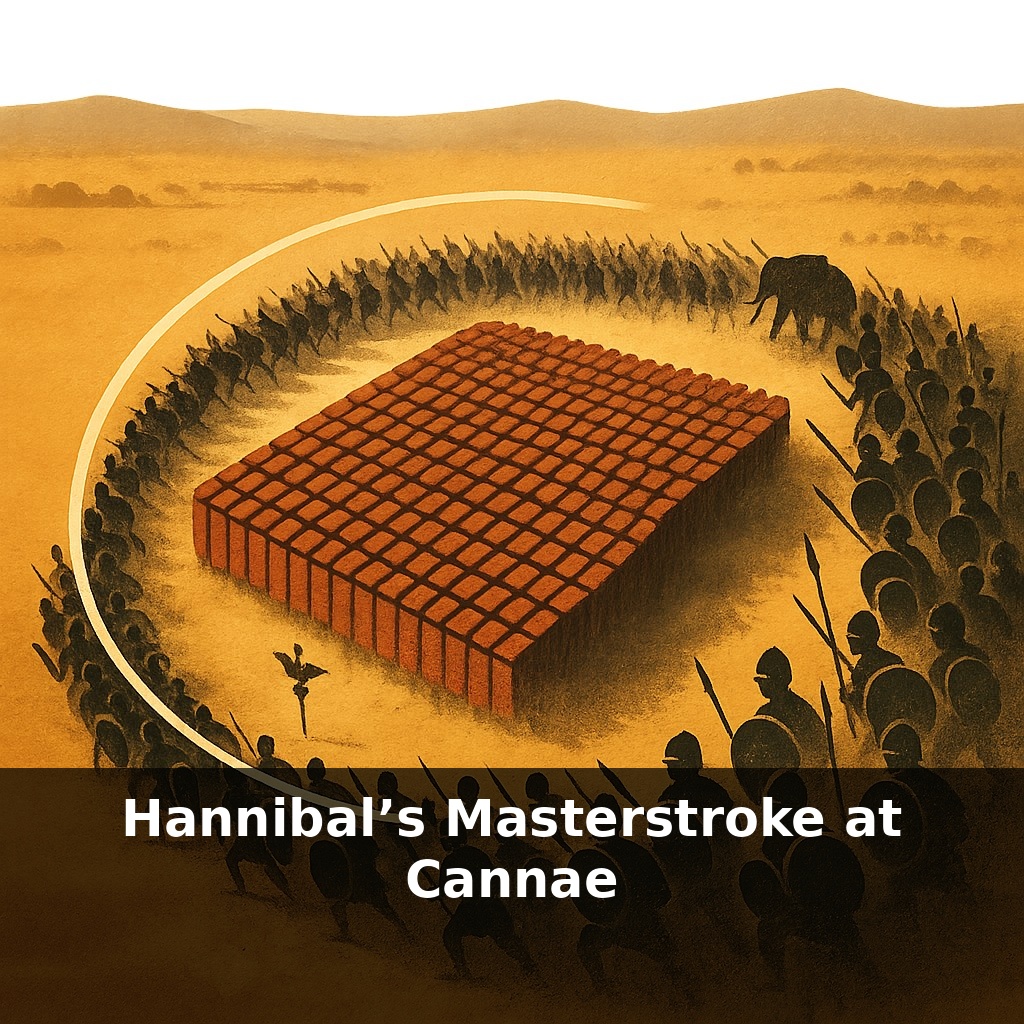
The crucial detail is in the numbers: the Romans tried to win by packing **more bodies into less space**. They compressed their infantry into an unusually dense block, confident that weight alone would break through. Hannibal quietly took the opposite bet: if his line could bend without breaking, that dense mass would lose room to move, to think, to adapt.
So he stacked his **veterans on the wings**, not at the front. In the center he placed a mix of Spaniards and Gauls—good soldiers, but not his best—arranged in a shallow arc that bulged **toward** the Romans. Behind them, further back, he positioned his toughest African infantry in straighter, more controlled lines. They were not there to meet the first impact; they were the hinge for the closing door.
On his **left**, he stationed heavy cavalry facing Rome’s noble horsemen. On his **right**, lighter Numidian cavalry—fast, agile, used to harassing and distracting. These weren’t just different troops; they were different jobs in the same script. One side would smash, the other would stall, and both would eventually turn inward.
When contact began, the center stepped forward and **slowly gave ground**, retreating in a controlled curve. To the Romans, it looked like success: enemies falling back, banners yielding, space opening. But with every step they took, they moved deeper into a narrowing pocket. Dust, heat, and the crush of their own comrades limited signals and vision; commanders near the front could barely see past the shields in front of them.
Meanwhile, the Carthaginian left didn’t just hold—it **drove off** the Roman cavalry, then wheeled behind the Roman rear. The Numidians kept the other Roman horse occupied just long enough. Once those riders were scattered or pinned, nothing remained to guard the infantry’s back.
Only then did the African infantry on the flanks pivot inward, forming hard, disciplined edges around a soft, exhausted core. Pressure came from front, sides, and finally from behind. The Roman advantage in headcount flipped: the more men they had, the less air, space, and options remained inside that tightening ring. Like a storm system that starts as scattered gusts and then spirals into a single, inescapable vortex, Hannibal’s scattered moves coalesced into one overwhelming constraint: nowhere left to go.
In modern terms, Cannae looks less like a battlefield and more like a masterclass in **engineering pressure**. Hannibal didn’t just “win a fight”; he designed a process where, the further the Romans pushed, the fewer options they had.
You can see the same pattern in industries that weaponize **density and flow**. Think of a retailer that narrows its product line but controls every inch of shelf space and logistics, so competitors must fight for scraps at the edges. Or a streaming platform that quietly shapes recommendation funnels: the more a rival spends on one big show, the more that traffic gets absorbed and redirected deeper into its own catalog.
Leaders who study Cannae today don’t usually care about spears and shields; they care about **shaping behavior without saying a word**. They ask: Where are opponents already committed to moving in one direction? How do you make that direction gradually worse for them and better for you? And crucially: How do you keep your own “wings”—your best people and assets—free to pivot when the moment to close the circle finally arrives?
Modern planners mine Cannae for patterns of **timing** and **coordination**. The lesson isn’t just “surround the enemy,” but **shape the environment** so their next logical move quietly worsens their position. Cyber teams do this with decoy servers and layered traps; product strategists do it with ecosystems that pull users sideways, then backward, from rivals. Building on this idea of strategic traps, let's explore how you can apply similar tactics in your pursuits. Like a tide that seems harmless at first, the pull only becomes obvious when reversal is no longer simple.
So the deeper lesson isn’t about one ancient field; it’s about **how you set traps for momentum itself**. Today that might mean laying pricing tiers so rivals always pick the option that helps you, or arranging a product roadmap so each launch nudges users toward your core offer, the way a river’s curves slowly steer driftwood toward a single hidden inlet.
To go deeper, here are 3 next steps: 1) Pull up Barry Strauss’s *The Battle of Cannae* lecture (or his book *Masters of Command*) and sketch Hannibal’s double‑envelopment on a blank map of southern Italy using Google Earth or Scribble Maps, placing Roman and Carthaginian units exactly as described in the episode. 2) Open the free “Cannae 216 BC” scenario in the *Hannibal: Rome and Carthage in the Second Punic War* board game module on Vassal (or another digital wargame like *Field of Glory II*), and play just the opening 5–10 turns to see how cavalry superiority and the elastic center work in practice. 3) Read the Cannae sections in Polybius’ *Histories* (Books 3.107–118) via Perseus Digital Library, and as you go, pause to compare each phase of the battle with what the podcast highlighted—Roman depth, compressed frontage, and encirclement—jotting questions to bring to a discussion thread on r/AskHistorians.
From this course
Strategic Genius: Replay of Iconic Battles
6 episodesUnlock all episodes
Full access to 6 episodes and everything on OwlUp.
Subscribe — $1.99/monthLess than a coffee ☕ · Cancel anytime