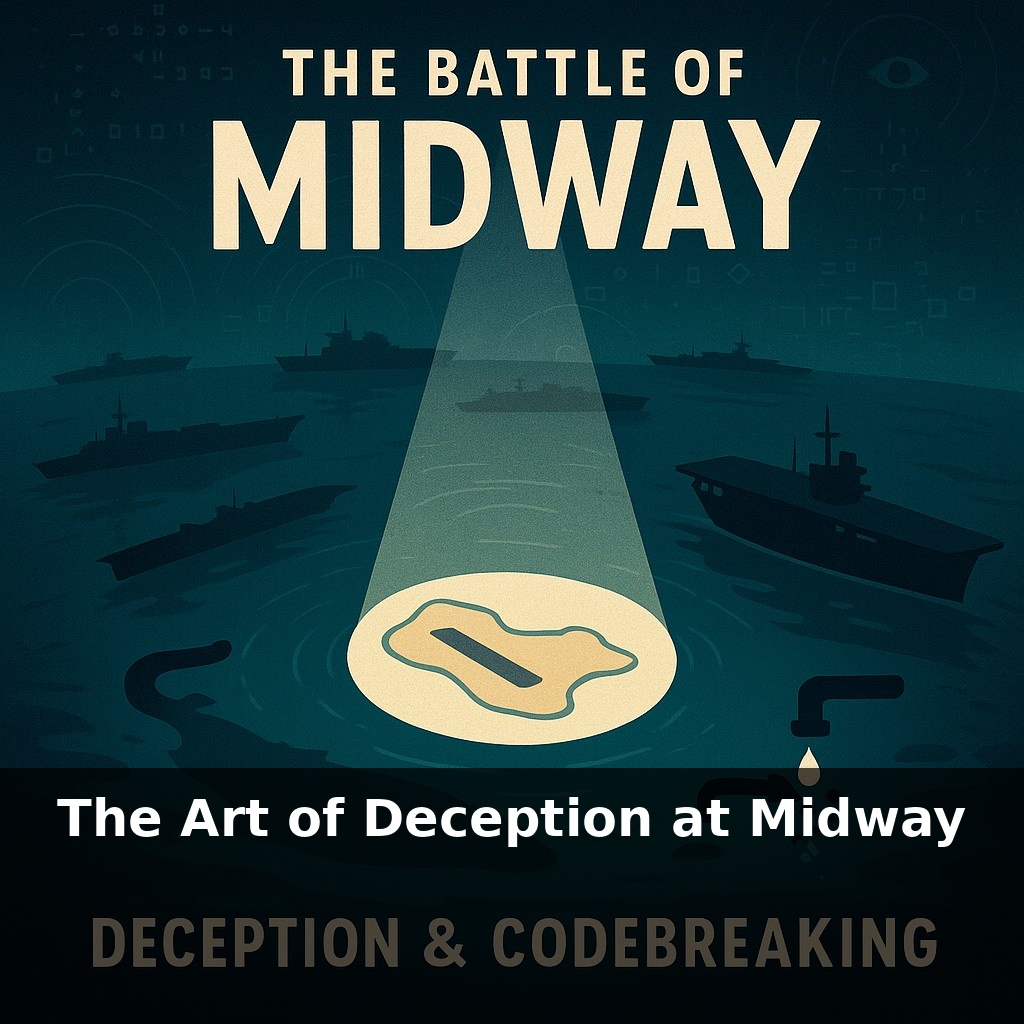
“Midway wasn’t won first on the waves—it was won in whispers.” A tiny island, a supposed broken water plant, and a handful of codebreakers set a trap for the most feared fleet in the Pacific. Stay with me as we follow the moment deception turned the tide of a war.
By early June 1942, Nimitz faced a brutal math problem: fewer carriers, fewer planes, and an enemy that had steamrolled across the Pacific for six months. A straight-up fight favored Japan. So instead of asking, “How do we win this battle?” U.S. planners quietly asked a different question: “How do we make them fight the wrong battle?” That shift turned an exposed outpost into deliberate bait. Midway’s pilots, ground crews, and even its geography became parts of a larger trap, like careful notes in a score designed to lure an overconfident orchestra into the wrong key. While Japanese commanders believed they were executing a flawless, rehearsed strike, they were actually walking into a performance the Americans had already rehearsed in their minds—down to where enemy carriers were likely to be when they finally launched their planes.
Nimitz’s real edge wasn’t firepower; it was timing and nerve. His staff had only fragments of enemy plans, overlapping like half-erased chalk lines on a board. Yet from those sketchy hints they fixed carrier positions, likely approach routes, even rough attack windows. That clarity let him do something radical: send his outnumbered carriers forward early, then hold them just outside the Japanese search net, like a storm front waiting beyond the visible horizon. When the first reports from scouts crackled in, he didn’t improvise from scratch—he simply unfroze a plan that had been sitting, coiled, for days.
Nimitz’s “whispers” advantage rested on something far less glamorous than carrier duels: disciplined pattern-reading. In the Pearl Harbor aftermath, his codebreakers had been grinding for months, reconstructing fragments of JN-25 like shards of a shattered mirror. By late May, they saw enough reflected shapes to sense a major operation aimed somewhere they called “AF”—but which island, and how soon?
The answer emerged from two parallel efforts. In Hawaii, Station HYPO tracked rhythm: which Japanese units talked more, which routes lit up with logistics chatter, how message volume changed when forces moved. In Washington, OP-20-G focused on structure: code groups, recurring phrases, shifts in superencipherment. Neither had a full picture. Together, they noticed something: traffic tied to “AF” behaved like preparations for a complex strike, with carriers, battleships, and transports all entering the conversation.
That’s when the “water-distillation” ploy became more than a clever stunt; it was a calibration tool. When Japanese signals echoed the planted Midway “shortage” inside JN-25, analysts didn’t just confirm AF—they tuned their whole mental model of Japanese planning language. Specific logistics phrases, once vague, now lined up with a concrete place and time, sharpening every subsequent intercept.
Armed with that evolving map, Nimitz made three bold operational calls. First, he accepted uncertainty: he would commit carriers based on partial data, trusting the trends HYPO saw in daily traffic more than any single decrypt. Second, he inverted risk: instead of shielding his last carriers, he pushed them forward into a concealed position, betting that surprise would be worth the exposure. Third, he decentralized initiative: commanders like Spruance received broad intent and high-confidence timing windows, then freedom to act on fleeting sightings.
On 4 June, this preparation met a messy reality. Midway’s first strikes were scattered and costly; torpedo squadrons attacked in vulnerable runs that looked, in isolation, like failure. But their pressure forced Japanese carriers into a cycle of landing, refueling, and rearming at precisely the wrong moment. When U.S. dive-bombers finally arrived overhead, enemy decks were crowded with fueled aircraft and ordnance—an opportunity created not by a lucky coincidence, but by weeks of reading, prodding, and quietly shaping how and when the enemy would expose its own weak points.
Nimitz’s real genius at Midway shows up most clearly when you compare it to how high-performing teams manage modern crises. Think of an incident-response team at a tech company facing a massive, unfolding outage: engineers don’t know the root cause, dashboards only show partial anomalies, and each log file is like one more cryptic intercept. The strongest leaders don’t wait for a perfectly decoded picture; they act on converging clues, pre-position options, and assign people to “likely hotspots” before the full pattern is obvious. That’s the same discipline Nimitz applied: separate signal from noise, decide early, and accept that some moves will be wrong but buy flexibility overall.
In business, you see a similar pattern in supply-chain managers who quietly reroute inventory weeks before a disruption becomes public, because small shifts in shipping data tell them something big is forming. Their edge isn’t secret knowledge—it’s the nerve to trust faint, consistent indicators over comforting guesses.
Today’s leaders inherit a new kind of ocean: torrents of emails, logs, transactions, and sensor pings where real threats and chances drift past like subtle shifts in wind. The lesson isn’t nostalgia for code rooms—it’s cultivating teams that scan for faint pattern-changes and test small feints of their own. As quantum tools harden encryption, advantage will migrate toward those who can choreograph narratives and data flows, nudging rivals to reveal intent long before they realize they’ve spoken.
Midway hints that future contests may hinge less on who shouts loudest and more on who listens with intent. Leaders who treat data like shifting tides—testing small probes, watching how stories ripple, adjusting stance as the current turns—will spot openings others miss. Your challenge this week: notice one “quiet clue” daily and sketch the move it invites.