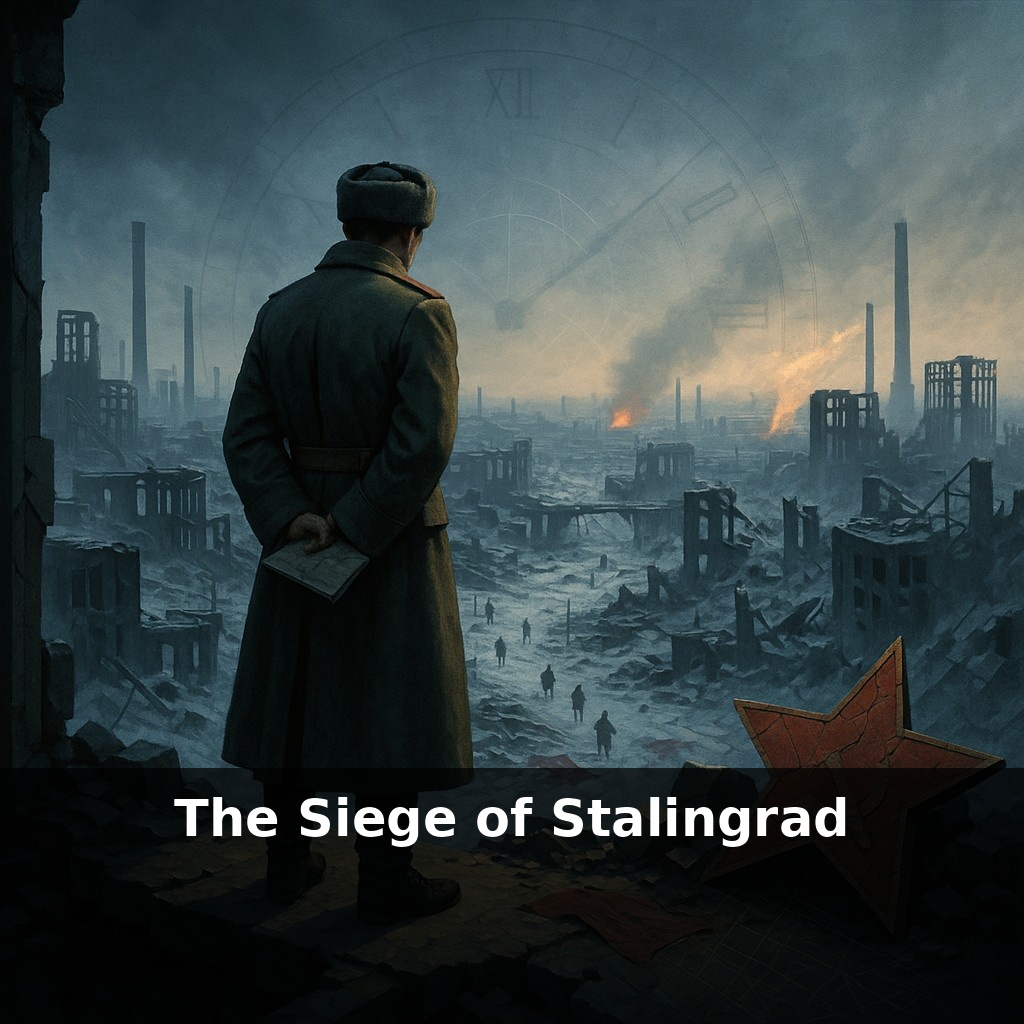
Gunfire echoes through a city that no longer exists. Whole neighborhoods are now dust, yet orders still say: “Not one step back.” A commander chooses between saving his army or obeying his leader—knowing either choice could destroy everything he’s supposed to protect.
Six months. That’s how long Stalingrad burned—long enough for summer dust to turn into frozen ruins, and for a confident advance to harden into a trapped disaster. By the time the guns fell silent in February 1943, over a million Soviet soldiers and civilians and hundreds of thousands of Axis troops were dead, wounded, or captured. Yet what made Stalingrad decisive wasn’t just the staggering cost; it was who held the initiative when it ended. A German army that had pushed deep into Soviet territory now found itself encircled, cut off from supplies as temperatures fell to –30 °C. Orders from above insisted on holding the city at any cost, even as escape routes vanished. In this episode, we’ll explore how control of time, space, and momentum quietly shifted—how a force that looked tactically strong ended up strategically cornered, and why that reversal reshaped the entire Eastern Front.
By late 1942, Stalingrad was no longer just a city; it was a symbol both sides felt they couldn’t afford to lose. Hitler saw its name as a personal challenge to his rivalry with Stalin, while Soviet propaganda turned its defense into proof that the Red Army could stand and bleed the invader dry. That symbolism distorted strategy. Resources, reinforcements, and attention were pulled toward ruins that held little intrinsic value. Like a storm system that refuses to move on, the battle began warping everything around it—logistics, diplomacy, even how both sides measured “victory” itself.
Numbers on a map made the German position look impressive: streets occupied block by block, Soviet forces clinging to thin strips along the Volga. But under the surface, two very different games were unfolding.
On the German side, focus narrowed to taking factories, rail yards, and riverbank strongpoints. The Sixth Army and its allies fought house to house, room to room, burning through elite infantry, ammunition, and fuel just to move a few hundred meters. Every block gained inside the city pulled them deeper into a narrow salient with exposed flanks held by weaker Romanian, Italian, and Hungarian units. The more “success” they had in the ruins, the more brittle the whole front quietly became.
Soviet planners watched this and prepared something that didn’t look heroic on propaganda posters: a huge double‑envelopment in the open steppe north and south of the city. Operation Uranus massed roughly a million troops, supported by hundreds of tanks and aircraft, not to win spectacular street battles, but to punch through the thinly held shoulders of the German advance. In November 1942, when those attacks hit, Axis lines cracked within days. Stalingrad itself stayed contested, but the real story was happening outside the city limits.
Once the ring closed, the German Sixth Army wasn’t just under pressure—it was cut off. Supply runs depended on a Luftwaffe airlift that never added up. Daily needs were thousands of tons; actual delivery was a fraction of that, and worsening winter weather and Soviet fighters kept pushing it lower. Rations shrank, horses were slaughtered for meat, fuel was hoarded for a last‑ditch defense instead of movement. By January, units that had once spearheaded an invasion were reduced to holding shrinking pockets amid ruins.
Think of it like a cold front slowly wrapping around a warm air mass: on the ground, the temperature doesn’t crash all at once, but the outcome is locked in long before anyone feels the full chill. The Sixth Army’s fate was sealed when the encirclement solidified and relief attempts stalled. When Field Marshal Paulus surrendered in February 1943, it wasn’t a single decision in isolation; it was the visible end of a months‑long shift from outward advance to inescapable containment.
Factories at Stalingrad didn’t just produce matériel; they absorbed it. Elite German infantry, pioneer units, and artillery were fed into block‑level assaults that couldn't be quickly redeployed elsewhere. Meanwhile, Soviet command kept entire fronts relatively quiet to hide the buildup for Uranus. That meant some sectors accepted temporary stagnation so that one sector could deliver a decisive shock.
A modern parallel: companies sometimes over‑invest in “flagship” projects that win presentations but drain top talent and budget. The real leverage may lie in less glamorous restructuring—like quietly strengthening supply chains or backend systems while competitors chase spectacle.
Note, too, how both sides bet on different forms of endurance. German command gambled on short, intense effort followed by consolidation; Soviet planners assumed a drawn‑out grind they could eventually dominate. You see similar patterns when startups race for rapid user growth while incumbents aim to outlast them with deeper reserves—each side is really wagering on how long the game will run and where fatigue will bite first.
Future conflicts in dense cities will test whether precision tech can truly “thread the needle” between military targets and civilians. Drones, sensors, and AI may map basements and alleys like weather radar tracks micro‑storms, but coordination failures could still spiral. Cold‑weather gear, power grids, and data links become as critical as armor. Politically, memories of urban annihilation already push some states to favor sieges by sanctions and blockades over direct assault.
Stalingrad also reshaped how people remembered war itself: a frozen ruin turned into myth, songs, and memorials, warning what happens when escalation outruns imagination. Your own “front lines” may be meetings, markets, or code, but the pattern endures: once events harden like ice, only choices made far earlier still move.
Try this experiment: Pick a 24-hour period this week and run it like you’re commanding a “Stalingrad front” in your own life. Choose one tough objective (a “Volga bank” goal, like finishing a project you’ve been avoiding) and deliberately “ration” your time and energy the way the Soviets rationed food and ammo—set strict time blocks, limited social media, and defined breaks. When something unexpected “bombs” your schedule (emails, messages, distractions), respond with a pre-decided “defensive tactic” (for example, a 10-minute delay rule before answering anything). At the end of the 24 hours, quickly assess like a field report: Did strict rationing and pre-planned defenses help you hold your “city,” or did your lines collapse—and what would you change for the next “campaign day”?