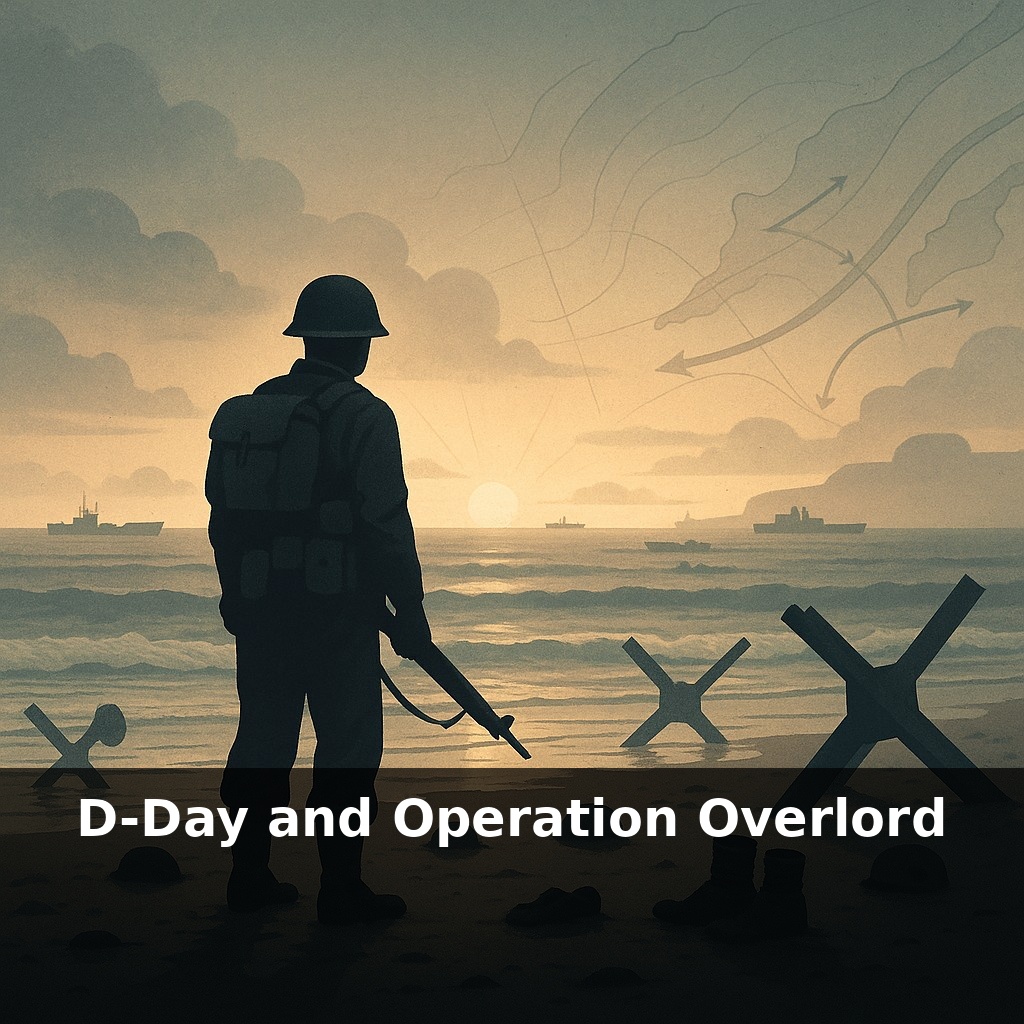
Before dawn on 6 June 1944, thousands of young men stepped into the dark, knowing two things: many wouldn’t see sunset—and the future of Europe rested on a stretch of French sand they’d never visited. Despite detailed plans, chaos loomed on every horizon.
By the summer of 1944, the Allies faced a brutal arithmetic problem: every month they delayed a Western invasion, more people died in camps, on the Eastern Front, under occupation. But moving too soon risked a catastrophic failure that could prolong the war for years. So Overlord became a test of *calculated readiness* rather than perfect conditions. Commanders argued over where to strike, how to mass enough ships and landing craft without tipping off German intelligence, and how to coordinate armies that didn’t even share a first language, let alone doctrine. They layered deception operations over genuine preparations, choreographed tides with moonlight and bomber routes, and built entire fake armies in England. If resilience and sacrifice were the human fuel, this was the machine: an immense, fragile system that had to work once, on a single day, in hostile weather.
Overlord’s real challenge wasn’t just getting ashore; it was building a self-sustaining war machine on hostile soil faster than the Germans could react. The first waves carried not only riflemen but engineers, medics, radio operators, and traffic controllers whose job was to turn chaos into structure within hours. Behind them followed floating harbours, fuel pipelines under the sea, and mile‑long queues of vehicles waiting to roll inland. Think of it as laying railway tracks from a moving train: supplies, reinforcements, and information all had to arrive in a precise, accelerating rhythm or the beachhead would slowly suffocate.
By dawn, the question wasn’t “Will we land?” but “Can we expand before the Germans organise a punch?” Overlord’s real genius lay in how it managed tempo: who moved when, where, and with what support. The five beaches were not five separate battles but a single, interlocking system. If one sector bogged down, neighbouring forces had to flex—pushing inland here to relieve pressure there, adjusting artillery plans hour by hour as reports filtered back through radios often clogged with static or silence.
Each beach had a distinct task. Utah was angled toward a faster link‑up with airborne troops inland, to block German counter‑attacks from the south. Omaha, the bloodiest, sat opposite key road networks the Allies desperately needed; failure there would have split the invasion in two. Gold, Juno, and Sword weren’t just additional entry points; they were the hinge designed to drive on Bayeux and Caen, to seize ground where airfields and major highways could later feed the growing force.
Above them, thousands of aircraft weren’t simply bombing; they were shaping the flow of the German response. Fighters prowled for any sign of armour on the move. Jabos—fighter‑bombers—turned crossroads and rail yards into bottlenecks, so divisions that looked formidable on paper arrived at the front in fragments, hours or days too late to throw the Allies back into the sea.
Underlying all this was a quiet but brutal calculation about time. The Allies knew German panzer divisions, if committed quickly and in mass, might smash the early lodgements. So every hour that passed with the Germans unsure whether Normandy was the *main* invasion, or still expecting a blow at Pas‑de‑Calais, tilted the balance. That uncertainty was worth more than any single division.
On the ground, junior officers and NCOs became the real processors of this complexity. When tides scattered units, they improvised new assault teams from whoever was nearby. When landmarks were obliterated, they navigated by compass bearings and snippets of intelligence briefed weeks earlier. Orders provided a skeleton; adaptation supplied the muscles.
Coordinating this was like conducting an orchestra in a storm: the score mattered, but survival depended on listening, adjusting, and knowing which instruments *had* to be heard above the noise.
Overlord’s deeper insight is how many *small* systems had to work together for that single day to matter. Take traffic control on the invasion beaches: military police with colored paddles, hand‑painted signs, and improvised one‑way routes turned a lethal traffic jam into a flowing artery inland. Or the beach clearance teams—engineers, demolition experts, and naval crews—who treated each stretch of sand like a live puzzle, clearing mines and obstacles in minutes so the next wave didn’t drown on the tide. Radar operators and codebreakers, far from the shoreline, watched for patterns in German movement the way a seasoned meteorologist reads shifting pressure lines, flagging threats that weren’t yet visible to troops on the ground. Meanwhile, logistics officers in rear areas treated every landing craft as a scarce, reusable asset, timing unloads so that ships spent the absolute minimum minutes beached and vulnerable. The lesson isn’t just “plan big”; it’s that decisive days are usually won by hundreds of unglamorous micro‑systems, each doing its quiet job well enough that others can do theirs.
Overlord hints at a future where winning isn’t just about strength, but about how fast you can re‑wire a complex system mid‑crisis. Modern planners sketch scenariBuilding on the intensity of the Allied efforts, picture scenarios where ports are cratered, satellites blinded, supply chains snapped—then ask, “What’s our Normandy workaround?” The quiet shift is ethical as much as technical: coalitions become less about prestige flags and more about interoperable trust, like neighbours who already agreed who grabs which bucket when the fire bell rings.
Overlord’s aftermath looked less like a victory parade and more like a construction site: bulldozers carving airstrips from hedgerows, signal crews stitching radio nets across ruined villages, medics turning barns into trauma wards. The real legacy isn’t just that the Allies got ashore, but how fast they turned chaos into a livable, usable bridgehead.
Before next week, ask yourself: Where in my life right now do I need the kind of painstaking preparation the Allies used for Operation Overlord—what’s my personal “landing zone,” and what specific reconnaissance (research, conversations, practice) could I do this week to reduce uncertainty like they did before hitting Normandy? If you imagined your next big challenge as your own D-Day, who are the 2–3 “allies” you’d want on your side (like the British, Canadians, resistance fighters), and what concrete support could you ask them for in the next few days? Looking at the incredible risks those soldiers accepted in the first wave at Omaha and Utah, what is one meaningful risk you’ve been avoiding that you’re now willing to face, and what’s the first bold step you could take toward it before the week is over?