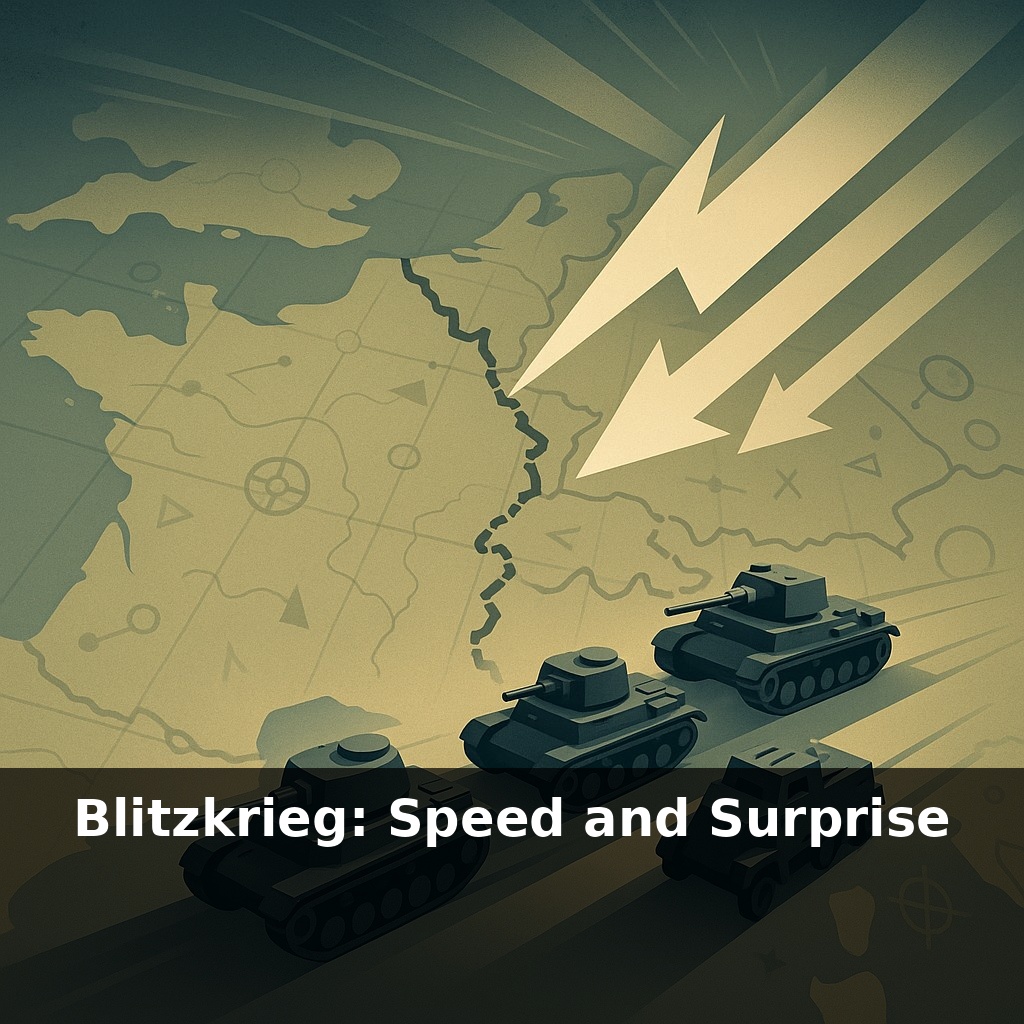
Armies once needed months to break through a single defensive line—then, almost overnight, whole countries collapsed in days. In this episode, we dive into how speed, surprise, and a new kind of coordination turned slow-moving war plans into a sudden thunderclap.
135 German divisions broke France in six weeks—a campaign planners once assumed would take at least a year. The shock wasn’t just in how fast it ended, but in *how* it unfolded: columns slicing deep instead of grinding forward, commanders adjusting on the fly, and entire headquarters realizing too late that their “front line” no longer existed.
In this episode, we zoom in on the engine behind that effect: a way of organizing people and tools so that decisions move faster than problems can pile up. Leaders at the tip of the spear carried radios, clear intent, and permission to improvise; staff in the rear focused less on controlling every move and more on keeping momentum from stalling.
Think of it as composing a piece of music where tempo matters less than timing—each section enters not when it’s “ready,” but at the exact moment it amplifies the shockwave already in motion.
Blitzkrieg added something else: a ruthless focus on *where* to move first. German planners hunted for weak seams—marshy gaps, quiet sectors, slow headquarters—and pushed their best units there, even if it meant leaving other areas almost naked. Support followed the tip, not a neat line. When resistance stiffened, they didn’t bash forever; they slipped around, probing for a softer spot, like water finding a crack in rock. In business or policy terms, it’s choosing one narrow corridor to over-resource, then flowing everything behind the first real breakthrough.
A Polish staff officer in 1939 joked bitterly that by the time they finished updating one map, the front had already moved off the paper. That wasn’t hyperbole; it was the lived experience of facing a system designed to keep unfolding *faster than anyone else could redraw reality*.
The real engine here wasn’t just where the first blow landed, but what happened *immediately after* it connected. German panzer leaders were trained to think in terms of “next doors” opening: the moment a gap appeared, reconnaissance units shot through it, not to seize territory, but to *find* the next set of weak joints—bridges, junctions, radio nodes, fuel depots. Behind them, follow-on waves weren’t marching in a tidy line; they were pre-allocated to specific tasks: secure flanks, widen the corridor, choke off enemy retreat routes, push supplies forward. Each echelon had a different job, but all served the same goal: keep the enemy system from knitting itself back together.
That’s why radios mattered so much. They didn’t make tanks faster; they made *intent* portable. A lead commander could pivot an entire column around a newly discovered opportunity—an undefended crossing, a panicked HQ—without waiting for written orders. Conversely, when a thrust bogged down, nearby units could be retasked in hours, not days. Think less “perfect script,” more “tight jazz ensemble” where everyone knows the key and tempo, so they can improvise without creating noise.
This approach also weaponized *ambiguity*. By driving deep and erratically, attackers forced defenders into a paralyzing question: “Do we plug the current gap, protect the capital, or save the army?” Each delay made all three harder. In France, columns that seemed reckless on the map—narrow, exposed, racing toward the coast—were calculated bets that the shock to Allied headquarters would buy the time needed for the rest of the force to catch up.
In modern terms, this is less about moving the fastest in a straight line and more about consistently being the first to turn when the road bends.
Strong leaders in 1940 weren’t the ones who shouted the loudest; they were the ones who saw the *second* and *third* consequences of a sudden opening. When a French unit pulled back to “shorten the line,” German staff didn’t just note the retreat—they asked: Which road did they uncover? Which depot is now exposed? Which neighboring commander is suddenly unsure what’s on his flank?
Think of a weather front rolling in: the first gust isn’t the storm, it’s the signal. Smart farmers don’t just brace for wind; they rethink which fields to cover, which tools to move, and which tasks to drop completely. The value is in how quickly they re-sequence everything around the new reality.
Modern teams can copy this mindset. When a competitor launches a product early, don’t only react to the launch itself; scan for what they *didn’t* do: features cut, markets ignored, partners left waiting. Those gaps are your equivalent of unguarded junctions and fuel dumps—places where a small, fast move can have outsized impact before anyone else notices what’s really now up for grabs.
A future “digital Blitzkrieg” wouldn’t just move forces faster; it would rewrite the tempo of perception. Swarms of cheap sensors, autonomous drones, and AI copilots could keep updating the picture like rain constantly reshaping a riverbed, carving new channels while old ones silt up. Victory may go less to whoever strikes first and more to whoever can keep re‑threading people, data, and supplies through those shifting channels without pausing to redraw the map.
In the end, the lesson isn’t about tanks at all; it’s about refusing to move at yesterday’s rhythm. When reality shifts, the “front” might now be a meme, a market rumor, or a sudden regulation. Treat those like a fault line starting to slip—whoever senses the tremor first, and calmly pivots around it, quietly writes the next chapter.
Try this experiment: Pick one work task you’ve been over-planning (like a report, feature, or pitch) and give yourself a strict 90-minute “blitz window” to attack it using blitzkrieg principles: speed, surprise, and concentrated force. For those 90 minutes, cut off all “defensive lines” (email, Slack, phone) and focus every resource on just that one “breakthrough point” in the task—no multitasking, no polishing. Do something unexpected in your process (start from the conclusion, draft the boldest version first, or send a rough prototype to a key stakeholder before it’s “ready”) to create surprise. When the 90 minutes are up, note what concrete progress you made, what “friction points” you crashed through faster than usual, and where speed actually hurt quality—those are your lessons for the next blitz.