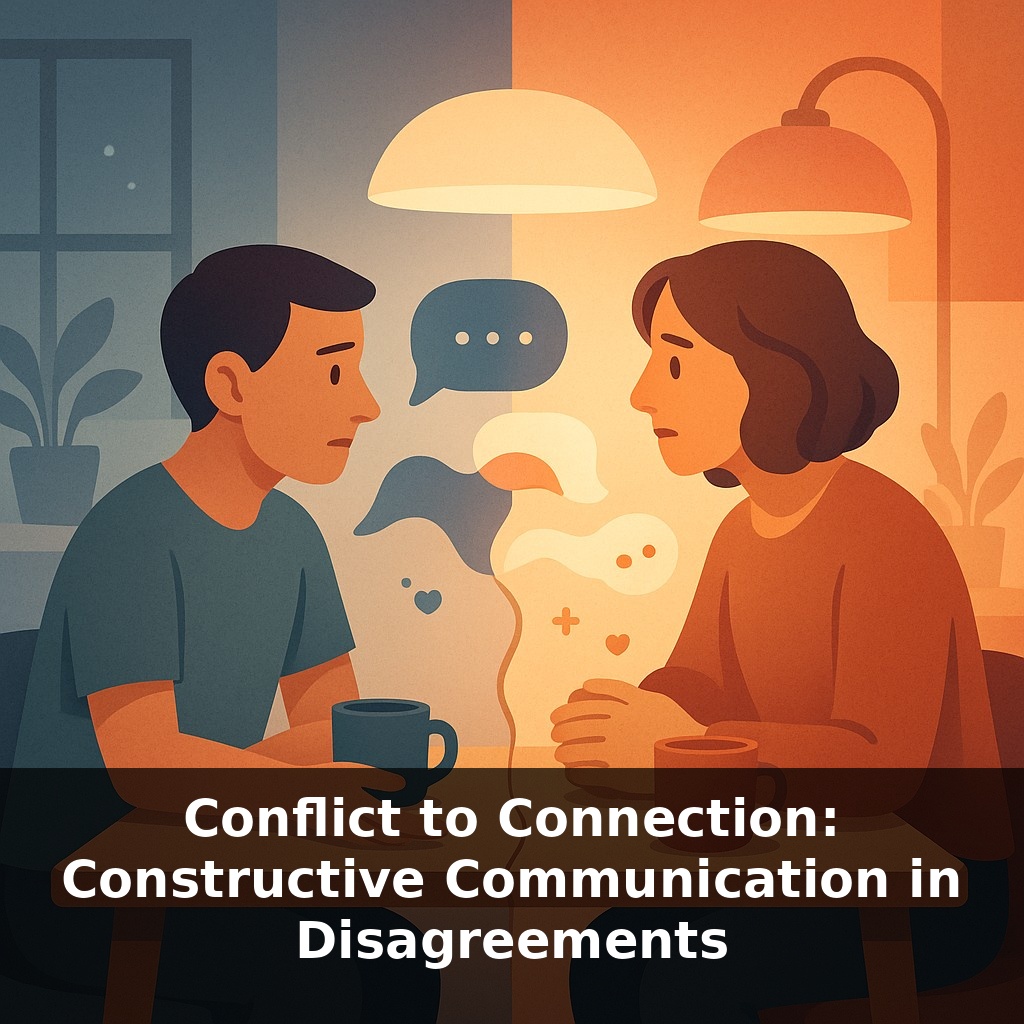
“In long‑term studies of couples, researchers could often predict who would stay together just by watching a few minutes of their arguments.” Two people, one kitchen table, voices rising—yet that short slice of conflict quietly reveals whether they’re building intimacy or eroding it.
“Couples who keep roughly five positive interactions for every negative one during conflict are far less likely to split up.” That ratio isn’t about fake cheerfulness; it’s about how you *fight*. In this series, we’ve explored listening, “I” statements, and empathy. Now we zoom in on what happens when those skills are stress‑tested in real disagreements: the moment your chest tightens, your jaw sets, and your brain starts collecting evidence that you’re right.
This is where many partners slide into Gottman’s “Four Horsemen”: criticism, defensiveness, contempt, and stonewalling. You may not shout or slam doors—sometimes it’s the quiet withdrawal, the sarcastic sigh, the eye roll. The goal isn’t to avoid conflict, but to turn it into a bridge instead of a wall, using curiosity, validation, and problem‑solving so that even sharp edges can be handled without cutting each other.
Conflict doesn’t begin with shouting; it often starts with tiny missteps—a tightened tone, a clipped reply, a distracted glance at your phone. Like a GPS that quietly recalculates when you miss a turn, constructive communication is about noticing those early detours and steering back before you’re miles off course. That’s where emotion regulation and needs-based language come in: catching your body’s stress signals, slowing yourself down, and translating “You’re so selfish” into “I’m overwhelmed and need more support.” The goal isn’t to win the point, but to protect the connection while you sort out the problem together.
When a disagreement hits, most of us focus on *words*: what they said, what we’ll say back. But your nervous system is often steering the conversation long before a sentence finishes. Heart rate climbs, breathing shortens, shoulders tense; your brain quietly shifts from “understand” to “protect.” Research shows that once arousal crosses a certain threshold, your capacity to take in new information and remember it drops. In other words, the more flooded you are, the less able you are to actually resolve anything.
So the first move in constructive conflict isn’t the perfect phrase—it’s a micro‑pause to check your body. Can you feel your pulse pounding? Heat in your face? That’s a cue to slow things down: lengthen your exhale, plant your feet on the floor, lower your voice by a notch. You’re not being dramatic by saying, “I want to talk about this, but I’m getting too worked up—can we take ten minutes and come back?” You’re protecting the quality of the conversation.
Once your body is a bit calmer, you can shift from attack/defend to “What’s the need underneath this?” Most complaints have a core need hiding inside: safety, respect, support, autonomy, closeness, appreciation. “You never help around here” might actually mean “I need to feel we’re a team.” “You’re always on your phone” may mean “I need more of your attention.”
Needs‑based language doesn’t soften the issue; it sharpens it. Instead of stockpiling examples to prove a point, you’re revealing the engine under your frustration. That makes it much easier for your partner to respond constructively, because they’re no longer fighting accusations—they’re responding to a clear need.
Here’s a simple progression you can use mid‑conflict:
1. **Name your state**: “I’m noticing I’m getting really tense/defensive.” 2. **Name your need**: “Underneath that, I think I’m needing ___ (support, reassurance, clarity, etc.).” 3. **Make a concrete ask**: “Right now, could you ___?” (listen without fixing, agree on a time to revisit, share your perspective slowly).
You can also invite your partner into the same process: “I can hear you’re upset. If we slow it down, what do you think you’re really needing from me here?”
Think of each disagreement like adjusting a shared budget: instead of arguing over every single purchase, you’re trying to understand the big categories—security, freedom, comfort—so you can plan together, not audit each other.
Think of a recent disagreement where things felt “off,” even if no one raised their voice. Maybe you were talking about weekend plans, and suddenly you were both weirdly sharp—like you’d each switched to a different radio station. That’s often a sign that unspoken needs are running the show. One person might be protecting their need for rest, the other for connection, but because neither is named, the argument gets stuck on surface details: “Why are you being so rigid?” versus “Why are you so demanding?”
In those moments, it can help to zoom out and ask yourself quietly, “If I had to put this in one word, what am I needing right now?” It won’t always be obvious. You might cycle through a few—respect, reassurance, space—before something clicks. From there, experimentation matters more than perfection. You can try sharing a draft version: “This may not be exactly it yet, but I think what I’m really needing here is…” Often, that rough first attempt opens a door you’ve both been pushing on from opposite sides.
When you treat conflict as a practice ground instead of a verdict on your relationship, the future starts to look different. Needs‑based talks today train the same “muscles” you’ll rely on for bigger decisions—parenting, money, aging parents, even job moves. As tech begins reading stress in real time, you might get a gentle buzz on your wrist right as your voice tightens, like a lane‑departure warning in a car, reminding you to steer back toward repair instead of repeating old, reactive routes.
Over time, these small shifts turn arguments into a kind of shared workshop, where both of you keep refining how you handle friction. You’re no longer trying to “win”; you’re learning how each of you is wired. Like tending a garden path after each storm, you clear debris, notice weak spots, and slowly create a route you can both walk, even when the weather turns rough.
Before next week, ask yourself: 1) “In my last disagreement, at what exact moment did I stop really listening and start preparing my comeback—and what would I do differently if I paused to name *their* core concern out loud first?” 2) “The next time I feel triggered, what specific phrase from the episode (like ‘Help me understand what matters most to you here’ or ‘Let me see if I’ve got this right…’) will I use to slow things down and shift us from attack to curiosity?” 3) “Who in my life do I most often have recurring conflicts with, and what’s one concrete, low-stakes conversation I can initiate this week where I practice validating their perspective before sharing mine, just as modeled in the episode’s role-play?”