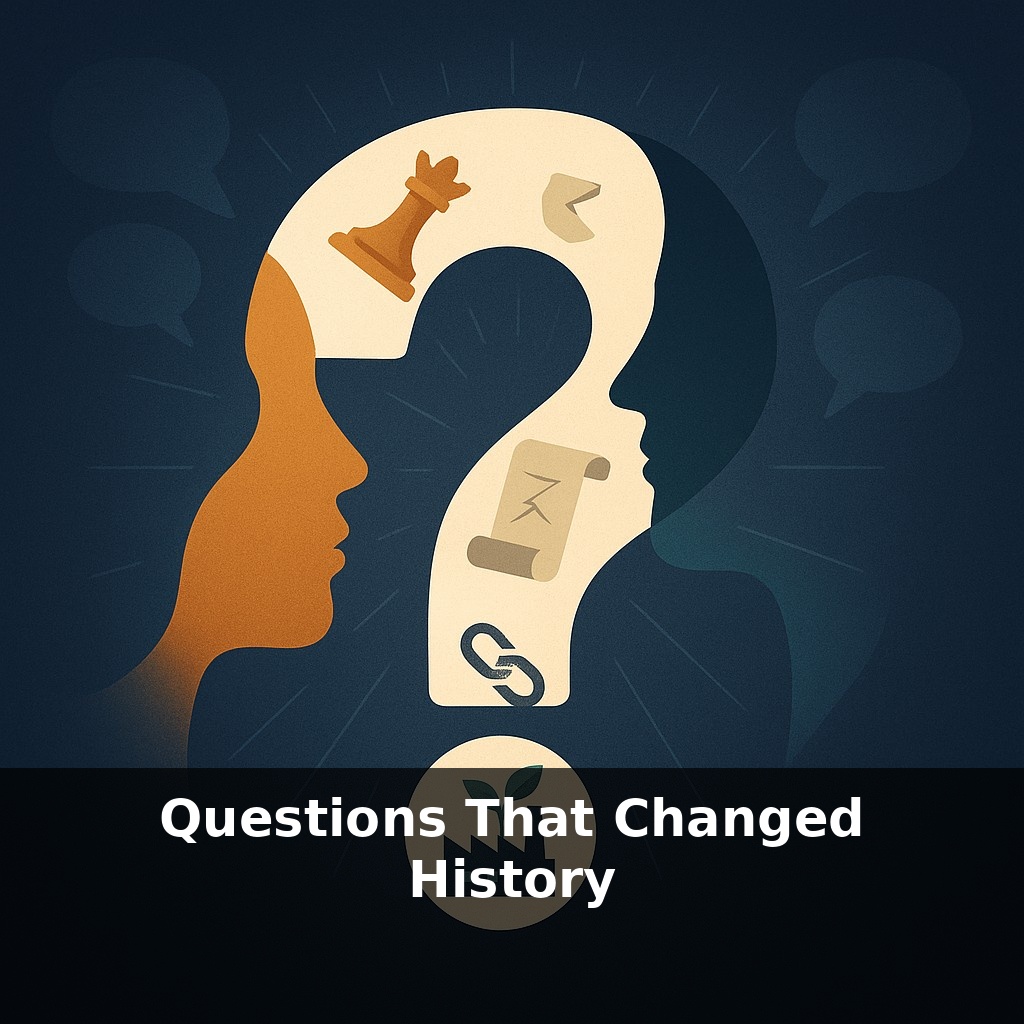
Questions That Changed History
📝 Transcript
A single question once helped topple the power of kings; another quietly launched the environmental movement. In this episode, we’re not chasing answers. We’re chasing the moments someone paused, looked at the world, and asked, “Wait…does it really have to be this way?”
Some of the most world-shaping questions didn’t arrive in grand speeches or perfectly crafted manifestos. They slipped out as almost offhand objections: a scientist doubting a textbook diagram, a citizen asking why a law applies to some bodies and not others. Again and again, history pivots when someone notices a hairline crack in “everyone knows…” and presses on it. Think of a chef who’s been handed a famous recipe and finally asks, “But…why do we burn this ingredient on purpose?” That tiny doubt can rewrite the whole menu. In this episode, we’ll trace how questions like Einstein’s about chasing a beam of light, or Rosa Parks’ quiet “why should I move?” didn’t just challenge ideas—they exposed hidden rules, triggered public debate, and forced systems to reveal what they were really built to protect.
Some of history’s most potent questions didn’t sound profound at first; they sounded annoying. “Show me the data.” “Who benefits if we keep doing it this way?” “What happens if we stop?” These aren’t poetic—they’re practical. They corner reality and ask it to pick a side. Luther didn’t just grumble about indulgences; he asked for a debate, in writing, where everyone could read it. Rachel Carson didn’t just worry in private; she asked, in print, what our chemicals were doing to soil, water, and bodies. The pattern isn’t genius inspiration—it’s ordinary curiosity made un-ignorable by where and how it’s voiced.
When we zoom in on turning points, a pattern appears: the question comes *before* the headline moment everyone remembers.
Before Einstein was a global symbol of genius, he was a patent clerk scribbling “What would a clock look like if you were riding a beam of light?” in the margins of his day job. That oddly specific puzzle forced physics to confront a clash between everyday intuition (“time is the same for everyone”) and experimental results. The equations came later; the hinge was the question that made the old picture of time impossible to keep believing.
Before Martin Luther was a “Reformer,” he was a frustrated monk asking, in effect, “Where, exactly, is the scriptural backing for this?” and nailing those doubts where the town could see them. The content of his arguments mattered, but the *move* that changed history was turning a private theological worry into a public, testable challenge: show me the source, show me the logic.
And before governments in the U.S. rewrote environmental policy, Rachel Carson asked something uncomfortably concrete: “If these chemicals are as ‘safe’ as advertised, why are birds’ eggs thinning and rivers losing life?” She didn’t attack industry in the abstract; she poked a hole in one reassuring claim and invited readers to notice the gap between promise and reality.
Notice three shared moves in these stories:
First, they target a specific pillar, not the whole building. “This doctrine,” “this assumption about time,” “this pesticide.” Vague complaint rarely moves history; precision does.
Second, they are answerable. Not answerable *immediately*, but in principle. You can run experiments on light, trace scriptural citations, measure toxin levels in water. The question dares the world: “Prove me wrong—or change.”
Third, they are asked where silence would be more convenient. A lab, a university, a church, a courtroom, a bus—places designed to keep certain routines running. A catalytic question jams the gears just long enough that others can say, “Wait, I’ve noticed that too.”
This is where ordinary people come in. Rosa Parks did not design a legal theory on that bus; she highlighted a contradiction: “Equal under the law” versus “Move to the back.” James Madison, drafting the Federalist Papers, didn’t just praise the proposed Constitution; he essentially asked, “Under what conditions does concentrated power become tyranny?” and walked readers through competing answers.
Across these moments, the people who reshape history are less like magicians pulling answers from thin air and more like careful auditors, running a highlighter over one line in the ledger and writing in the margin: “Does this actually add up?”
Think about Thomas Kuhn in 1962, quietly asking his colleagues, “What if ‘normal science’ isn’t steadily marching toward truth, but cycling through blind spots?” That wasn’t just philosophy; it gave scientists a label—“paradigm shift”—for those unsettling periods when the old map no longer fits the territory. Or consider early suffragists asking courts, “On what legal basis do you tax us but deny us a vote?” They weren’t pleading for kindness; they were forcing a contradiction into the record, where it had to be answered or exposed as hypocrisy.
You see this in business too. When Toyota engineers kept asking “Why?” five times about each defect, they weren’t being difficult—they were tunneling past convenient answers to the root cause. That simple protocol quietly transformed manufacturing worldwide. Catalytic questions work a bit like seed funding in finance: small, focused investments of doubt that, placed in the right market—the lab, the courtroom, the shop floor—can compound into full-scale revaluation of what’s profitable, fair, or even thinkable.
Tomorrow’s fault lines may run through climate tech, gene editing, and AI, where asking the wrong question too late is like checking a parachute *after* you jump. The frontier skill isn’t having hot takes; it’s drafting better questions: “Who is exposed if this fails?”, “Which voices aren’t in this room?”, “What evidence would change our mind?” Your challenge this week: each time you read a big claim, write one concrete question that, if answered, would truly test it.
History’s next hinge question might not come from a genius or a headline—it might come from you noticing one tiny mismatch and refusing to look away. Treat each “That’s just how it is” like a beta version of reality: still full of bugs. When you file a “bug report” as a sharp, public question, you’re quietly helping patch the operating system we all live in.
Before next week, ask yourself: 1) “If I were in Lincoln’s place at the moment he drafted the Emancipation Proclamation, what principle would I refuse to compromise on in my own life right now—and where am I currently staying silent instead of acting on it?” 2) “Like the scientists who first asked ‘What if we’re wrong about how disease spreads?’, where in my work or relationships am I clinging to an assumption that might be false—and how could I safely run one small ‘experiment’ this week to test a different possibility?” 3) “Thinking of the leaders who asked ‘What if we talk instead of fight?’, who is one real person I’m in tension with today, and what courageous, curiosity-based question could I ask them (in a message, call, or conversation) that might genuinely shift our dynamic?”
From this course
The Art of Asking Questions
5 episodesUnlock all episodes
Full access to 5 episodes and everything on OwlUp.
Subscribe — $1.99/monthLess than a coffee ☕ · Cancel anytime