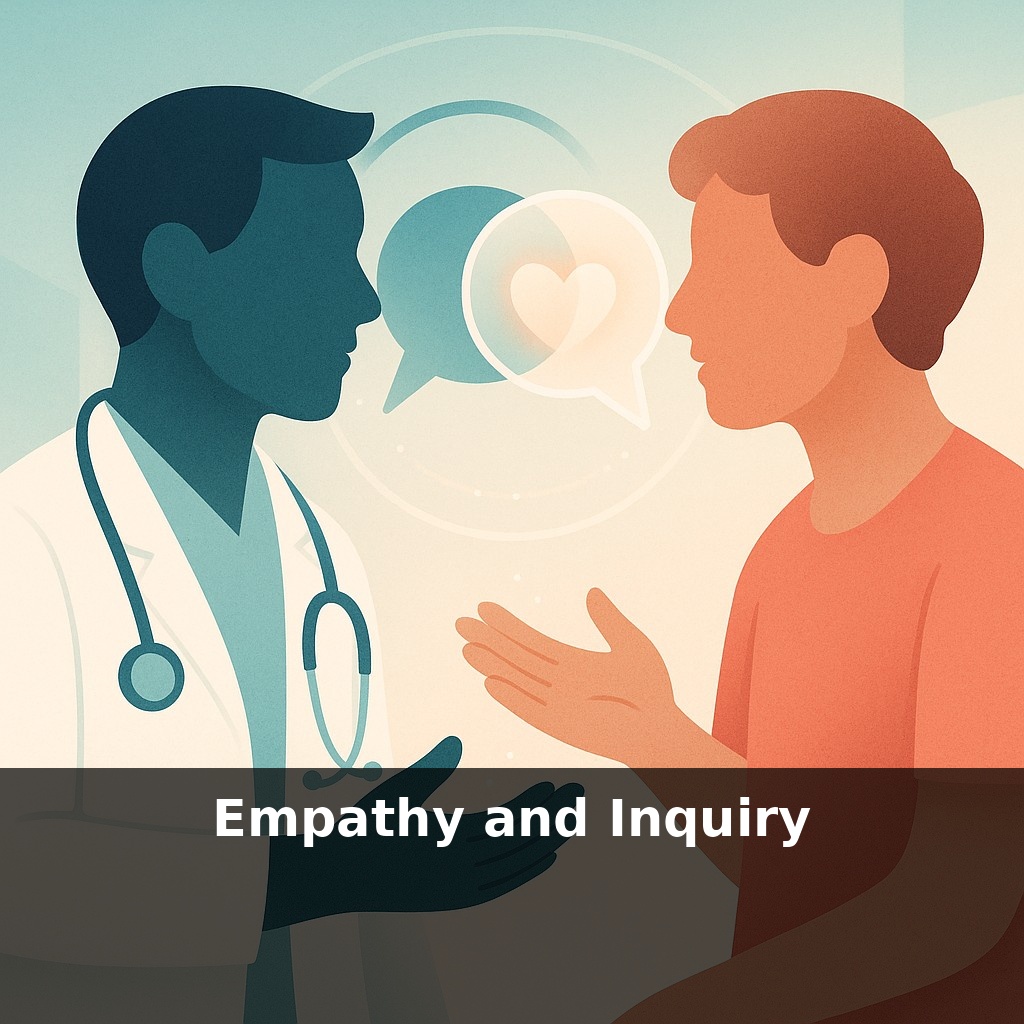
A group of doctors took the same medical exams, worked similar hours, saw similar patients—yet one group’s patients had far fewer complications. The difference wasn’t a new drug or device. It was how those doctors *listened* and what they asked in the first two minutes.
Those doctors weren’t just “being nice.” They were running a quiet experiment in every conversation: instead of jumping to conclusions, they used empathy to aim their questions, and questions to sharpen their empathy. That loop—feel, ask, refine, ask again—turned routine checkups into real insight about their patients’ lives, constraints, fears, and habits.
This isn’t a mystical talent. Neuroscience shows our brains come with basic wiring for understanding others, but twin studies tell us most of what we do with that wiring is learned. In practice, empathy is less “having a big heart” and more “using your curiosity well.” Think of partners who finally stop arguing in circles once one of them asks, “What’s the part of this that hurts the most for you?” The conversation changes—not because they’re softer, but because they’re more precise in *where* they care.
In relationships, we rarely get that kind of disciplined feedback. No exam scores, no quarterly reviews—just recurring arguments, awkward silences, or a partner who “shuts down.” It’s easy to label that as incompatibility or withdrawal, but often it’s a sign that our questions are missing the real target. We ask, “Are you mad at me?” when the better question is, “Did something I did make today heavier for you?” In this series, we’ll treat conversations less like performances and more like experiments, where small question tweaks can change the whole outcome.
Think about how questions usually show up in conflict: as cross-examination (“Why are you *always* late?”), as self-defense (“So you’re saying this is *my* fault?”), or as quick fixes (“What do you want me to do then?”). All of these are technically questions, but they steer attention away from the other person’s inner world and toward your own fear, frustration, or urgency to resolve things fast.
Empathetic inquiry works differently. It shifts the goal from “prove a point” or “solve the problem” to “map what this experience is like for you.” The surface topic—dishes, money, in-laws—might be the same, but the path you walk through it changes.
There are three small shifts that make a big difference:
1. **From “why” attacks to “what” and “how” invitations** “Why” questions easily sound like courtroom charges: “Why would you do that?” Swap them for “what” and “how”: - “What was going through your mind when that happened?” - “How did that land for you when I said that?” These keep the focus on their perspective instead of their justification.
2. **From mind-reading to hypothesis-testing** Instead of declaring, “You don’t care about this relationship,” turn your assumption into a testable guess: - “I’m reading your silence as you not caring. Is that accurate or am I off?” You show your cards *and* invite correction, which reduces defensiveness.
3. **From single-shot questions to gentle sequences** One big question can feel overwhelming (“Tell me everything you’re feeling”). A short sequence lowers the bar: - “What’s the part of this that’s bothering you most?” - “And under that, is there something you’re worried might happen?” Each answer gives you a more precise next question.
A useful way to design these sequences is to think like a product tester, not a prosecutor. A tech team doesn’t ask, “Why is this user so irrational?” It asks, “What’s happening on their screen right before they quit?” You’re looking for friction points in your partner’s experience, not verdicts about their character.
Over time, this style of questioning changes the emotional “rules of the room.” When someone learns that your follow-up question won’t be a trap, they share more on the first one. That’s how psychological safety quietly accumulates: not through grand declarations of support, but through dozens of small, precise questions that prove you’re there to understand, not to win.
Think about three everyday moments:
First, you and your partner are planning a weekend. Instead of “So… what do you want to do?”, you try: “What kind of weekend would leave you feeling recharged on Monday?” If they say, “One where I don’t have to decide everything,” your follow‑up becomes obvious.
Second, money tension. Rather than, “Are you mad I bought this?”, you ask, “What part of this purchase feels risky or uncomfortable to you?” Maybe it’s not the amount; it’s a fear of sliding back into debt. Now you’re talking about *that*, not just the receipt.
Third, after a tense dinner with friends, you’re walking home. You could say, “You were quiet—what’s wrong?” or you could ask, “What moment tonight stuck with you the most?” You might hear about a comment you barely noticed.
Your questions act like a software update: tiny, targeted tweaks that quietly change how the whole system runs.
As work, care, and even friendships sprawl across time zones and screens, the quality of our questions quietly shapes who gets included and who drifts to the edge. Tools like VR role‑plays or AI “conversation mirrors” may soon flag when we’re shutting people down or missing hidden signals—like a smart thermostat nudging the room toward comfort. The open question: will we use that data to deepen real connection, or to script polite, hollow performances of concern?
Your challenge this week: pick one recurring tension—at home, work, or with a friend. In your next live conversation about it, commit to asking three “map your experience” questions *before* offering a single solution or defense. Afterward, jot down two things: what you learned that surprised you, and one follow‑up question you wish you’d asked. Repeat once more with the same person and notice: does their level of detail, honesty, or calm shift at all?
Tiny adjustments in how you ask can ripple outward: conflicts cool faster, shy voices edge forward, even routine check‑ins feel less like status reports and more like shared problem‑solving. Over time, you’re not just trading updates; you’re co‑designing a language where both of you can be specific about what hurts, what helps, and what you actually need next.
Before next week, ask yourself: 1. “In my last three meaningful conversations, where did I jump to advice or ‘fixing’ instead of staying curious a few questions longer—and what might I ask differently next time, like ‘What feels most important to you about this?’” 2. “Who in my life do I usually assume I ‘already understand,’ and what’s one specific, open-ended question I could ask them this week (for example, ‘How has this been for you lately?’) to practice genuine inquiry instead of mind-reading?” 3. “When I feel defensive or eager to be understood, what’s one short, grounding phrase I can silently use—such as ‘stay with their story’—to help me listen for underlying emotions before responding?”