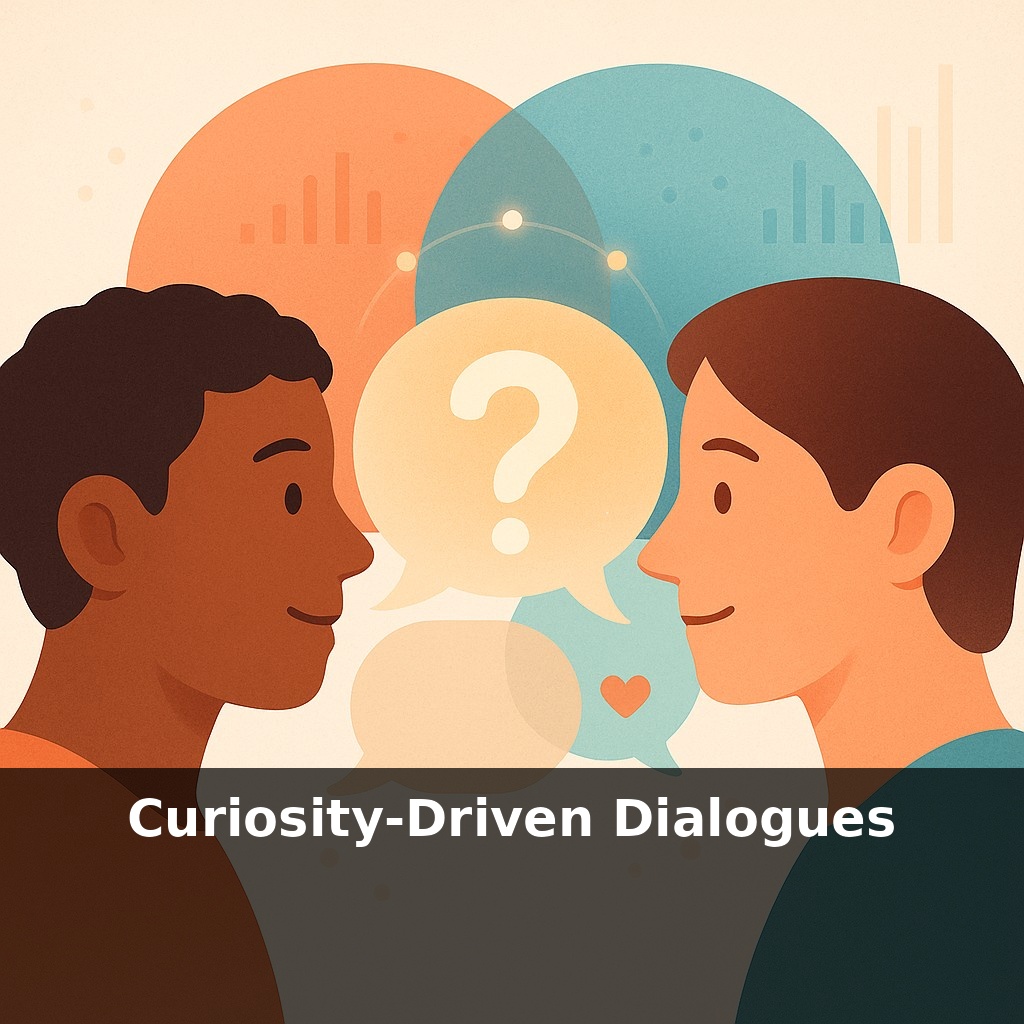
Mid-conversation, you ask one simple follow‑up—and everything shifts. The other person leans in, shares more, and later says, “I don’t know why, but I just trust you.” Today, we’re diving into why that tiny moment of curiosity quietly changes the whole dialogue.
Harvard researchers found that people who asked more follow‑up questions in conversation were consistently rated as more likable—often without realizing they were doing anything special. Something similar shows up at work: Gallup reports that managers who lean on “ask and listen” conversations see turnover drop by more than a quarter. In other words, the way we shape a conversation quietly reshapes the relationship underneath it.
And there’s more happening under the surface. Neuroscientists using fMRI have shown that when your interest is genuinely sparked, your brain becomes better at storing even unrelated, neutral details that come right after. That means the moment a partner, friend, or colleague feels you’re truly interested, you both become better at remembering what was said—and at building on it next time you talk.
Here’s the twist: most of us think “good communication” means saying the right thing, yet the real shift often comes from designing the right *questions*. Neuroscience, organizational research, and even design firms like IDEO converge on the same point: when conversations are structured around open exploration instead of quiet debates-in-disguise, people stop bracing for judgment and start revealing what they actually think. It’s the difference between running a script and running a joint experiment, where both people get to update their views in real time.
Most people think “being curious” in relationships means coming up with clever questions on the spot. In practice, what matters more is *how* your questions move the conversation: do they open new territory, or funnel the other person back toward what you already expect to hear?
Across studies in teams, couples, and negotiations, three patterns show up in conversations that lead to deeper connection and better problem‑solving:
1. **They zoom in before they zoom out.** Instead of jumping to advice or big-picture analysis, they linger on the specifics of the other person’s world. - “Walk me through what happened right after that email.” - “What was the hardest part of today, specifically?” These questions signal: *I’m willing to understand your actual reality, not just react to the headline version.*
2. **They separate sense‑making from score‑keeping.** In fragile moments, people scan your questions for hidden verdicts: *Are you trying to understand me, or to prove me wrong?* High‑quality, curiosity‑driven questions postpone the verdict. - “What made that option feel risky to you?” - “If we rewind to when this first started bothering you, what do you remember?” By explicitly exploring perceptions, timelines, and constraints, you invite the fuller story instead of a rehearsed defense.
3. **They invite co‑design instead of confession.** Research on conflict conversations shows that when one person feels “on the stand,” openness collapses. Questions that move from *interrogating the past* to *designing the future* change the emotional stakes. - “Given everything we’ve just surfaced, what would ‘better’ look like a month from now—for you?” - “If we were going to experiment with one tiny change this week, what feels doable?” Notice the shift from “Why did you do that?” to “What could we try next?” The focus moves from blame to options.
IDEO’s “How might we…” prompts reflect this same move. Instead of, “Why do you always shut down in meetings?” a curiosity‑driven version might be, “How might we make it easier for you to jump in before the topic changes?”
Think of it less as extracting information and more as running a joint diagnostic: together you map what’s really going on, then you prototype better ways of relating, one small experiment at a time.
A quick way to spot the difference between surface‑level talk and exploratory talk is to watch what happens right after someone shares something vulnerable.
Partner says, “I’m exhausted by how we handle money.” - A *closing* move: “We just need a budget; you’re overreacting.” - An *opening* move: “What part of it wears you out the most—surprises, tracking, or talking about it?”
Friend says, “Work’s been rough lately.” - Closing: “Everyone’s job is stressful. Just push through.” - Opening: “Rough in what way—people, workload, or something else?”
Notice how the second versions don’t rush to solve or soothe. They sort the experience into clearer buckets so you can pick one to explore together.
In tech terms, you’re not downloading a prewritten answer; you’re iterating a shared draft. Each question is like a small code change you both test: “Did that make things clearer, or do we need to rewrite this function of how we’re talking about it?”
Neuroscientists now argue that the *questions you habitually ask* may slowly reshape your emotional “default settings,” much like repeated search queries train an algorithm. In couples and teams, patterns of questions can become invisible norms: some groups optimize for safety, others for novelty or speed. As AI tools start handling routine updates, your value shifts toward designing these norms—choosing prompts that surface misalignment early, before it hardens into resentment or costly mistakes.
Treat each exchange like updating shared navigation: instead of locking in directions, you’re both refining the map with every question. Your challenge this week: in one important relationship, notice the exact moment you’re tempted to react or defend—and insert a single clarifying question instead. Then watch how the route between you quietly redraws itself.