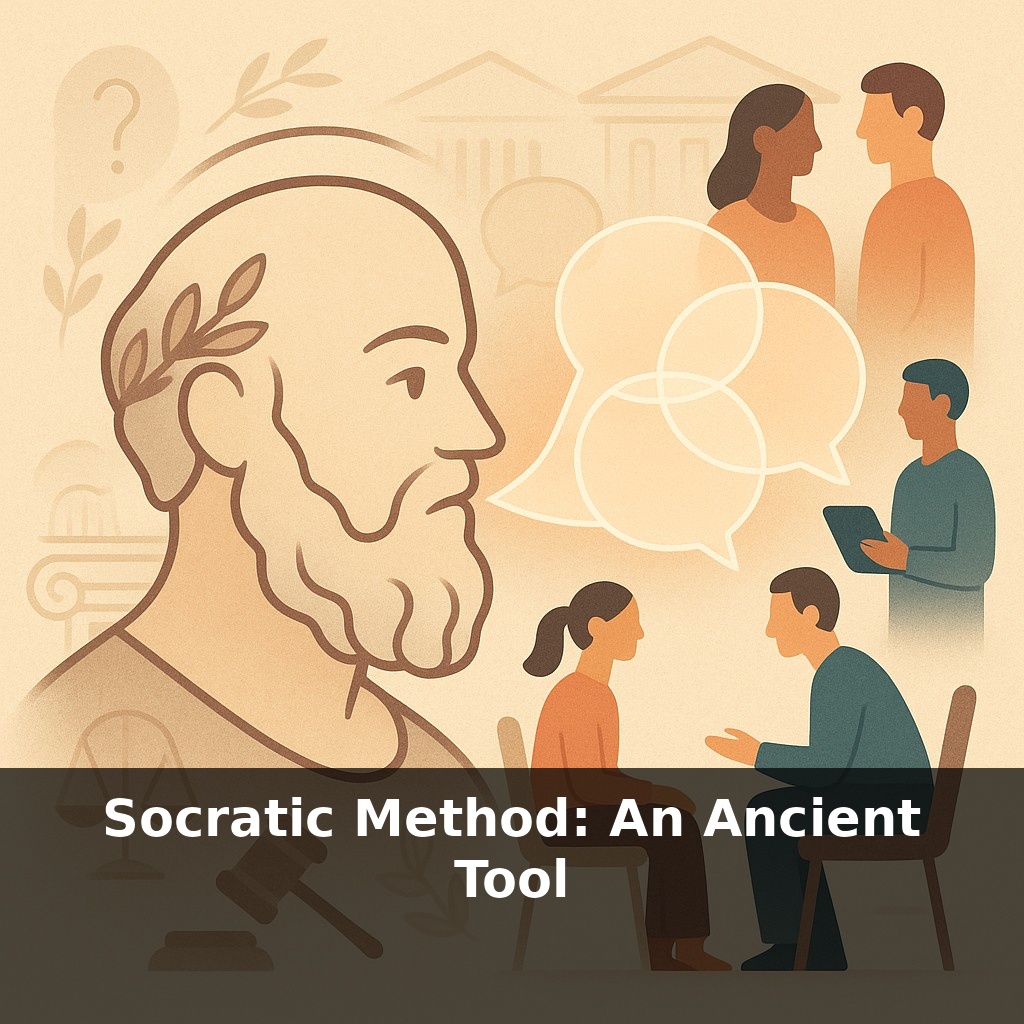
Socrates never wrote a single book, yet his way of asking questions still shapes how lawyers argue, therapists listen, and teachers teach. Athenian jurors once found his questions dangerous enough to kill him. So, what makes a conversation style that risky—and that powerful?
That risky, powerful way of talking didn’t stay in ancient Athens. It quietly migrated into courtrooms, therapy offices, classrooms, and even team meetings. A Harvard law student on the hot seat, a client in CBT unpacking a stubborn belief, a product team debating a launch—each is shaped by this same questioning tradition, even if no one names it.
What’s striking is how *modern* it feels. In a world drowning in takes, tutorials, and “ultimate guides,” it centers something rarer: disciplined curiosity. Instead of praising quick answers, it rewards better follow-up questions. Instead of “Who’s right?” it keeps asking “What are we missing?”
Think of a software debugger stepping through code, line by line, to find the exact point where things break. Socratic questioning does that for your assumptions—systematically testing them until only the most resilient ones remain.
Across history, the people most transformed by this way of talking weren’t just “good arguers”—they were unusually *good listeners* to their own thinking. In Plato’s ‘Apology,’ Socrates doesn’t lecture the jury; he walks them, step by step, through their own claims until the ground under their feet feels different. That same shift happens today when a law professor pushes past a student’s first answer, or a therapist gently tracks the jump from “I made a mistake” to “I’m a failure.” The power isn’t in winning; it’s in noticing where your thinking quietly changes lanes.
At its core, this approach is structured like a sequence of “stress tests” for an idea. Each question has a job. The first wave usually clarifies: “When you say this product is ‘for everyone,’ who exactly is included? Who isn’t?” Next comes probing for evidence: “What makes you confident that this group will pay for it?” Then come consequences and alternatives: “If you’re wrong, what breaks first? What else could explain the same data?”
In law, that structure became formalized. When Harvard’s Christopher Langdell shifted legal education in 1870, he didn’t just throw cases at students; he paired them with targeted questioning that forced future lawyers to trace how a tiny change in facts could flip an entire ruling. Over time, that blend of cases plus questioning spread so thoroughly that today roughly 95% of U.S. law schools rely on some version of it. The goal isn’t to memorize precedents; it’s to train minds to navigate ambiguity under pressure.
Psychology adapted the same spine of questions to a very different purpose. In cognitive‑behavioral therapy, a client might say, “If I don’t respond instantly to messages, people will abandon me.” The therapist doesn’t rebut; they dissect. “What’s the evidence that this always happens? When has it not? If a friend delayed replying to you, would you draw the same conclusion?” Session by session, these questions chip away at catastrophic certainties. Data from places like the Beck Institute (still being refined and verified) suggests that this process, when done well, can coincide with large drops in depressive symptoms.
STEM education borrows the pattern too, but aims it at problem‑solving. In a physics lab, an instructor might ask, “What would have to be true about friction for your result to make sense? How could we check that?” In code review, a senior engineer might press: “What assumption about user behavior sits under this shortcut? How would we know if it stopped being true in production?” The surface topics differ; the underlying choreography of questioning is strikingly consistent.
Across these fields, the method functions less like a debate tactic and more like a disciplined protocol: start from a claim, systematically test its foundations, and let the revised picture emerge from the answers themselves.
In a product meeting, a designer insists, “The signup flow is simple.” Instead of arguing, the team runs a mini Socratic drill on the claim itself. One person asks, “Simple for whom, specifically?” Another follows, “What would have to be true about our users’ context for this to feel effortless?” A third presses, “Which screen generates the most support tickets, and what does that suggest we’ve overlooked?” By the end, the original statement has quietly evolved into a concrete hypothesis they can actually test.
You can do a similar thing solo. Take a belief such as, “This relationship can’t be fixed.” Write it at the top of a page. Underneath, list three questions that would make that sentence less absolute: “In what small ways *has* it shifted before?” “What would ‘slightly better’ look like?” “Who disagrees with me about this, and what do they see that I don’t?” Each answer becomes fresh material to question again, revealing nuance where you previously saw a wall.
Soon, this style of questioning may shape how we relate, not just how we learn. Picture couples, teams, even online communities using shared “question maps” the way coders use version control—tracking how a disagreement evolves as each side refines its claims. AI tools could flag when a discussion loops or polarizes and suggest targeted questions that reopen stuck topics. Used well, this turns conflict from a win‑lose contest into a joint search protocol for better models of each other.
Let this be less a technique you “use” and more a stance you try on. In your next hard conversation, treat your questions like lenses on a camera: swap them, refocus, zoom in on details you’d usually crop out. Notice which questions open people up, which close them down, and how often a better question quietly beats your smartest speech.
Start with this tiny habit: When you catch yourself saying “I’m sure I’m right about this,” pause and ask yourself one Socratic question that starts with “What if…?” (for example, “What if the opposite were true?”). The next time you disagree with someone, repeat back their point in one sentence and ask, “Did I get that right?” before replying. When you notice a strong emotion about a belief (like frustration or certainty), silently ask, “What evidence would actually change my mind on this?” and then move on with your day.