Understanding Assertiveness vs. Aggressiveness
📝 Transcript
Right now, somewhere in a hospital or cockpit, a quiet voice is saving lives—not by shouting, but by speaking up clearly. Here’s the paradox: the people we trust most aren’t the loudest or the nicest… they’re the ones who can say “no” without making enemies.
Think about your last uncomfortable conversation: maybe you apologized three times before sharing your opinion, or you waited until you were already irritated before speaking up. That “slow leak” of unspoken needs doesn’t just make relationships awkward; over time, it rewires how safe your brain feels around other people. Neuroscience shows that when you express yourself clearly and respectfully, your prefrontal cortex stays online—so you can problem–solve, read cues, and stay grounded. When you swallow everything or explode, your brain shifts toward survival mode instead of connection. The cost isn’t only emotional. At work, this shows up as silent resentment, avoidable mistakes, and burnout. At home, it becomes walking on eggshells or endless, circular arguments. In this series, we’ll turn assertiveness from a vague ideal into a set of skills you can actually practice—without becoming someone you’re not.
Here’s the twist most people miss: your brain doesn’t just react to conflict; it learns from your *style* of conflict. Each time you either bite your tongue or bulldoze ahead, you’re teaching your nervous system what “normal” looks like with that person. Over time, it starts predicting danger in perfectly ordinary moments—a calendar invite from your boss, a partner asking “Can we talk?”, a friend taking longer to reply. That prediction shapes your body: tight shoulders, shallow breathing, scanning for signs you’re in trouble. Assertiveness interrupts this loop by giving your brain new evidence that honesty and safety can coexist.
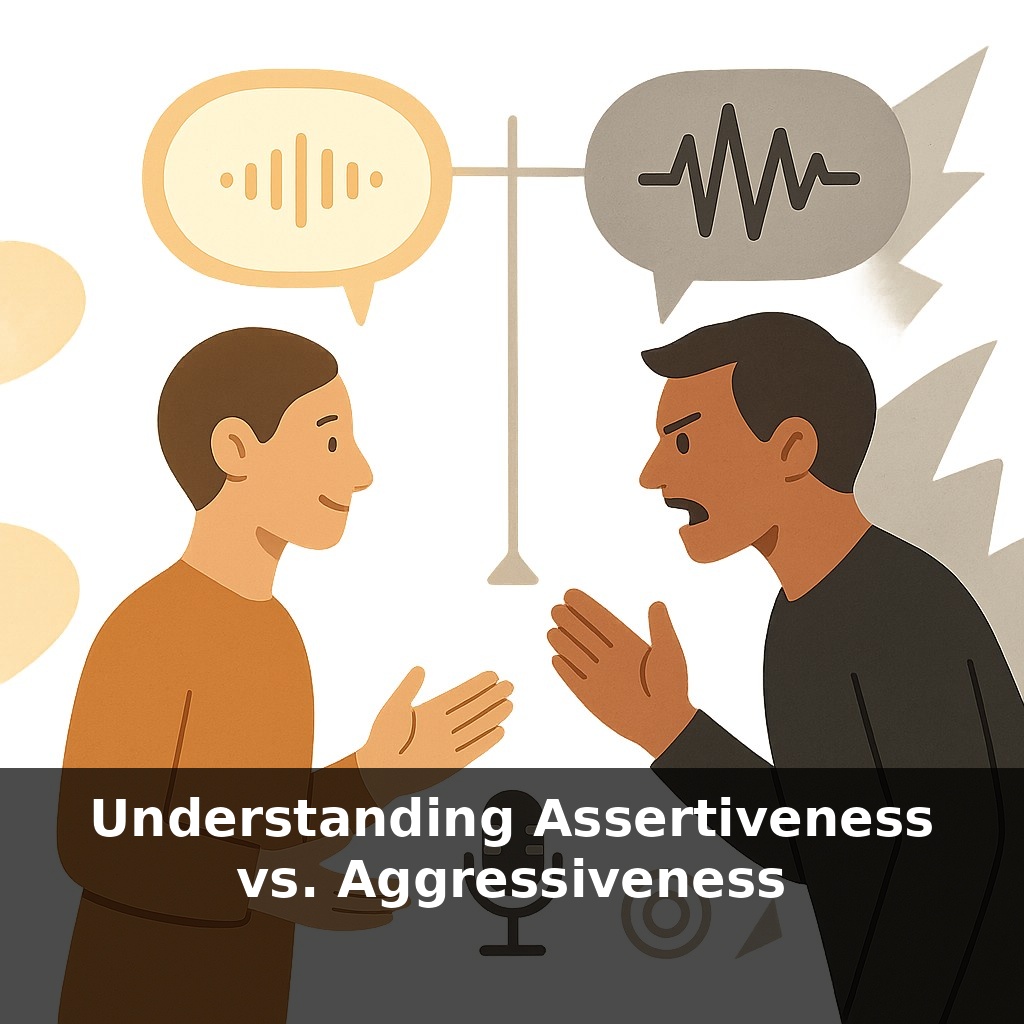
Here’s where the difference between assertive and aggressive really matters: both involve speaking up, but they send totally different signals to other people’s brains.
Assertiveness says, “I take my needs seriously *and* I take yours seriously.” Aggressiveness says, “Only my needs count.” On the surface, the words might even look similar—“I need this done by Friday”—but the *way* it’s said changes everything: tone, timing, and whether there’s room for the other person’s reality.
Behaviorally, three ingredients show up again and again in assertive communication:
1. **Ownership of your experience** Using “I” language isn’t just politeness; it’s a cue that you’re reporting your inner world, not declaring absolute truth. - Assertive: “I felt sidelined when the plan changed without me.” - Aggressive: “You completely disrespected me.”
2. **Clear boundaries with options, not threats** Assertive people state what they will and won’t do, then leave space for collaboration. - Assertive: “I can stay late tonight or tomorrow, but not both. Which helps you more?” - Aggressive: “Don’t you dare dump this on me again.”
3. **Respectful persistence** They don’t escalate in volume; they repeat the core message with calm clarity. - “I hear you’re under pressure. I still won’t share my password. Let’s find another solution.”
Neuroscience studies line up with this behavioral picture: when you communicate assertively, you invite the other person’s prefrontal cortex to stay engaged too. You’re essentially saying, “We can think this through together.” Aggression yanks both of you toward quick, defensive reactions; the conversation becomes about self-protection instead of problem–solving.
You can see this in data, not just theory. Employees who score higher on assertiveness aren’t just “nicer to have around”—they reliably report more job satisfaction and less burnout. In aviation, structured training that teaches junior crew to challenge captains *firmly but respectfully* has been linked to sharp drops in incidents blamed on communication breakdown. In close relationships, couples who start hard conversations with clear, non-attacking statements about their own feelings resolve problems more often and recover faster afterward.
The misconception is that assertiveness is a personality trait you either have or you don’t. But what actually shows up in successful teams and couples is a repeatable pattern of small behaviors: how you state a need, how you say no, how you hold your ground without needing the other person to lose.
Think of two managers giving feedback after a project slips. Manager A leans back, voice flat: “It’s fine. We’ll just try harder next time.” Everyone exhales, but nothing changes; the tension just goes underground. Manager B slams the table: “This was a joke. Get it together.” People move faster—out of fear—but they also start hiding mistakes. Now picture Manager C: “We missed our deadline, and I’m frustrated because this affects our client’s trust. I want us to walk through what blocked us and agree on two changes for next time.” Same problem, three totally different relational outcomes. The research you saw explains *why* Manager C’s style works; in practice, it sounds ordinary, even calm. You don’t need perfect words, just a steady pattern of stating: here’s what happened, here’s how it impacted me, here’s what I’m asking for now—and then staying present long enough to hear the other side without collapsing or attacking.
An 11-year-old today might lead a virtual team across three time zones before they’re 30. In that world, assertiveness becomes less “nice-to-have” and more infrastructure, like stable Wi‑Fi for relationships. Platforms that can flag when chats slide from clear to hostile could act as early-warning systems. If schools, teams, and families treat assertive speech as basic literacy, we’re essentially rewiring everyday norms—less drama, more dialogue—even when avatars, not faces, fill the screen.
Treat this like learning a new sport: clumsy at first, then oddly satisfying as small moves start to land. Each time you state a need plainly, you’re updating the “rules of the game” for that relationship. Over time, people learn you’re someone they can argue *with* safely—which is often when the most creative solutions finally appear.
To go deeper, here are 3 next steps: Explore the “assertive rights” list in Manuel J. Smith’s book *When I Say No, I Feel Guilty* and compare it to moments you tend to either stay silent or get reactive in conversations at work or home. Try the DESC script (Describe, Express, Specify, Consequences) using the free DESC worksheet from the Centre for Clinical Interventions (CCI) website, and plug in a real situation where you usually come across as either too passive or too harsh. Watch a 10–15 minute YouTube role-play on assertive communication (search “assertive vs aggressive communication role play” by a counseling or psychology channel) and pause after each example to literally say out loud how you’d rephrase the aggressive line into an assertive one, keeping your tone calm but firm.
From this course
The Art of Assertive Communication
5 episodesUnlock all episodes
Full access to 5 episodes and everything on OwlUp.
Subscribe — $1.99/monthLess than a coffee ☕ · Cancel anytime