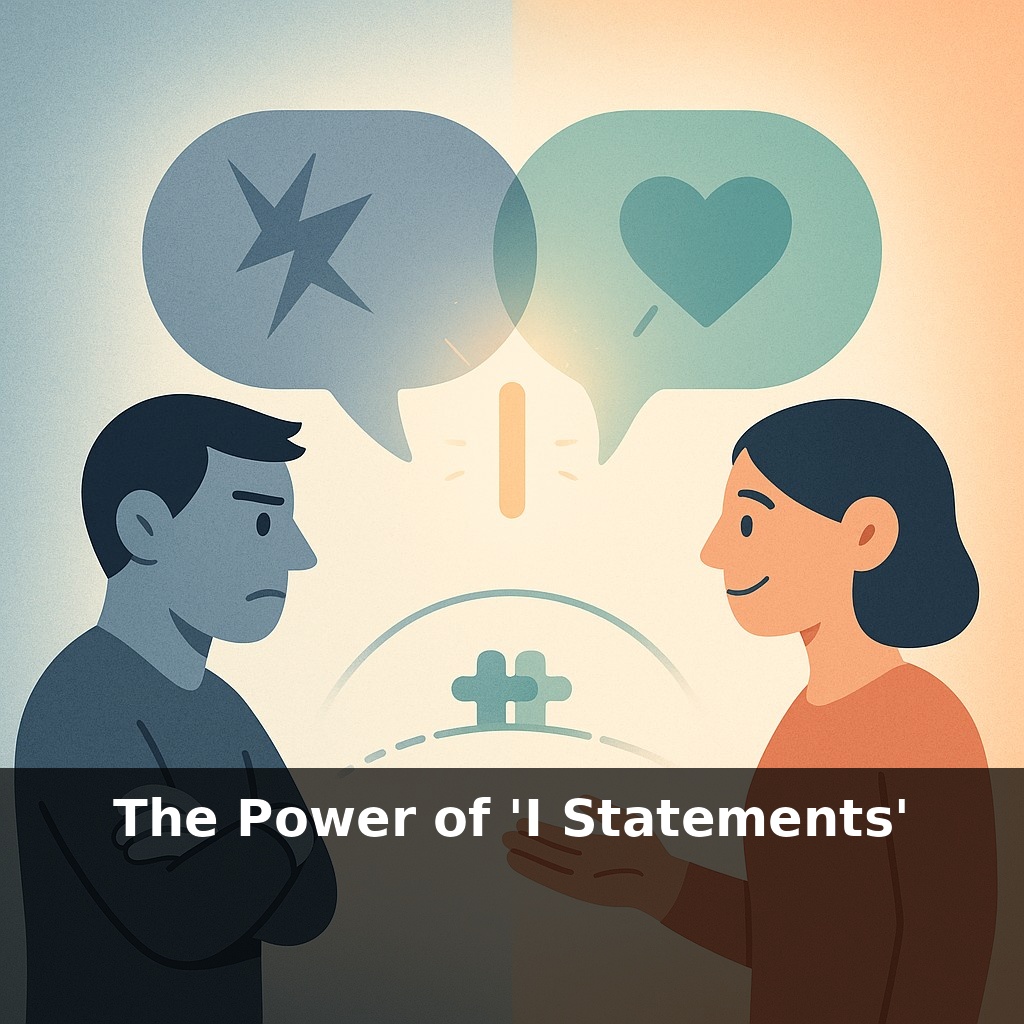
“You never listen to me.” Four words, and a quiet evening turns into a cold war.
Now shift just one of those words—“I feel unheard right now”—and suddenly the same moment has a completely different future.
This episode explores how that tiny switch changes everything.
“You never listen to me” shoves the other person into the defendant’s chair. “I feel unheard right now” invites them into the conversation. Same tension, same people, but the roles on that invisible stage have changed.
This is the quiet power of I statements: they don’t erase hard feelings, they give those feelings a safer doorway out. Instead of launching a verdict (“you always…,” “you never…”), you’re submitting evidence: what you feel, what happened, and why it matters to you.
Research backs this up across marriages, workplaces, and even school mediations: when people shift from “you” attacks to “I” descriptions, defensiveness drops and cooperation rises. In this series, we’ll treat I statements as a practical skill, not a slogan—something you can use in tense meetings, family blowups, and everyday friction, without sounding scripted or fake.
Most of us think the real problem is *what* we’re arguing about—money, chores, deadlines, in‑laws, that one teammate who never answers emails. But studies suggest *how* we start those hard conversations often predicts the outcome more than the topic itself. In Gottman’s research, the first three minutes of a conflict discussion reliably forecast whether couples would eventually stay together or split up. That’s why this episode zooms in on the opening move. We’ll look at the small linguistic shifts—especially around “I” language—that quietly tilt those first three minutes toward repair instead of rupture.
When researchers analyze real arguments—between partners, coworkers, even kids in school programs—they don’t look for poetry. They look for patterns. And a big one is this: the more a sentence sounds like a verdict about *you*, the more the other person’s nervous system gears up for a fight. The more it sounds like data about *me*, the more room there is to think instead of react.
That’s where the structure of a solid I statement matters. It’s not just “I feel” stapled in front of an accusation (“I feel like you’re selfish” is still a verdict). The useful version usually has three parts:
1. **Emotion** – what’s happening inside you 2. **Observation** – what specifically triggered it 3. **Meaning/Need** – why it matters, or what you’re asking for
Consider a tense project meeting at work:
- “You dropped the ball on this deadline.” versus - “I feel really stressed and exposed when the deck isn’t ready by the time we present, because it reflects on my team too.”
Both point to the same problem. But the second one gives the other person something to *work with*: your stress, the missed preparation window, the shared impact.
Across studies, that extra clarity changes behavior. In Schrodt & Witt’s meta‑analysis, self‑referent emotional language wasn’t just “nicer”; it reshaped how people interpreted the *intent* behind the message—less attack, more signal. In Gottman’s couple data and NYC’s school mediation outcomes, the pattern repeats: when people consistently anchor feedback in their own experience, tough conversations stop snowballing as often.
Notice what’s *not* required: perfect calm, perfect wording, or mutual skill. Even when only one person switches to I statements, you often see fewer interruptions, softer tone, and more willingness to problem‑solve. It’s like a codec in video streaming: if just one side upgrades, the whole interaction can run smoother—clearer signal, less static.
The catch: I statements can be misused as stealth weapons (“I feel disappointed that you’re so inconsiderate”). Those still smuggle in a character judgment. The litmus test is simple: if you can remove “I feel” and the sentence still sounds like a charge sheet, it’s not the tool we’re talking about.
In real life, this often plays out in tiny, ordinary moments.
At home, your roommate leaves dishes everywhere *again*. One path: “You’re disgusting.” Another: “I feel on edge walking into the kitchen when the sink is full right before I need to cook, because it throws off my evening.” Same sink, different invitation. The first comment dares them to defend themselves; the second asks them to see the room through your eyes.
At work, consider a manager talking to a high‑performing but chronically late employee: “You’re unreliable” versus “I get anxious starting client calls when you aren’t there on time, because it undercuts the confidence I’m trying to build.” The focus shifts from judging their character to revealing the hidden cost of their habit.
In a way, it resembles refactoring messy legacy code in a large system: the behavior might not change instantly, but each clearer, self‑anchored message makes the whole relationship easier to debug over time.
Courts already shape behavior with scripted phrases; language tech may quietly do the same. As platforms log millions of tense exchanges, they could spot patterns long before we notice them—flagging “heat spikes” and proposing calmer rewrites the way spell‑check fixes typos. Think of a GPS that reroutes you when you drift toward a dead end: subtle prompts away from blame‑heavy phrasing, nudging cultures—teams, families, even whole workplaces—toward norms where emotional clarity is simply expected.
Treat this less as self‑help and more as field research on your own patterns. Your challenge this week: each time tension flickers—an eye roll, a clipped reply—pause and test one “I” sentence out loud or in your head. Notice not just what shifts between you, but what shifts *in* you, like trading heavy boots for shoes you can actually walk in.