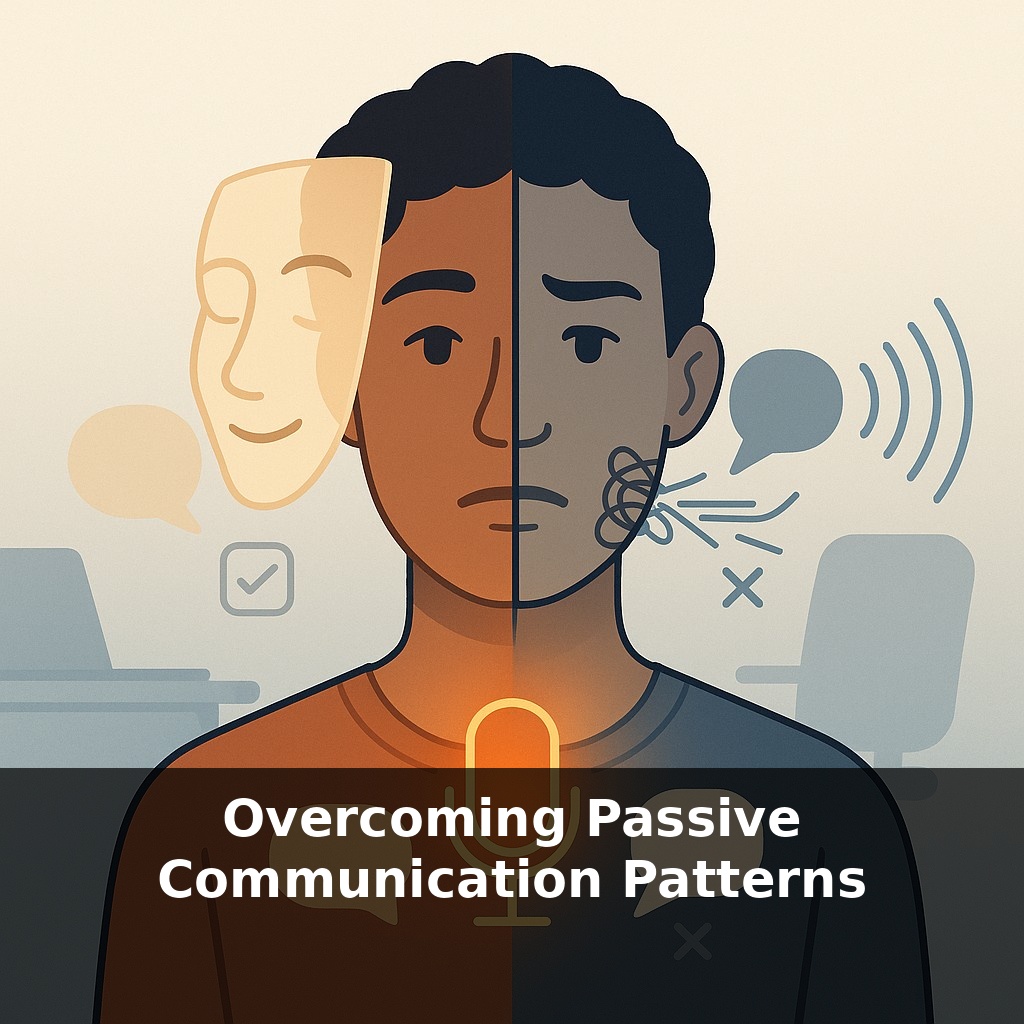
About half of the tough conversations that should happen at work never do—and every silent “it’s fine” quietly reshapes your life. You’re nodding, smiling, agreeing. But inside, you’re thinking, “This is not okay.” So why does your mouth say yes when your whole body is saying no?
You weren’t born nodding along to things that grate against you. Passive patterns are learned—often so early and so consistently that they start to feel like “just my personality.” Maybe you grew up where speaking up led to punishment, or where being “easygoing” got you approval and affection. Over time, your brain quietly linked safety with silence. In a meeting, your idea sparks… then dies at your lips. In a relationship, a boundary flickers… then gets filed under “not worth the hassle.” The twist? Research shows those tiny moments of self-erasure don’t stay tiny. They accumulate like unnoticed subscription fees draining your energy, confidence and even income. The good news: the same brain that learned to disappear can learn a different script—step by small step, on purpose.
So let’s zoom in on what “passive” looks like in everyday life—not as a label, but as a pattern. You say “no worries” when there very much are worries. You apologise before sharing a perfectly reasonable point. You rush to fill awkward silences so others stay comfortable while you quietly tense up. At work, you soften your ideas so much they stop sounding like ideas and start sounding like “just a thought.” In close relationships, you wait for the “right moment” to raise something… and that moment never quite arrives, so resentment slowly takes its place instead.
Here’s the twist most people miss: passive communication isn’t just “not speaking.” It’s a whole covert strategy your mind runs to keep you safe—often at a cost you don’t notice until much later.
Researchers talk about “cognitive scripts”: mental if‑then rules your brain quietly follows. For example: - If someone looks disappointed → change your opinion - If there’s tension in the room → smooth it over, even if you disagree - If you’re not 100% sure → stay silent
These scripts feel automatic, but they were written by past experiences—classrooms where the loud kids got praised, families where calm meant compliance, workplaces where questioning was “making trouble.” Over time, your nervous system learns that your best survival move is to shrink.
That’s one reason passive communication so often travels with anxiety and low self‑efficacy. When you consistently outsource decisions—“Whatever you think,” “I don’t mind,” “You decide”—your brain gets less practice linking your actions with outcomes. Psychologists call this a weakened sense of agency: life feels like something that happens to you, not with you.
Layered on top of that are social messages. Women, people from collectivist cultures, junior employees, anyone from a marginalised group often receive double binds: - “Speak up more” / “But don’t be too direct” - “Be confident” / “But don’t make others uncomfortable” So you learn to read the room exquisitely well—and edit yourself just as carefully.
Notice how this creates a feedback loop. You hold back in a meeting, your idea doesn’t land, someone else’s does. The outcome seems to confirm, “Good thing I stayed quiet; I might’ve been wrong.” In relationships, you tolerate small breaches of your limits; others assume you’re fine; the pattern deepens. Silence gets mistaken for consent, and the world organises around a version of you that isn’t actually true.
In that sense, communication is less like a single conversation and more like programming a shared app: every time you respond, you’re updating the code that tells people how to treat you next time. Change the code often enough, and the whole system shifts.
Notice how quickly these scripts can kick in. Your manager says, “Any volunteers to stay late?” and your hand twitches, then drops when no one else moves. A friend suggests a holiday you don’t want, and you hear yourself saying, “Sure, that could be fun,” while your mind is already dreading it. In dating, you agree to “see how it goes” when you actually want clarity, then blame yourself later for the blurry outcome.
One subtle clue: your words and your body don’t match. You say “it’s fine,” but your shoulders rise; you agree to help, then procrastinate; you say “I don’t mind,” then replay the interaction for hours. That gap isn’t you being irrational—it’s data. It’s your system flagging, “Something about what you just said doesn’t line up with what you actually need.”
Think of these moments less as failures and more as pop-up notifications in a cluttered interface. They’re telling you exactly where your next micro‑experiment in assertiveness could go: one sentence said a bit more honestly, one tiny “actually, that doesn’t work for me” tried in low‑stakes contexts.
As workplaces and friendships normalise clearer “no” and more precise “yes,” collaboration can start to look less like a crowded group chat and more like a well‑moderated forum: people contribute because they choose to, not because they’re cornered or guilty. Over time, that clarity reshapes norms—managers rely less on pressure, teams plan around real capacity, partners negotiate sooner. The long‑term gain isn’t just fewer conflicts; it’s more honest fit between people, roles and expectations.
So the real shift isn’t leaping from “quiet” to “fearless,” but learning to treat each small choice—speaking up, pausing, renegotiating—as a live experiment. Over the next episodes, we’ll zoom into specific moments: how to phrase a clean “no,” how to handle interruptions, how to request change without blame. Think of it as upgrading from mute to a custom mixing desk.
To go deeper, here are 3 next steps: (1) Print out or download the “Aggressive vs. Passive vs. Assertive Language” chart from TherapistAid.com and highlight 5 passive phrases you actually use (like “It’s fine, whatever you want”) and rewrite them using the “respectful + clear” examples from the chart. (2) Listen to the “Assertive Communication” episode of The Savvy Psychologist podcast right after this one, and pause after each example script to practice saying it out loud using the calm, steady tone the host models. (3) Grab a copy of “The Assertiveness Workbook” by Randy Paterson and complete just Chapter 2’s exercises tonight, then use one of the exact boundary scripts from that chapter tomorrow in a low‑stakes situation (like declining an invitation or asking a coworker to change how they interrupt you).