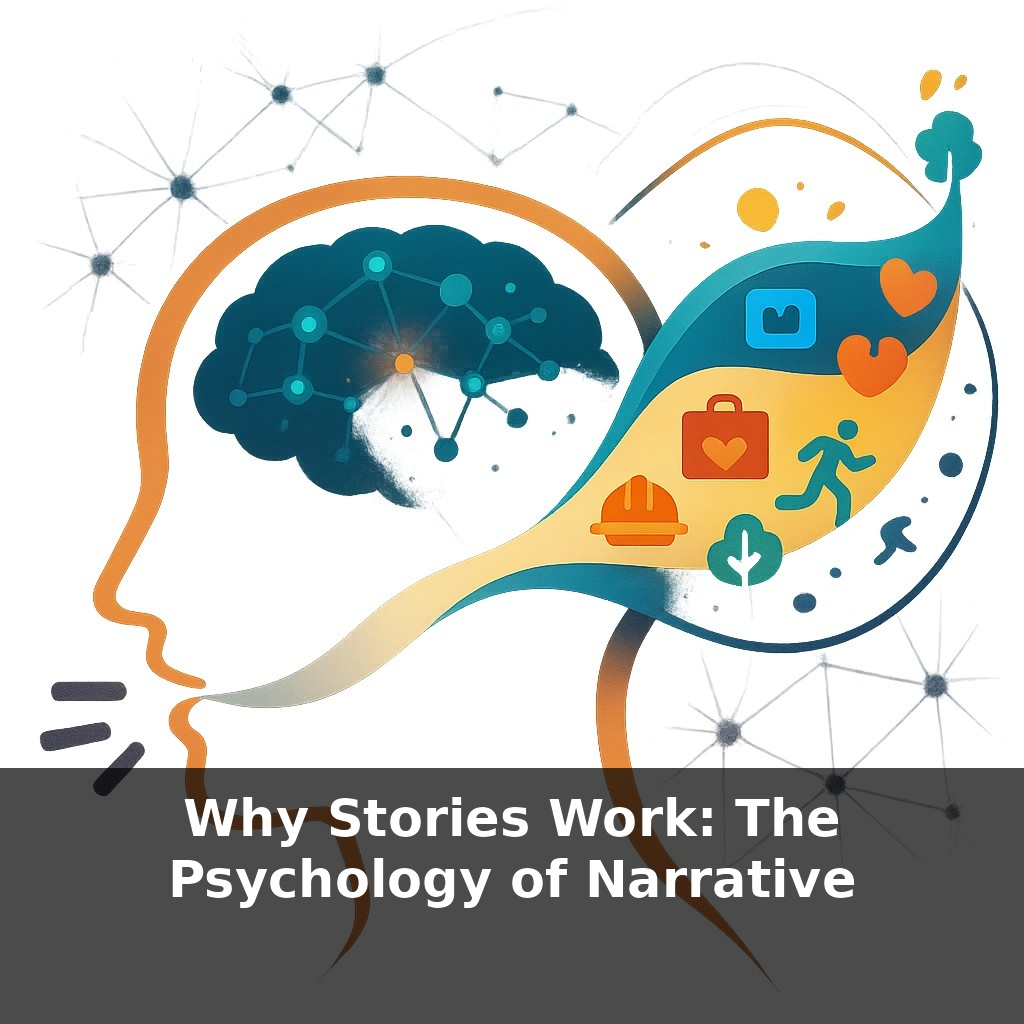
Why Stories Work: The Psychology of Narrative
📝 Transcript
A single story can double how much we remember, yet most presentations are just bullet points with better fonts. A founder wins investors, a charity unlocks donations, a safety officer cuts accidents—each by changing only one thing: they stop explaining, and start telling.
Neuroscientists can literally watch stories “light up” the brain: motor regions fire when we hear about actions, pain circuits react when a character is hurt, and social networks engage as we track motives and relationships. This overlap with real experience is why narrative quietly steers our attention, shapes what we remember, and nudges what we do next. But here’s the twist: your audience’s brain is already running a constant internal story—about who they are, what matters, and what threats or opportunities are nearby. Any message you share either plugs into that ongoing narrative or bounces off it. This is where most leaders, marketers, and educators misfire: they polish their content instead of aligning with the listener’s inner script. To become effective with narrative, you need to ask a different question: “What story is already playing in their mind—and how can mine continue it?”
Think of your listener’s mind less like an empty theater and more like a crowded marketplace. Past experiences, half-formed worries, private ambitions—all of them are vendors already shouting for attention. When your story arrives, it’s competing with emails, calendar alerts, and that lingering argument from breakfast. This is why even beautifully crafted narratives can fall flat: they enter at the wrong moment, or speak a language the “market” doesn’t care about. Effective storytellers don’t just polish content; they time their entry, choose the right stall, and speak to the busiest corner of that mental bazaar.
Most people hear “narrative brain wiring” and jump straight to “so I should add a story at the start of my slide deck.” That’s like tossing a garnish on a dish you never actually seasoned. If you want narrative to do real work for you—hold attention, reshape memory, shift behavior—you have to design your message the way the brain prefers to process experience: as a sequence of meaningful changes.
At a minimum, that sequence needs three things: a before-state, a turning point, and an after-state. Neuroscience studies on event segmentation show that our brains naturally carve continuous experience into “chunks” when something changes—goals, stakes, or understanding. No change, no chunk. No chunk, no memory. When you present a stream of information with no clear shifts, the brain has nothing to grab onto; it feels like background noise. When you mark changes—“then something happened,” “but there was a problem,” “until we tried X”—you’re giving the brain boundaries it can file and retrieve later.
Here’s how this plays out in practice:
In a pitch: instead of “our product has features A, B, C,” you trace a path. “Teams used to struggle with X. Then Y made that struggle urgent. Now there’s a different way to handle X entirely.” The product becomes the bridge between before and after, not the center of the story.
In a policy change: rather than dropping new rules, you map a transition. “We operated like this; then these pressures appeared; so we’re moving toward that.” People aren’t just told what’s new; they see why the shift makes sense inside a larger arc.
In teaching: facts are introduced at the moment they resolve some uncertainty or obstacle. The brain tags them as part of “what changed things” rather than loose trivia.
Notice what all of these share: they respect the listener’s ongoing expectations and then deliberately break or fulfill them. That expectation-management is where emotional weight and memorability come from. A flat line of predictability keeps neural activity low. A line with tasteful, meaningful jolts wakes the system up without overwhelming it.
Your challenge this week: any time you have to share something important—an email, a meeting update, a piece of feedback—force yourself to spell out the before, the turning point, and the after in one or two sentences each. Don’t polish; just sketch. By the end of the week, compare: which messages got responses, follow-ups, or visible behavior change? You’ll start to see where you accidentally send “fact streams” and where you’re actually sending stories.
A useful shortcut is to hunt for “story seeds” in moments you’d normally rush past. Think about three everyday situations: explaining a decision, giving instructions, or sharing results. Each one hides a before / turning point / after sequence if you zoom in just a bit further than you’re used to.
Explaining a decision: instead of “We’re moving the deadline,” zoom back one frame. What changed in the environment, constraint, or goal that forced a fork in the road?
Giving instructions: rather than listing steps, anchor them to mini-shifts. “First you’re lost, then you notice X, then you’re oriented.” Each step marks a small victory.
Sharing results: don’t just report numbers. Ask, “Compared to what?” and “So what now?” That contrast and next move create motion.
In practice, you’re not inventing drama; you’re revealing the hidden transitions that were already there. Over time, you start spotting these shifts almost automatically, like seeing constellations where you once saw random stars.
Soon, stories won’t just be consumed; they’ll negotiate with us. As AI systems learn your habits the way a doctor tracks symptoms, they’ll adjust plot tension, pacing, even moral ambiguity to fit your current “cognitive diet.” Public debates may shift from “whose facts are right?” to “whose narrative settings shaped this?” The real skill won’t be resisting stories, but learning to inspect them—like checking the weather—before you let them guide your next move.
As you notice these arcs, you may realize your own habits are scripted too—how you react in meetings, negotiate, or even argue at home. Treat each reaction like a recipe you can tweak: swap an ingredient, adjust the heat, taste again. The point isn’t to control every story, but to stay curious about how small edits can shift the whole meal.
Start with this tiny habit: When you reach for your phone to scroll (Instagram, news, email—anything), pause and silently turn the last thing you did into a 3-part story: “Setup” (where you were), “Struggle” (what was tricky or annoying), and “Shift” (what changed, even a little). Keep it to one sentence for each part, in your head only. Do this once a day, with any mundane moment (waiting in line, making coffee, finishing a meeting), so your brain starts automatically spotting narrative arcs the way the episode described.
From this course
The Art of Storytelling: Captivate Any Audience
7 episodesUnlock all episodes
Full access to 7 episodes and everything on OwlUp.
Subscribe — $1.99/monthLess than a coffee ☕ · Cancel anytime