Your brain can’t resist a good story—even in a boring quarterly update. One neuroscientist found that a well-told narrative can change your body chemistry in minutes. Now, here’s the twist: most top presenters secretly build their talks on the same ancient story pattern.
That “secret pattern” isn’t just for epic myths or Hollywood films—it’s quietly running inside your weekly team meeting, your client pitch, even your update to your boss. Think about the last time a colleague presented a project: there was a setup (where we are), a complication (what’s going wrong), and a resolution (what we’ll do). That’s not an accident; it’s your brain nudging the story into a beginning, middle, and end so it can decide: “Is this important? Do I care? What happens next?”
Professionals who understand these patterns don’t just “tell stories”—they choreograph attention. They know when to introduce tension, when to slow down, when to release pressure. In this episode, we’ll break down how those universal structures quietly shape winning presentations—and how you can start using them on purpose, instead of by luck.
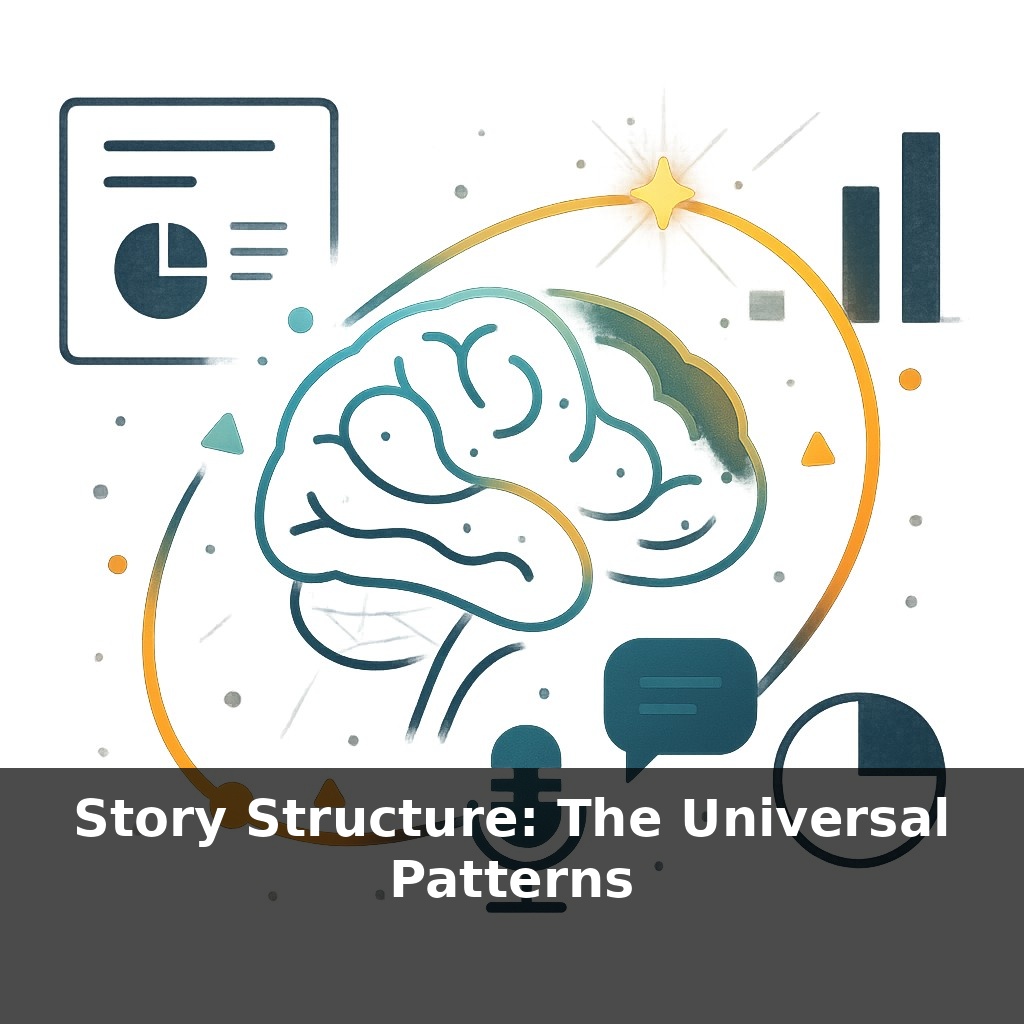
Think of story structure as a hidden roadmap your audience is already following in their heads. When your content matches that roadmap, they relax and lean in; when it fights the pattern, they feel lost or bored, even if your ideas are strong. Neuroscientists like Paul Zak suggest this isn’t mystical—it’s neurological. As stakes rise and resolve, the brain tracks “then what?” and tags key moments as worth remembering. That’s why Pixar relentlessly iterates on structure, and why top sales decks start with a customer’s struggle: they’re aligning with how attention naturally climbs, wobbles, and lands.
When people talk about “story patterns,” they usually mean one of three families you can borrow from, mix, and adapt.
First, the classic Three-Act model: Act I introduces a stable world and something that disrupts it, Act II deepens the struggle, Act III resolves it. For a presentation, that might look like: Act I – how things work today, Act II – what’s breaking or limiting growth, Act III – your proposed path forward. Simple, but powerful, because it mirrors how your audience updates their mental model: “normal → problem → new normal.”
Second, the Hero’s Journey. Instead of just “before/after,” it tracks a person crossing thresholds. There’s a call to act, initial refusal, tests, help from allies, a decisive ordeal, and a transformed return. In business, the “hero” is often a customer or stakeholder, not you. You’re the guide, the one offering tools, data, or products that help them survive their ordeal and come back stronger. This framing keeps you from centering yourself and forces you to show why your solution matters in someone else’s world.
Third, there are non-confrontational patterns like Kishōtenketsu from East Asian traditions. Rather than a single big clash, it unfolds as: introduction, development, twist, and reconciliation. For analytical or cross‑functional work, this can be ideal: you present a familiar situation, add detail, introduce an unexpected angle (a surprising dataset, a new constraint), then reveal how everything fits together. The “twist” jolts attention without needing a villain.
These patterns aren’t cages; they’re scaffolds. You can compress them into a three‑minute update or stretch them across a full workshop. You can swap sequences, repeat beats, or layer structures—say, a Hero’s Journey about one customer nested inside a broader Three-Act business narrative.
Pixar’s story spine is a lightweight way to sketch any of these: “Once upon a time… Every day… Until one day… Because of that… Until finally… And ever since then…” It’s essentially a checklist of turning points that forces you to answer: what changed, why it mattered, and how life looks now.
Your job isn’t to memorize labels; it’s to choose the pattern that best fits your goal: persuasion, insight, or shared understanding.
Think of a data-heavy update. You could simply march through metrics—or you could frame them like this: “A regional manager wakes up to a dashboard that looks healthy. By Friday, three hidden trends have quietly erased her quarterly gains.” Now your charts become plot points in a week‑long saga: Monday’s misleading spike, Wednesday’s warning, Friday’s fallout, and the lesson that changes how she reads data next time.
Or take a product roadmap. Instead of listing features, trace one customer’s “season”: launch as early spring (hopeful, messy), adoption as summer (growth, heat, bottlenecks), churn risk as autumn (signals, decisions), and renewal as winter (reflection, redesign). Each phase earns its own mini‑arc, with a clear shift in stakes.
Even a hiring proposal can follow a pattern: life before the role (strain), the breaking point (missed opportunities), the candidate’s journey (why them, why now), and the future state everyone in the room can see—and wants to speed up.
In the next decade, the most effective communicators won’t just “tell stories”; they’ll design choose‑your‑own narrative paths. Think of a forecast meeting where the CFO can tap a tablet and jump to the “worst‑case branch,” while an ops lead follows the “execution branch,” each path still aligned to a shared arc. As tools evolve, your real edge won’t be templates, but the skill to remix patterns live, in response to shifting rooms and real‑time data.
As you start playing with these arcs, don’t hunt for perfection—treat them like maps you can redraw mid‑journey. Swap scenes, linger on a “wrong turn,” or fast‑forward to consequences. Like adjusting a recipe on the stove, you’ll learn which moments need more heat. Over time, your “updates” stop feeling like reports and start feeling like progress.
Try this experiment: Pick a story you love (a movie like “The Matrix,” a novel like “Harry Potter,” or a myth like “Odysseus”) and, in real time as you re-watch or re-read one key section, pause at the moment you first notice the “inciting incident” and predict out loud what kind of “call to adventure” it’s setting up. Then keep going until the midpoint and jot a 1-sentence guess about what the character’s “point of no return” will be before it happens on screen or on the page. Finally, compare your predictions to what actually happens and note where the universal pattern held and where it surprised you—your “aha” moments are clues to how you can play with or lean into those same beats in your own stories.